Many English learners and even native speakers struggle with continually vs continuously. At first glance, the two words seem interchangeable because both relate to something happening over time. However, they carry slightly different meanings, and choosing the right one can make your writing clearer and more precise.
If you’ve ever wondered whether an action happens without stopping or simply happens again and again, understanding the distinction between continually and continuously will help. This guide explains the difference in simple terms, provides practical examples, highlights common mistakes, and shows you exactly when to use each word.
Quick Answer
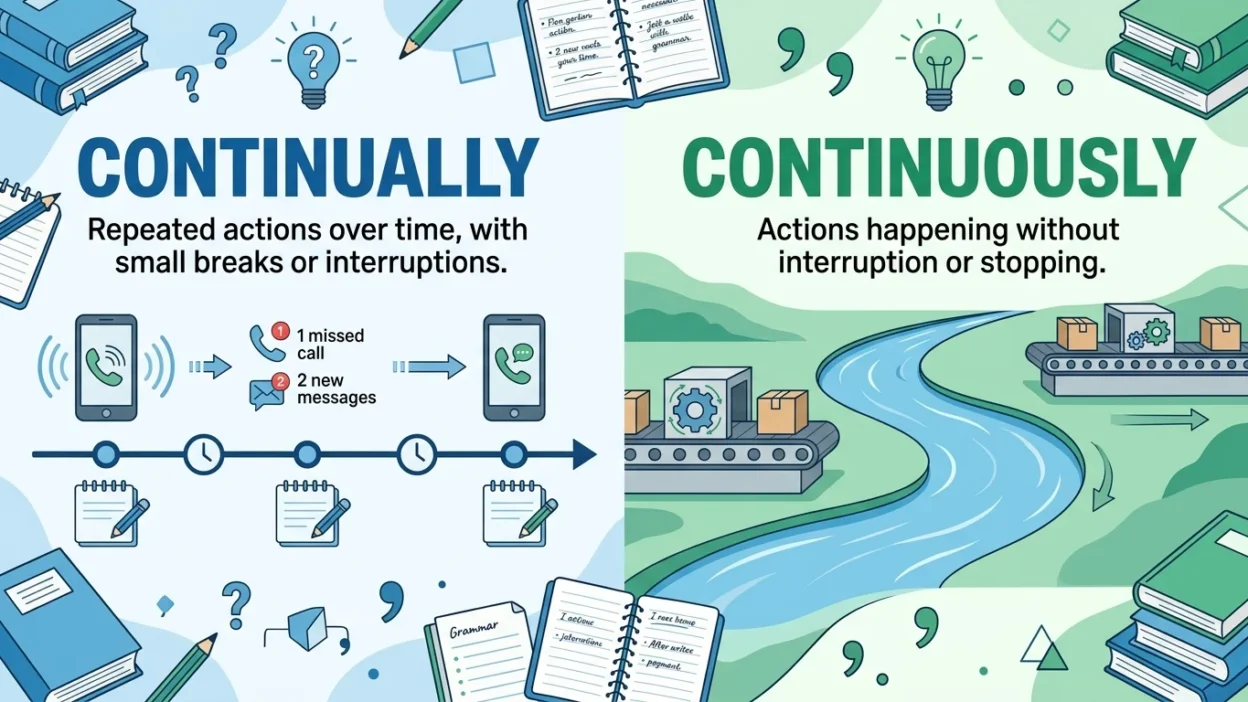
Continually means something happens repeatedly with interruptions or pauses.
Continuously means something happens without any interruption or break.
Examples:
- The phone rang continually throughout the day. (It rang many times, but not nonstop.)
- The river flowed continuously all year. (It flowed without stopping.)
A simple memory trick:
- Continually = Again and again
- Continuously = Without stopping
What Does Continually Mean?
The word continually describes something that happens repeatedly over a period of time. There may be pauses or interruptions between occurrences, but the action keeps returning.
Think of continually as meaning “frequently” or “repeatedly.”
Examples of Continually
- The teacher continually reminded students about the deadline.
- My dog continually barks whenever someone walks by.
- She was continually checking her phone during the meeting.
- The company continually updates its software.
- We were continually interrupted by phone calls.
In each example, the action occurs multiple times, but not without interruption.
When to Use Continually
Use continually when:
- Something happens repeatedly.
- The action occurs at regular or irregular intervals.
- There are breaks between occurrences.
- You want to emphasize recurrence rather than nonstop activity.
What Does Continuously Mean?
The word continuously refers to something happening without any interruption. Once the action starts, it continues steadily and consistently.
Think of continuously as meaning “nonstop” or “without a break.”
Examples of Continuously
- The machine operated continuously for 24 hours.
- Rain fell continuously throughout the night.
- The heart beats continuously during life.
- The conveyor belt moved continuously.
- The security camera records continuously.
These actions occur without stopping.
When to Use Continuously
Use continuously when:
- An action never pauses.
- The process is ongoing and uninterrupted.
- You want to emphasize constant activity.
Continually vs Continuously: Key Differences
Although these words are related, their meanings are not identical.
| Feature | Continually | Continuously |
|---|---|---|
| Meaning | Repeatedly over time | Without interruption |
| Breaks Allowed? | Yes | No |
| Focus | Recurring actions | Constant action |
| Similar Meaning | Frequently, repeatedly | Constantly, nonstop |
| Example | She continually checks emails. | The machine runs continuously. |
The most important difference is whether interruptions occur.
Continually vs Continuously in Sentences
Comparing them side by side makes the distinction easier to understand.
Continually
- The child continually asked questions.
- The manager continually requested updates.
- Customers continually contacted support.
These actions happen many times but include pauses.
Continuously
- The engine ran continuously for hours.
- Water flowed continuously through the pipe.
- The alarm sounded continuously.
These actions never stop during the period described.
How to Remember the Difference
A simple memory trick can help.
Continually = Repeated
Think:
- Continually = Again and again
- Continually = Repeated occurrences
Example:
- He continually forgets his keys.
He forgets them repeatedly, not every second.
Continuously = Constant
Think:
- Continuously = Constantly
- Continuously = Nonstop
Example:
- The fan ran continuously all night.
The fan operated without interruption.
Common Mistakes People Make
Because the words are closely related, they are often confused.
Mistake 1: Using Continuously for Repeated Events
Incorrect:
- She continuously called me throughout the week.
Better:
- She continually called me throughout the week.
Phone calls happen multiple times, not nonstop.
Mistake 2: Using Continually for Nonstop Processes
Incorrect:
- The waterfall flowed continually.
Better:
- The waterfall flowed continuously.
The water flows without interruption.
Mistake 3: Assuming They Are Always Interchangeable
Many writers treat these words as exact synonyms.
While some contexts allow either word, choosing the correct one creates more precise communication.
Real-Life Examples
At Work
- The team continually improves customer service.
- The production line operates continuously.
- Students were continually asking questions.
- The online learning platform runs continuously.
- Software is continually updated.
- Servers operate continuously.
- My neighbor continually plays loud music.
- The refrigerator runs continuously to maintain temperature.
These examples show how the distinction appears in everyday situations.
Which Word Is More Common?
In everyday conversation, continually is often used when discussing repeated actions, habits, or behaviors.
Continuously appears more frequently in technical, scientific, engineering, and manufacturing contexts because it describes uninterrupted processes.
For example:
- A customer may continually contact support.
- A machine may run continuously.
Both words are common, but they often appear in different contexts.
Continually vs Continuously in Formal Writing
Precise word choice is especially important in academic and professional writing.
Formal Example with Continually
- The organization continually reviews its policies.
This indicates periodic reviews over time.
Formal Example with Continuously
- The monitoring system operates continuously.
This indicates nonstop operation.
Using the correct word helps readers understand exactly what you mean.
American vs British English
There is virtually no difference between American and British English regarding continually and continuously.
Both varieties use:
- Continually for repeated actions with interruptions.
- Continuously for uninterrupted actions.
The spelling and meanings remain the same on both sides of the Atlantic.
Why the Difference Matters
The distinction may seem small, but it can affect clarity.
Consider these sentences:
- The employee continually checked the report.
- The employee continuously checked the report.
The first suggests repeated checking throughout the day.
The second suggests nonstop checking without pause, which is unlikely.
Choosing the correct word helps readers visualize the action accurately.
Precise language also improves professionalism, credibility, and readability.
Frequently Asked Questions
What is the difference between continually and continuously?
Continually means repeatedly with interruptions, while continuously means without any interruption.
Can continually and continuously be used interchangeably?
Sometimes, but not always. Using the correct word makes your meaning more precise.
Does continually mean nonstop?
No. Continually usually involves repeated actions that occur with breaks in between.
Does continuously mean constantly?
Yes. Continuously often means constantly, nonstop, or without interruption.
Which word should I use for a machine that never stops?
Use continuously because the action occurs without interruption.
Which word should I use for repeated reminders?
Use continually because reminders happen multiple times with pauses between them.
Is there a spelling difference between American and British English?
No. Both American and British English use the same spellings and meanings.
Which word is more common in technical writing?
Continuously is often more common in technical and scientific writing because it describes uninterrupted processes.
Summary
Understanding continually vs continuously can improve both your writing and speaking. While the two words are closely related, they are not identical. Continually refers to actions that happen repeatedly over time, often with pauses or interruptions between occurrences. It emphasizes recurrence rather than nonstop activity.
Continuously, on the other hand, refers to actions that occur without interruption. It highlights a steady, ongoing process that never stops during the period being described. By remembering that continually means repeatedly and continuously means nonstop, you can choose the right word with confidence and communicate your ideas more clearly.

Dani Morrison is a dedicated language writer and spelling expert at Spelword.com, where she focuses on helping readers understand common English spelling mistakes and confusing word pairs. With a passion for clear communication, Dani creates easy-to-follow guides that simplify complex grammar and spelling rules for everyday use.