Many English learners and native speakers alike get confused by laying vs lying. These two words sound similar, are related to the same idea of resting or placing something, and come from verbs that change forms in unusual ways. As a result, mistakes are extremely common in both writing and conversation.
If you’ve ever wondered whether you should say “I am laying on the couch” or “I am lying on the couch,” you’re not alone. Understanding the difference is easier than it seems once you know the basic rule. This guide explains everything you need to know about laying vs lying, including meanings, examples, common mistakes, and simple tips to remember the correct usage.
Quick Answer
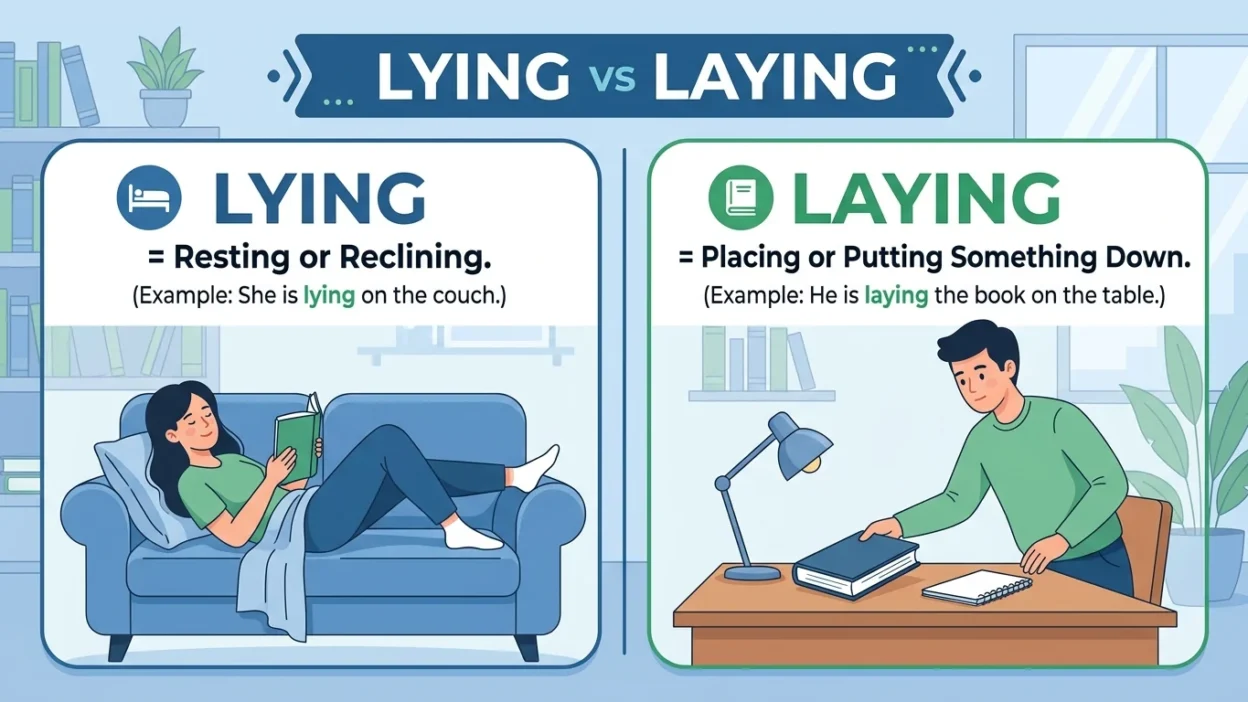
Lying means reclining, resting, or being in a horizontal position yourself.
Laying means placing or putting something down.
- ✅ I am lying on the bed.
- ✅ I am laying the book on the table.
The key difference is that laying requires an object, while lying does not.
What Does “Lying” Mean?
Lying is the present participle of the verb lie, meaning to recline, rest, or be in a horizontal position.
When someone is lying down, they are performing the action themselves. No object is receiving the action.
Examples of Lying
- She is lying on the sofa.
- The dog is lying by the fireplace.
- I spent the afternoon lying in a hammock.
- They were lying on the beach all day.
- The keys are lying on the counter.
In each sentence, the subject is simply resting or existing in a position.
What Does “Laying” Mean?
Laying is the present participle of the verb lay, which means to place or put something somewhere.
Unlike lying, laying requires a direct object. Something must be placed down.
Examples of Laying
- She is laying the dishes on the table.
- He is laying bricks for the new wall.
- They are laying fresh carpet in the living room.
- I am laying my phone beside the bed.
- The worker is laying tiles in the kitchen.
Notice that something is always being placed somewhere.
Laying vs Lying: The Main Difference
The easiest way to remember the difference is to ask:
Is something being placed somewhere?
- If yes, use laying.
- If no, use lying.
Comparison Table
| Feature | Laying | Lying |
|---|---|---|
| Base Verb | Lay | Lie |
| Meaning | Putting or placing something down | Reclining or resting |
| Needs an Object? | Yes | No |
| Example | She is laying the blanket on the bed. | She is lying on the bed. |
| Action Target | Another thing receives the action | Subject performs the action |
Why Do People Confuse Laying and Lying?
The confusion comes from the irregular verb forms.
The Verb “Lie”
| Tense | Form |
|---|---|
| Present | Lie |
| Present Participle | Lying |
| Past | Lay |
| Past Participle | Lain |
Examples:
- I lie down every afternoon.
- I am lying down now.
- Yesterday, I lay down early.
- I have lain here for hours.
The Verb “Lay”
| Tense | Form |
|---|---|
| Present | Lay |
| Present Participle | Laying |
| Past | Laid |
| Past Participle | Laid |
Examples:
- I lay the book on the desk.
- I am laying the book down.
- Yesterday, I laid the book there.
- I have laid it there before.
Because the past tense of lie is lay, many people accidentally mix the two verbs.
Common Mistakes With Laying and Lying
Incorrect: I am laying on the couch.
Correct: I am lying on the couch.
Here, no object is being placed anywhere. The speaker is reclining.
Incorrect: The cat is laying under the tree.
Correct: The cat is lying under the tree.
The cat is resting, not placing something.
Incorrect: She is lying the papers on the desk.
Correct: She is laying the papers on the desk.
The papers are being placed on the desk.
Incorrect: He was laying in bed all morning.
Correct: He was lying in bed all morning.
He was resting himself, not putting something down.
Easy Trick to Remember
A simple memory trick can help:
Laying = Placing
Think of laying as involving another thing.
- Laying a book down
- Laying a blanket on the bed
- Laying bricks
- Laying cards on the table
Lying = Resting
Think of lying as relaxing or reclining.
- Lying in bed
- Lying on the couch
- Lying on the beach
- Lying in the grass
If you can identify an object receiving the action, use laying.
Examples in Everyday Sentences
Using Lying Correctly
- The baby is lying peacefully in the crib.
- We were lying under the stars.
- She enjoys lying on the hammock.
- The cat is lying near the window.
- He spent the afternoon lying on the sofa.
Using Laying Correctly
- She is laying the table for dinner.
- The gardener is laying new grass.
- He is laying the tools in the garage.
- They are laying concrete for the driveway.
- I am laying the documents on your desk.
Laying vs Lying in Questions
Questions can sometimes make the difference less obvious.
Correct Examples
- Are you lying down?
- Why is the dog lying in the shade?
- Who is laying the carpet today?
- Are they laying the foundation yet?
- Where are you laying the books?
Look for the object to determine whether laying is appropriate.
American vs British English Differences
There is no major difference between American and British English when it comes to the grammatical distinction between laying and lying.
Both varieties follow the same rules:
- Lying = reclining or resting.
- Laying = placing something down.
However, in casual speech, especially in some regional dialects, you may hear people use laying when lying is technically correct. While common in conversation, this usage is generally considered nonstandard in formal writing and professional communication.
How to Choose the Correct Word Every Time
Follow these three simple steps:
- Identify the action.
- Look for an object receiving that action.
- Choose the correct form.
Use Lying If:
- Someone is resting.
- Someone is reclining.
- No object follows the verb.
Examples:
- She is lying down.
- They are lying on the grass.
Use Laying If:
- Something is being placed somewhere.
- An object follows the verb.
Examples:
- She is laying the plates on the table.
- He is laying the books on the shelf.
Frequently Asked Questions
Is it laying in bed or lying in bed?
The correct phrase is lying in bed because the person is resting or reclining. No object is being placed anywhere.
Why do people say laying down instead of lying down?
Many people use laying down informally because the verbs are commonly confused. In standard grammar, lying down is correct when referring to resting yourself.
Is the dog laying or lying on the floor?
The correct form is lying on the floor because the dog is resting and not placing an object.
What is the easiest way to remember laying vs lying?
Remember that laying involves placing something, while lying involves resting or reclining.
Is laying grammatically correct?
Yes, laying is grammatically correct when referring to putting or placing something somewhere.
Why is the past tense of lie “lay”?
English contains several irregular verbs. The verb lie changes to lay in the past tense, which is one reason many people confuse these words.
Can I use laying without an object?
In standard grammar, laying usually requires an object because something must be placed down.
Which word is more commonly misused?
Lying is more commonly replaced incorrectly with laying, especially in casual conversation.
Summary
Understanding laying vs lying becomes much easier once you remember one key rule: laying means placing something down, while lying means resting or reclining. The presence or absence of an object is the quickest way to determine which word is correct.
Although many people mix up these terms in everyday speech, using them correctly improves both writing and communication. Whenever you’re unsure, ask yourself whether something is being placed somewhere. If the answer is yes, use laying. If someone is simply resting or reclining, use lying.