
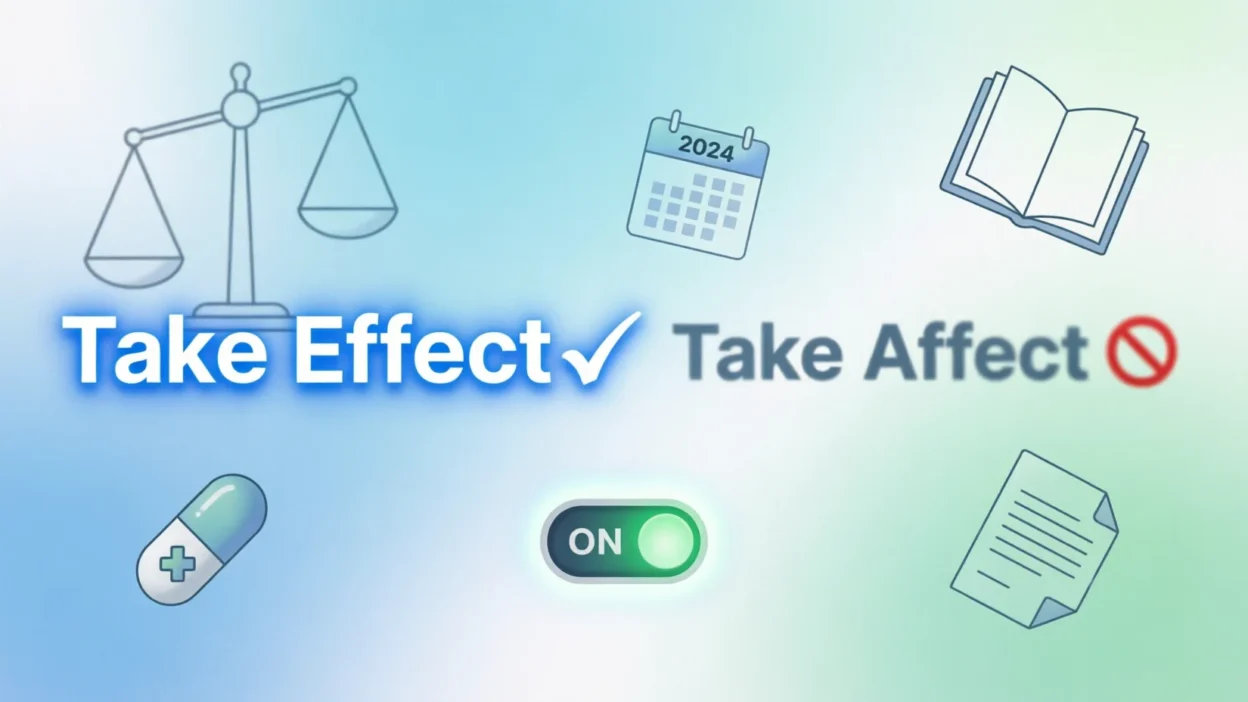
English phrases can sometimes sound nearly identical while having completely different meanings or in some cases, one phrase may not even be correct at all. A common example is take effect vs take affect. Because the words effect and affect are often confused, many people accidentally use the wrong phrase in writing and conversation.
If you’ve ever wondered which version is correct, you’re in the right place. Understanding the difference between take effect and take affect can improve your grammar, strengthen your writing, and help you communicate more confidently in professional, academic, and everyday situations.
Quick Answer
“Take effect” is the correct phrase.
“Take affect” is incorrect in standard English.
The phrase take effect means:
“To begin working” or “to become active.”
What Does “Take Effect” Mean?
The phrase take effect is used when something officially starts, becomes active, or begins to produce results.
It is commonly used with:
- Laws
- Policies
- Medicines
- Rules
- Changes
- Decisions
Examples:
- The new law will take effect next month.
- The medicine should take effect within an hour.
- The updated policy takes effect immediately.
In all these examples, the phrase refers to something beginning to work or operate.
Is “Take Affect” Correct?
No, take affect is not considered correct in standard English.
The confusion happens because:
- Affect and effect sound similar
- Both words relate to change or influence
- English learners often mix them up
Incorrect example:
- ❌ The changes will take affect tomorrow.
Correct example:
- ✔️ The changes will take effect tomorrow.
Take Effect vs Take Affect: Key Differences
| Phrase | Correct? | Meaning |
|---|---|---|
| Take effect ✅ | Yes | To become active or start working |
| Take affect ❌ | No | Incorrect phrase |
Understanding “Effect” vs “Affect”
To fully understand the phrase, it helps to know the difference between the individual words.
Effect
Effect is usually a noun meaning:
- Result
- Outcome
- Consequence
Example:
- The weather had a positive effect on crops.
In the phrase take effect, “effect” refers to a result becoming active.
Affect
Affect is usually a verb meaning:
- To influence
- To change something
Example:
- Stress can affect sleep quality.
Because affect is generally a verb, it does not fit correctly after “take” in this expression.
Why People Confuse the Phrase
The confusion mostly comes from pronunciation and word similarity.
Common reasons:
- “Affect” and “effect” sound alike
- Both relate to change or impact
- English spelling rules can be tricky
- Many people learn the phrase by hearing it rather than reading it
This mistake is extremely common even among native speakers.
Common Situations Where “Take Effect” Is Used
1. Laws and Government Rules
One of the most common uses.
Example:
- The tax increase will take effect in July.
2. Medicine and Treatments
Describes when medication begins working.
Example:
- The pain reliever took effect quickly.
3. Workplace Policies
Used in business and HR communication.
Example:
- The updated dress code takes effect Monday.
4. Changes and Improvements
Describes when a change becomes noticeable.
Example:
- The new strategy is starting to take effect.
Common Mistakes to Avoid
1. Writing “Take Affect”
This is the biggest and most frequent mistake.
❌ Take affect
✔️ Take effect
2. Confusing Affect and Effect Everywhere
Many writers struggle because the words are closely related.
3. Using the Wrong Part of Speech
Remember:
- Affect = usually a verb
- Effect = usually a noun
The phrase needs a noun after “take.”
Easy Trick to Remember the Correct Phrase
A simple memory trick is:
👉 “Effects are results.”
Since take effect means “to produce results,” the noun effect is correct.
Another useful reminder:
- Policies take effect
- Emotions affect people
American vs British English
There is no difference between American and British English here.
American English:
- Take effect ✅
British English:
- Take effect ✅
Both forms of English use the exact same phrase.
Examples of “Take Effect” in Sentences
Everyday Examples
- The caffeine began to take effect after a few minutes.
- The weather warning takes effect tonight.
Professional Examples
- The contract will take effect on January 1.
- New regulations are expected to take effect soon.
Educational Examples
- The updated school rules take effect next semester.
Similar Phrases That Cause Confusion
English contains many similar word pairs that create grammar mistakes.
Examples:
| Incorrect | Correct |
|---|---|
| Take affect | Take effect |
| Could of | Could have |
| Apart of | A part of |
| Loose interest | Lose interest |
| Bare with me | Bear with me |
Learning these distinctions can significantly improve writing quality.
Why Correct Usage Matters
Using the correct phrase helps:
- Improve professionalism
- Build reader trust
- Strengthen communication
- Enhance grammar accuracy
- Improve SEO readability
In business, academic, and legal writing, small grammar errors can make content appear less reliable.
Synonyms and Similar Expressions
Depending on context, you could also use:
- Become active
- Go into effect
- Start working
- Begin operating
- Come into force
- Start functioning
These alternatives can help vary your writing naturally.
Why “Take Effect” Matters in SEO and Online Writing
Correct grammar improves:
- User experience
- Search engine understanding
- Content credibility
- Reader engagement
Using incorrect phrases repeatedly may:
- Distract readers
- Reduce trust
- Lower perceived quality
Clear, accurate writing always performs better for both readers and search engines.
FAQs
Is “take affect” ever correct?
No, “take affect” is considered incorrect in standard English.
Which phrase is correct: take effect or take affect?
“Take effect” is the correct phrase.
What does “take effect” mean?
It means something begins working, becomes active, or starts producing results.
Why do people confuse affect and effect?
The words sound similar and both relate to change or influence.
Is “effect” a noun or verb?
“Effect” is most commonly used as a noun.
Is “affect” a noun or verb?
“Affect” is most commonly used as a verb.
Does British English use a different phrase?
No, both British and American English use “take effect.”
Can grammar mistakes affect professional writing?
Yes, incorrect grammar can reduce credibility and make writing appear less polished.
Summary
The difference between take effect vs take affect is straightforward once you understand how the words function in English. Take effect is the correct phrase, meaning something becomes active, begins working, or starts producing results. In contrast, take affect is a common grammatical mistake caused by confusion between affect and effect.
Because this phrase appears frequently in legal, business, medical, and everyday communication, learning the correct usage can greatly improve your writing clarity and confidence. Small grammar improvements like this make communication more professional, accurate, and trustworthy.

Dani Morrison is a dedicated language writer and spelling expert at Spelword.com, where she focuses on helping readers understand common English spelling mistakes and confusing word pairs. With a passion for clear communication, Dani creates easy-to-follow guides that simplify complex grammar and spelling rules for everyday use.