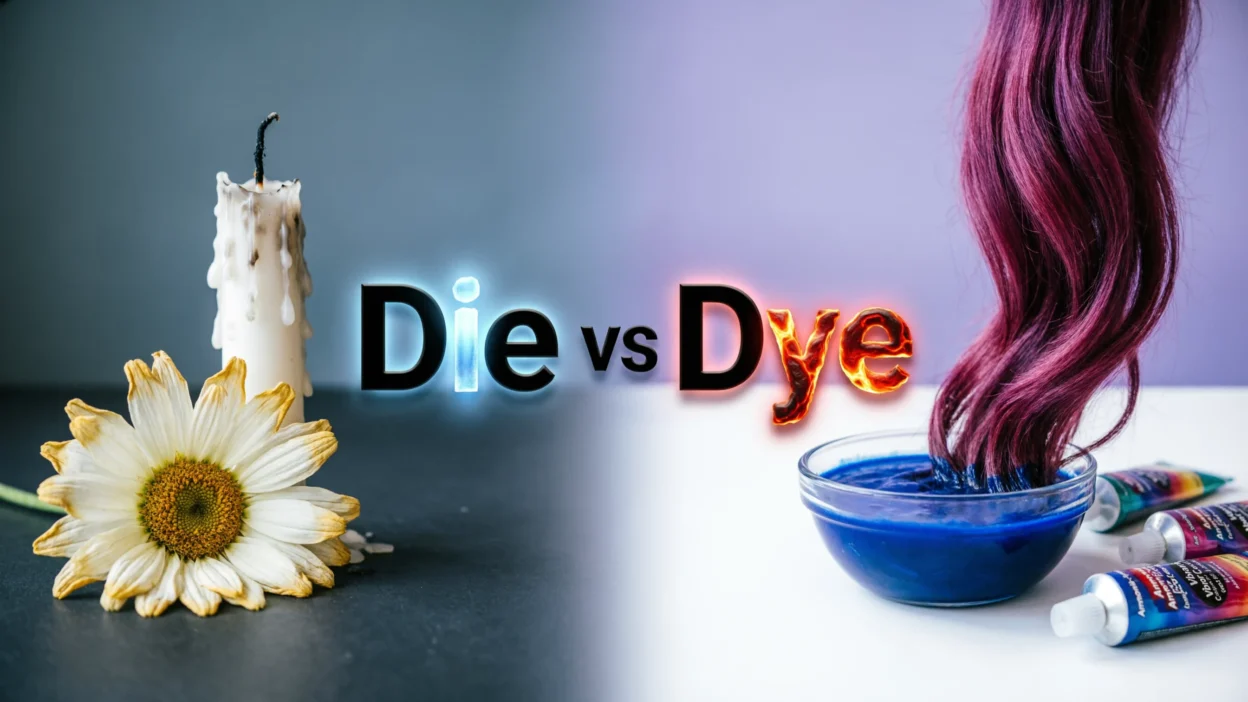
The English language contains many confusing word pairs, but die vs dye is one of the most commonly mixed up examples. Since both words sound exactly alike, writers often accidentally use the wrong spelling in emails, essays, social media posts, and everyday communication.
Although die and dye are pronounced the same way, their meanings are completely different. One relates to death or tools used for shaping materials, while the other refers to changing color. Understanding the distinction can help you write more accurately and avoid awkward grammar mistakes.
Quick Answer
- Die = to stop living or a tool used for shaping material
- Dye = a substance used to change color
Simple examples:
- Plants may die without water.
- She used blue dye on the fabric.
What Does “Die” Mean?
The word die has multiple meanings in English.
1. Die as a Verb
Most commonly, die means:
To stop living.
Examples:
- Flowers die without sunlight.
- Many fish can die in polluted water.
2. Die as a Noun
In manufacturing, a die is:
A tool used for cutting, shaping, or stamping material.
Examples:
- The factory replaced the metal die.
- The machine uses a steel die for shaping parts.
What Does “Dye” Mean?
The word dye refers to:
A substance or coloring material used to change the color of hair, fabric, or other objects.
It can also be used as a verb.
Examples:
- She used red dye for the shirt.
- I want to dye my hair black.
- They dyed the fabric blue.
Die vs Dye: Key Differences
| Word | Meaning | Common Usage |
|---|---|---|
| Die ✅ | Stop living or shaping tool | Life, manufacturing |
| Dye ✅ | Coloring substance or action | Hair, clothing, art |
Why These Words Are Confusing
The confusion happens because:
- Both words sound identical
- Their spellings differ by only one letter
- Both are short and common English words
- Spellcheck tools may not catch mistakes
Compare:
- I want to dye my hair. ✅
- I want to die my hair. ❌
That small spelling change completely alters the meaning.
Understanding “Die” as a Verb
Life and Death
The most common use of die relates to living things.
Examples:
- Trees can die during droughts.
- Nobody wants their pets to die.
Figurative Usage
The word can also appear in expressions.
Examples:
- I nearly died laughing.
- The excitement began to die down.
Understanding “Dye” as a Coloring Substance
Hair and Fabric Coloring
The word dye is commonly associated with:
- Hair color
- Clothing
- Paints
- Crafts
- Art projects
Examples:
- She bought purple hair dye.
- They used natural dye on the cloth.
Dye as a Verb
The word also functions as an action word.
Examples:
- I plan to dye my jeans black.
- He dyed his beard brown.
Common Mistakes to Avoid
1. Writing “Die” Instead of “Dye”
Incorrect:
- ❌ She wants to die her hair blonde.
Correct:
- ✔️ She wants to dye her hair blonde.
2. Using “Dye” When Talking About Death
Incorrect:
- ❌ Plants may dye without water.
Correct:
- ✔️ Plants may die without water.
3. Forgetting Context
The surrounding sentence usually makes the correct word obvious.
Easy Trick to Remember the Difference
A simple memory trick is:
👉 Dye has a “y” for colors like yellow.
Since dye relates to coloring, the “y” can remind you of colorful words.
Another helpful tip:
👉 Die relates to life ending.
American vs British English
There is no major spelling difference between American and British English for these words.
American English:
- Die
- Dye
British English:
- Die
- Dye
The meanings and spellings remain the same in both forms of English.
Examples of “Die” in Sentences
Everyday Examples
- Some insects die after winter.
- The fire slowly began to die out.
Emotional Expressions
- I almost died from embarrassment.
- We were laughing so hard we nearly died.
Manufacturing Examples
- The machine operator repaired the damaged die.
Examples of “Dye” in Sentences
Hair Examples
- She used temporary hair dye.
- He decided to dye his hair silver.
Clothing Examples
- The shirt was dyed green.
- Natural plant dyes are environmentally friendly.
Art and Craft Examples
- Artists often create handmade fabric dyes.
Similar Confusing Word Pairs
English contains many homophones that confuse writers.
Examples:
| Word Pair | Difference |
|---|---|
| Die vs Dye | Death/tool vs coloring |
| Break vs Brake | Damage vs stopping |
| Allowed vs Aloud | Permission vs spoken |
| Sale vs Sail | Selling vs boat movement |
Recognizing these differences improves grammar and vocabulary skills.
Synonyms for “Die”
Depending on context:
- Perish
- Expire
- Pass away
- Fade
- End
Synonyms for “Dye”
Depending on context:
- Color
- Tint
- Stain
- Pigment
- Paint
Using synonyms naturally can improve writing variety and readability.
Why Correct Usage Matters
Using the correct word improves:
- Grammar accuracy
- Writing clarity
- Reader understanding
- Professionalism
- SEO quality
Since both words are real English terms, incorrect usage may still pass spellcheck.
That’s why understanding meaning and context is important.
Die vs Dye in SEO and Online Writing
Correct grammar helps:
- Build reader trust
- Improve readability
- Strengthen authority
- Increase engagement
Clear writing also creates a better user experience across blogs, websites, and educational content.
Die and Dye in Idioms and Expressions
Common “Die” Expressions
- Die down
- Die out
- Never say die
Common “Dye” Usage
- Tie-dye clothing
- Hair dye treatment
- Fabric dyeing
These expressions appear frequently in everyday English.
FAQs
What is the difference between die and dye?
“Die” usually means to stop living, while “dye” refers to coloring something.
Is dye used for hair color?
Yes, dye is commonly used for coloring hair and fabrics.
Can die be a noun?
Yes, a die can also mean a tool used in manufacturing and shaping materials.
Which spelling is correct for coloring fabric?
“Dye” is the correct spelling when referring to coloring fabric.
Why do people confuse die and dye?
The words sound exactly the same but have different meanings and spellings.
Is there a British vs American difference?
No, both forms of English use the same spellings and meanings.
What is the past tense of dye?
The past tense is “dyed.”
Can spellcheck catch die vs dye mistakes?
Not always, because both are valid English words.
Summary
Understanding die vs dye becomes much easier once you focus on context and meaning. Die usually relates to death or manufacturing tools, while dye refers to coloring substances or the act of changing color.
Although these words sound identical, their meanings are completely different. Learning the distinction helps improve grammar, writing accuracy, and communication confidence in both everyday and professional English.

Dani Morrison is a dedicated language writer and spelling expert at Spelword.com, where she focuses on helping readers understand common English spelling mistakes and confusing word pairs. With a passion for clear communication, Dani creates easy-to-follow guides that simplify complex grammar and spelling rules for everyday use.