Small spelling mistakes can make a big difference in how your writing is perceived. One of the most common mix ups is foward vs forward. At a glance, both may seem acceptable, especially when typing quickly but only one is correct.
If you’ve ever hesitated while writing this word, you’re not alone. In this guide, you’ll learn the correct spelling, meaning, usage, examples, and how to avoid this mistake so your writing stays clear and professional.
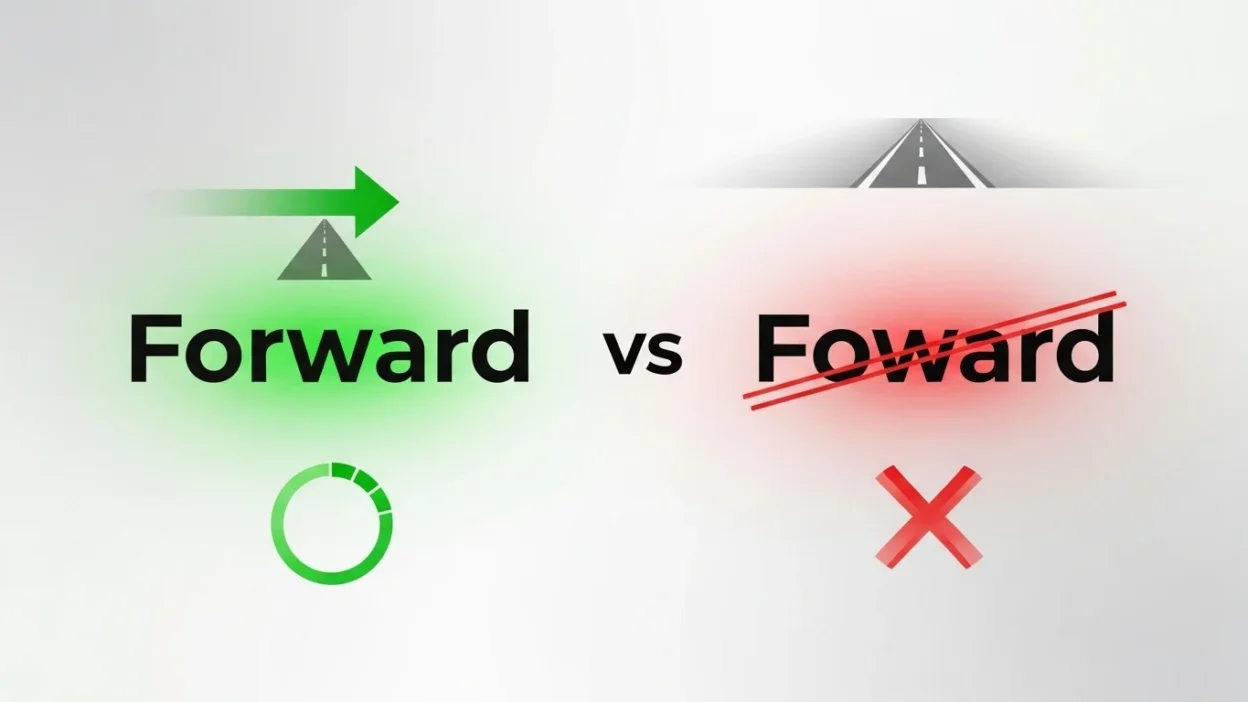
Quick Answer: Foward vs Forward
- ✅ Correct spelling: Forward
- ❌ Incorrect spelling: Foward
The word forward is the correct and standard spelling in English. Foward is a common typo or misspelling and should not be used.
What Does “Forward” Mean?
The word forward can be used as an adverb, adjective, verb, or noun, depending on the context. Its core meaning relates to movement or direction ahead.
Simple Definitions:
- Toward the front or ahead
- Moving onward or progressing
- To send something to another person
Examples in Sentences:
- She stepped forward to speak.
- We are moving forward with the plan.
- Please forward the email to the team.
Why Do People Write “Foward”?
The incorrect spelling foward usually happens because of a missing letter.
Common Reasons:
- Typing too quickly and skipping “r”
- Pronunciation confusion (the “r” sound is subtle)
- Habitual spelling errors
Since the word is used frequently, even small mistakes can become common.
Understanding the Correct Spelling Pattern
The word forward includes the sequence “rwa”, which can sometimes be overlooked.
Key Insight:
👉 The correct spelling always includes the “r” after “fo”: for-ward, not fo-ward.
Break It Down:
- For → base part
- Ward → direction or position
This structure helps explain the correct form.
Foward vs Forward: Comparison Table
| Feature | Forward ✅ | Foward ❌ |
|---|---|---|
| Correct spelling | Yes | No |
| Meaning | Ahead, onward, or send | No meaning |
| Dictionary status | Recognized | Not recognized |
| Usage | Formal & informal | Incorrect |
| Spelling pattern | Includes “r” | Missing “r” |
Common Mistakes to Avoid
Even simple spelling errors can affect clarity. Here are common mistakes to watch for:
1. Dropping the “R”
❌ Move foward with confidence.
✅ Move forward with confidence.
2. Typing Without Proofreading
Fast typing often leads to skipped letters.
3. Relying Only on Pronunciation
The “r” sound can be subtle, leading to incorrect spelling.
4. Repeating the Same Error
Once a mistake becomes a habit, it can be harder to correct.
More Examples of “Forward” in Context
In Everyday Language:
- He leaned forward to listen.
- Let’s move forward together.
In Professional Context:
- The manager asked to forward the report.
- We are looking forward to your response.
In Technology:
- Please forward this message to your contacts.
American vs British English Differences
There is a small variation in British English usage.
- 🇺🇸 American English: forward
- 🇬🇧 British English: forward (common), forwards (also used as an adverb)
Example:
- US: Move forward
- UK: Move forwards (also acceptable)
However, forward remains correct in both forms.
Why Correct Spelling Matters
Using the correct spelling of forward improves your writing quality and professionalism.
Key Benefits:
- Enhances readability
- Builds credibility
- Prevents confusion
- Improves communication
Even small errors like foward can distract readers and reduce trust.
Synonyms and Related Words
Using alternative words can make your writing more engaging.
Synonyms of “Forward”:
- Ahead
- Onward
- Progress
- Advance
- Send
Easy Memory Trick
Here’s a simple way to remember:
👉 “Forward moves ahead—and it carries the ‘r’ forward too.”
This helps you recall that the “r” should never be missing.
FAQs About Foward vs Forward
Is “foward” ever correct?
No, foward is always incorrect and should not be used.
What is the correct spelling?
The correct spelling is forward.
Why do people misspell “forward”?
Because they accidentally drop the “r” when typing or rely on pronunciation.
Is “forward” used as a verb?
Yes, it can mean to send something to another person.
Is there a difference in British English?
British English may also use forwards, but forward is still correct.
Can “forward” be used in formal writing?
Yes, it is widely used in both formal and informal contexts.
How can I remember the correct spelling?
Remember that “forward” always includes the “r.”
Can spell-check tools catch this mistake?
Yes, most tools will flag foward as incorrect.
Summary: Foward vs Forward
The difference between foward vs forward is simple but important. Forward is the correct spelling and is used to describe movement ahead or sending something, while foward is a common misspelling caused by a missing letter.
By understanding the correct structure and practicing it, you can avoid this mistake and improve your writing clarity. Small spelling details like this can make a big difference in how your message is received.