Have you ever written a sentence using the verb sneak and paused to wonder whether the correct past tense is sneaked or snuck? If so, you’re not alone. This is one of the most debated word choices in English grammar, and even native speakers often disagree about which version sounds more natural.
The good news is that both words are widely used and recognized. However, there are important differences in style, regional preference, and formality. Understanding sneaked vs snuck can help you choose the right word for your audience and write with greater confidence.
Quick Answer
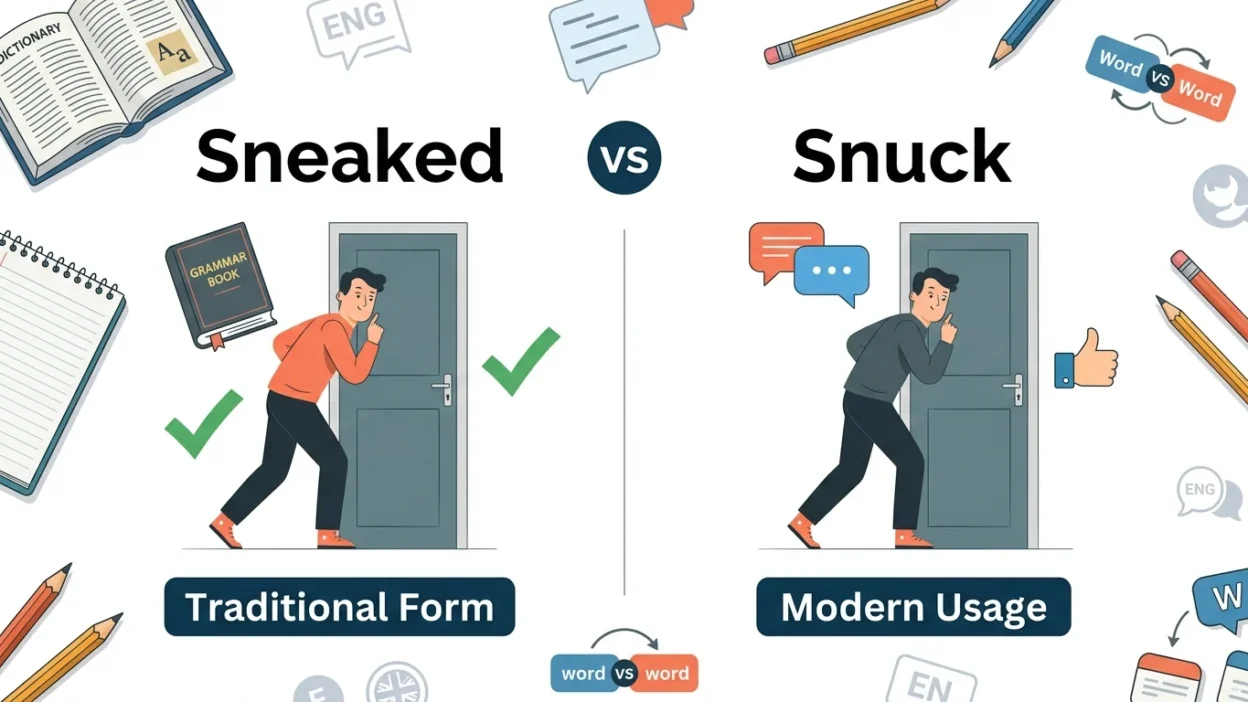
Both sneaked and snuck are correct past tense forms of the verb sneak.
- Sneaked is the traditional and older form.
- Snuck is a newer form that has become extremely common, especially in North America.
Examples
✅ She sneaked into the room quietly.
✅ She snuck into the room quietly.
Both sentences are grammatically correct.
In formal writing, many style guides still prefer sneaked, while snuck is widely accepted in everyday speech and modern writing.
What Does “Sneak” Mean?
Before comparing the two forms, it’s helpful to understand the base verb.
Sneak means to move quietly, secretly, or without being noticed.
Examples
- The cat tried to sneak into the kitchen.
- He decided to sneak out before the meeting ended.
- The child attempted to sneak an extra cookie.
The action usually involves secrecy or avoiding attention.
What Does “Sneaked” Mean?
Sneaked is the traditional past tense and past participle of sneak.
For centuries, it was the only accepted form in standard English.
Examples of Sneaked
- She sneaked out of the house after midnight.
- The dog sneaked into the bedroom.
- He had sneaked a look at the answers.
Many editors and teachers still favor sneaked, especially in formal contexts.
What Does “Snuck” Mean?
Snuck is an irregular past tense form that emerged in English during the nineteenth century.
Although some people originally viewed it as nonstandard, it eventually gained widespread acceptance.
Examples of Snuck
- He snuck into the movie theater.
- They snuck away during the break.
- She had snuck out before anyone noticed.
Today, snuck appears frequently in books, newspapers, and everyday conversation.
Sneaked vs Snuck: Comparison Table
| Feature | Sneaked | Snuck |
|---|---|---|
| Traditional Form | Yes | No |
| Modern Acceptance | Yes | Yes |
| Formal Writing | Often preferred | Accepted but less formal |
| Everyday Speech | Common | Very common |
| American English | Common | Extremely common |
| British English | More common | Less common |
| Grammatically Correct | Yes | Yes |
The table shows that both forms are valid, but their usage varies depending on context and location.
Why Are There Two Past Tenses?
English contains many irregular verbs.
Examples include:
- Stick → Stuck
- Strike → Struck
- Dig → Dug
Over time, speakers naturally began treating sneak like similar irregular verbs.
As a result:
- Sneak → Sneaked
- Sneak → Snuck
Both forms survived and became accepted.
This explains why the debate continues today.
When to Use “Sneaked”
Many writers choose sneaked in situations that require a more traditional or formal tone.
Formal Writing
- Academic papers
- Business documents
- Professional reports
- Formal essays
Examples
- The student sneaked a glance at the reference materials.
- The employee sneaked into the office early.
Because it follows the regular verb pattern, some readers perceive sneaked as slightly more polished.
When to Use “Snuck”
Snuck is especially common in everyday speech and modern storytelling.
Casual Writing
- Blogs
- Fiction
- Dialogue
- Social media
Examples
- The kids snuck into the backyard.
- He snuck a piece of cake before dinner.
- We snuck out during the credits.
Many native speakers find snuck more natural and conversational.
Common Mistakes with Sneaked and Snuck
Mistake 1: Thinking Snuck Is Incorrect
❌ Snuck is not a real word.
✅ Snuck is a recognized and accepted past tense of sneak.
Major dictionaries accept both forms.
Mistake 2: Mixing Verb Forms
❌ She has sneak into the room.
✅ She has sneaked into the room.
✅ She has snuck into the room.
The past participle should be sneaked or snuck, not the base form.
Mistake 3: Switching Styles Inconsistently
If you’re writing a formal document, maintaining a consistent style is important.
Example:
❌ The student sneaked into class and later snuck out.
✅ The student sneaked into class and later sneaked out.
Or:
✅ The student snuck into class and later snuck out.
Consistency improves readability.
Examples in Everyday Sentences
Using Sneaked
- The cat sneaked through the open window.
- She sneaked a note to her friend.
- We sneaked out before the crowd arrived.
- He had sneaked a look at the gift.
Using Snuck
- The children snuck downstairs after bedtime.
- Someone snuck into the garden.
- She snuck an extra cookie from the jar.
- They had snuck away quietly.
Both sets of examples are grammatically acceptable.
What Do Dictionaries Say?
Modern dictionaries generally recognize both forms.
Most dictionary entries list:
- Sneak
- Sneaked
- Snuck
This means writers can confidently use either form depending on audience and style preferences.
The debate today is less about correctness and more about usage.
Sneaked vs Snuck in American English
American English strongly favors snuck.
Many Americans naturally say:
- He snuck out.
- She snuck in.
- They snuck away.
In everyday conversation, snuck often sounds more natural than sneaked.
Examples
- The teenager snuck out after curfew.
- The dog snuck onto the couch.
Although sneaked remains acceptable, snuck dominates casual American usage.
Sneaked vs Snuck in British English
British English traditionally favors sneaked.
Many British writers and speakers continue to prefer:
- She sneaked away.
- He sneaked into the room.
Examples
- The child sneaked downstairs.
- Someone sneaked into the building.
However, snuck has become increasingly common in the UK due to media influence and global communication.
Which Form Should You Use?
The best choice depends on your audience.
Use Sneaked If:
- You’re writing formally.
- Your audience prefers traditional grammar.
- You’re following a style guide that favors regular verb forms.
Use Snuck If:
- You’re writing conversationally.
- You’re creating natural dialogue.
- You’re targeting a modern American audience.
In most situations, readers will understand either form without difficulty.
Memory Trick
A simple trick can help you remember the difference.
Sneaked = Traditional
Think:
- Sneaked = Older form.
- Sneaked = Formal choice.
Snuck = Spoken
Think:
- Snuck = Sounds like stuck.
- Snuck = Common in conversation.
This can help you decide which form fits your writing style.
Why the Debate Continues
Language constantly evolves.
Many words that were once criticized eventually became accepted.
The rise of snuck is an example of how everyday speech can influence standard grammar over time.
Today:
- Both forms are correct.
- Both appear in major dictionaries.
- Both are used by professional writers.
The choice often comes down to preference rather than strict grammatical rules.
Frequently Asked Questions
Is sneaked or snuck correct?
Both sneaked and snuck are correct past tense forms of sneak.
Which is more formal, sneaked or snuck?
Sneaked is generally considered more formal and traditional.
Is snuck a real word?
Yes. Modern dictionaries recognize snuck as a standard English word.
Which form is more common in American English?
Snuck is extremely common in American English, especially in speech and informal writing.
Which form is more common in British English?
Sneaked is traditionally more common in British English.
Can I use snuck in professional writing?
Yes, although some editors may prefer sneaked in highly formal contexts.
What is the past participle of sneak?
Both sneaked and snuck can function as past participles.
Why do some people dislike snuck?
Some people view it as less traditional because sneaked was the original standard form.
Summary
The debate over sneaked vs snuck is one of style and preference rather than correctness. Both words are accepted past tense forms of sneak, and both appear in respected dictionaries. Sneaked is the older and more traditional form, while snuck has become increasingly popular, particularly in North American English.
When choosing between them, consider your audience and tone. Formal writing often favors sneaked, while casual conversation and modern storytelling frequently use snuck. Since both forms are grammatically correct, selecting the one that best matches your context will help your writing sound natural and effective.

Dani Morrison is a dedicated language writer and spelling expert at Spelword.com, where she focuses on helping readers understand common English spelling mistakes and confusing word pairs. With a passion for clear communication, Dani creates easy-to-follow guides that simplify complex grammar and spelling rules for everyday use.