Choosing between despite or in spite can be confusing because both expressions have almost the same meaning. Many English learners and even native speakers wonder whether one is more correct, more formal, or better suited for certain situations.
The good news is that both are grammatically correct and interchangeable in most contexts. The main difference lies in style rather than meaning. This guide explains the difference between despite and in spite of, shows when to use each one, provides plenty of examples, highlights common mistakes, and answers the most frequently asked questions.
Quick Answer
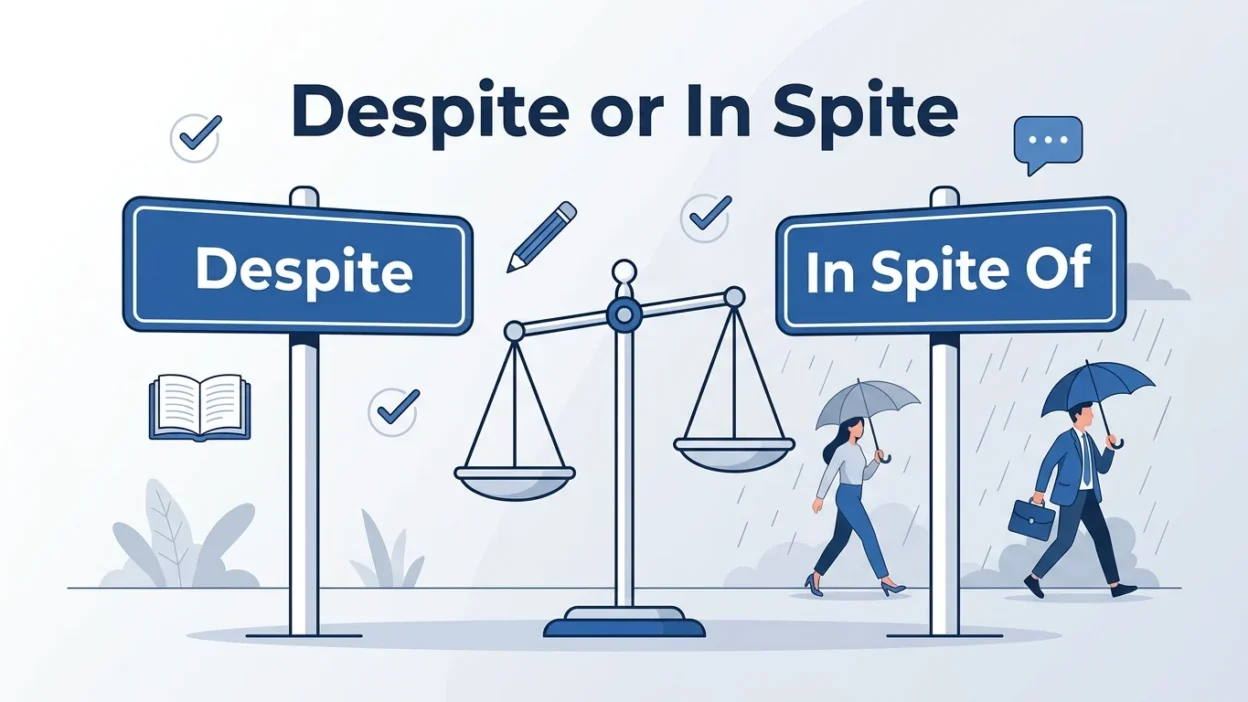
Both despite and in spite of mean “without being affected by” or “regardless of.” They are used to show contrast between two ideas.
- Despite is a single-word preposition.
- In spite of is a three-word prepositional phrase.
- Both are equally correct in American and British English.
- You can usually replace one with the other without changing the meaning.
Examples:
- Despite the rain, we went hiking.
- In spite of the rain, we went hiking.
Both sentences mean exactly the same thing.
What Does “Despite” Mean?
Despite is a preposition used to show that something happened even though another circumstance could have prevented it.
It introduces a contrast between two ideas and is followed by a noun, pronoun, or gerund (verb ending in -ing).
Examples
- Despite the heavy traffic, we arrived on time.
- She smiled despite her disappointment.
- Despite working late, he finished the project.
- Despite the cold weather, they went swimming.
- We enjoyed the trip despite the delays.
Notice that despite is never followed directly by a complete sentence.
Correct:
- Despite the rain, we played football.
Incorrect:
- Despite it was raining, we played football.
What Does “In Spite Of” Mean?
In spite of has the same meaning as despite. It is simply a longer expression used to show contrast.
Like despite, it must be followed by a noun, pronoun, or gerund.
Examples
- In spite of the rain, we played football.
- She passed the exam in spite of feeling sick.
- In spite of his fears, he gave the presentation.
- They continued walking in spite of the strong wind.
- We finished early in spite of several interruptions.
The meaning remains identical to sentences using despite.
Despite vs In Spite: Key Differences
Although both expressions are interchangeable, there are slight stylistic differences.
| Feature | Despite | In Spite Of |
|---|---|---|
| Meaning | Without being affected by | Without being affected by |
| Word Count | One word | Three words |
| Grammar | Preposition | Prepositional phrase |
| Formality | Slightly more concise | Slightly more conversational |
| Common Usage | Very common | Equally common |
| Interchangeable | Yes | Yes |
In most writing, you can choose either expression based on personal preference or writing style.
How to Use Despite Correctly
Use despite before:
- A noun
- A pronoun
- A gerund (verb ending in -ing)
Examples
With a noun
- Despite the noise, I fell asleep.
With a pronoun
- Despite him, we completed the task.
With a gerund
- Despite studying hard, she found the test difficult.
How to Use In Spite Of Correctly
The grammar rules are exactly the same.
Examples
With a noun
- In spite of the noise, I fell asleep.
With a pronoun
- In spite of him, we completed the task.
With a gerund
- In spite of studying hard, she found the test difficult.
Can You Use Them Before a Full Sentence?
Not directly.
If you want to introduce a full clause, use the fact that after the expression.
Correct
- Despite the fact that it was raining, we went outside.
- In spite of the fact that it was raining, we went outside.
Incorrect
- Despite it was raining.
- In spite of it was raining.
Adding the fact that makes the sentence grammatically correct.
Everyday Examples
Here are some practical examples.
At School
- Despite being nervous, she answered every question.
- In spite of missing several classes, he passed.
At Work
- Despite the deadline, the team stayed calm.
- In spite of technical problems, the meeting continued.
In Daily Life
- Despite the traffic, we arrived early.
- In spite of the high prices, people kept shopping.
Sports
- Despite the injury, the player finished the match.
- In spite of the bad weather, the game continued.
Common Mistakes to Avoid
Many learners make similar mistakes when using these expressions.
1. Using a Complete Sentence After Despite
Incorrect:
- Despite she was tired, she worked late.
Correct:
- Despite being tired, she worked late.
- Despite the fact that she was tired, she worked late.
2. Forgetting “Of”
Incorrect:
- In spite the rain…
Correct:
- In spite of the rain…
Always include of.
3. Mixing Despite With “Of”
Incorrect:
- Despite of the rain…
Correct:
- Despite the rain.
- In spite of the rain.
Despite of is incorrect.
4. Confusing Them With Although
Although all three express contrast, they have different grammar.
Correct:
- Although it was raining, we went outside.
- Despite the rain, we went outside.
- In spite of the rain, we went outside.
Despite, In Spite Of, and Although
These expressions often confuse learners because they express similar ideas.
| Expression | Followed By | Example |
|---|---|---|
| Despite | Noun or gerund | Despite the rain, we stayed outside. |
| In spite of | Noun or gerund | In spite of the rain, we stayed outside. |
| Although | Complete clause | Although it rained, we stayed outside. |
Remember that although introduces a complete sentence, while despite and in spite of do not.
American vs British English
There is virtually no difference between American and British English when it comes to despite and in spite of.
Both varieties use these expressions regularly in speech and writing.
Some style guides suggest that despite sounds slightly more concise and modern, while in spite of may sound a little more traditional or conversational. However, neither is considered incorrect or outdated.
Whether you are writing for an American or British audience, you can confidently use either expression.
Tips for Remembering the Difference
A few simple tricks can help you remember the correct usage.
- Despite never takes of.
- In spite always needs of.
- Both are followed by nouns or -ing verbs.
- For a complete sentence, add the fact that or use although instead.
- If you’re unsure, replacing one with the other usually keeps the meaning unchanged.
FAQs
Is despite the same as in spite of?
Yes. Both expressions have the same meaning and can usually be used interchangeably without changing the sentence’s meaning.
Which is more formal, despite or in spite of?
Neither is significantly more formal. However, despite is slightly shorter and often preferred in concise or formal writing.
Can I say despite of?
No. Despite of is grammatically incorrect. Use despite alone or in spite of.
Can despite be followed by a sentence?
Not directly. If you need a full sentence, write despite the fact that or use although instead.
Is in spite of old-fashioned?
No. It is still widely used in both spoken and written English around the world.
Can I use despite with a verb?
Yes, but the verb should usually be in the -ing form.
Example: Despite working hard, she was tired.
Which is more common in everyday English?
Both are common. Many writers choose despite because it is shorter, while in spite of remains equally natural in conversation.
Summary
Understanding despite or in spite is easier than many learners expect because both expressions share the same meaning. They are used to show contrast and are followed by a noun, pronoun, or gerund rather than a complete sentence. In most cases, you can replace one with the other without changing the meaning.
The key point to remember is that despite never takes of, while in spite must always be written as in spite of. Once you know this simple rule, choosing the correct expression becomes much easier, helping you write and speak English with greater confidence and accuracy.

Dani Morrison is a dedicated language writer and spelling expert at Spelword.com, where she focuses on helping readers understand common English spelling mistakes and confusing word pairs. With a passion for clear communication, Dani creates easy-to-follow guides that simplify complex grammar and spelling rules for everyday use.