The confusion between breath vs breathe is one of the most common grammar mistakes in English. Since the two words look almost identical and are closely related in meaning, many people accidentally use the wrong one in writing. However, understanding the difference is actually quite simple once you know how each word functions in a sentence.
Whether you’re writing an email, a school assignment, a blog post, or a social media update, using breath and breathe correctly can make your writing clearer and more professional. In this guide, you’ll learn the meaning of each word, see practical examples, discover common mistakes, and find easy ways to remember the difference.
Quick Answer
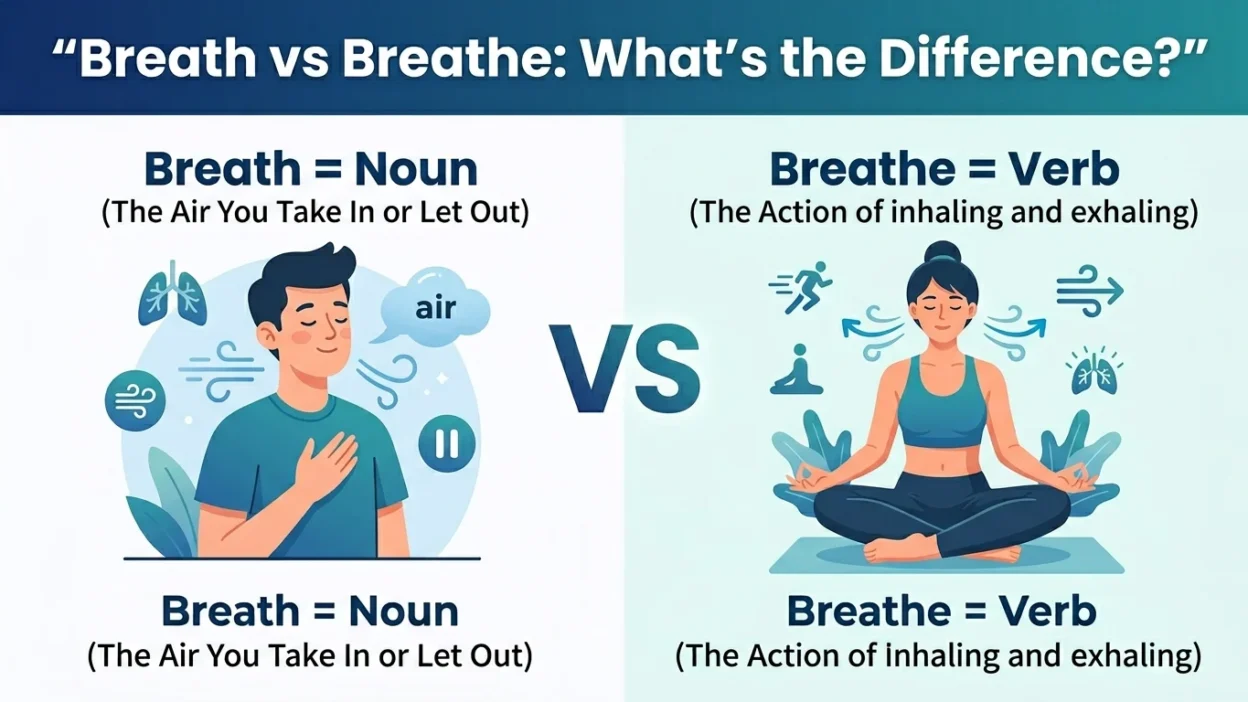
Breath is a noun that refers to the air taken into or expelled from the lungs.
Breathe is a verb that means to inhale and exhale air.
Examples:
- Take a deep breath before speaking.
- Remember to breathe slowly during meditation.
A simple rule is:
- Breath = Thing (noun)
- Breathe = Action (verb)
What Does Breath Mean?
Breath is a noun. It refers to the air that moves in and out of your lungs or a single act of inhaling and exhaling.
You can think of a breath as something you have, take, hold, or lose.
Examples of Breath
- She took a deep breath before diving into the water.
- After running up the stairs, he was out of breath.
- Hold your breath for a few seconds.
- The cold air took my breath away.
In each example, breath names a thing rather than an action.
What Does Breathe Mean?
Breathe is a verb. It describes the action of taking air into the lungs and releasing it.
Whenever someone is performing the act of respiration, breathe is the correct word.
Examples of Breathe
- Try to breathe slowly and calmly.
- Patients were encouraged to breathe deeply.
- It was difficult to breathe in the smoky room.
- Remember to breathe during exercise.
In each sentence, the word expresses an action.
Breath vs Breathe: Side-by-Side Comparison
| Feature | Breath | Breathe |
|---|---|---|
| Part of Speech | Noun | Verb |
| Meaning | Air taken into or expelled from lungs | To inhale and exhale air |
| Function | Names a thing | Describes an action |
| Example | Take a deep breath | Breathe deeply |
| Question It Answers | What? | What action? |
How to Know Which Word to Use
A quick way to choose the correct word is to determine whether you need a noun or a verb.
Use Breath When You Need a Noun
Ask yourself:
“What thing am I referring to?”
Examples:
- Take a breath.
- Catch your breath.
- Hold your breath.
In these sentences, breath refers to something tangible or countable.
Use Breathe When You Need a Verb
Ask yourself:
“What action is being performed?”
Examples:
- Breathe deeply.
- Breathe through your nose.
- Try to breathe slowly.
Here, breathe describes the act of respiration.
Common Expressions with Breath
The noun breath appears in many popular English expressions.
Catch Your Breath
Meaning: Recover after physical exertion.
Example:
- I needed a moment to catch my breath after the race.
Hold Your Breath
Meaning: Stop breathing temporarily or wait anxiously.
Example:
- The audience held its breath during the final moments.
Take Your Breath Away
Meaning: Be extremely impressive or beautiful.
Example:
- The mountain view took my breath away.
Out of Breath
Meaning: Breathing heavily after activity.
Example:
- She was out of breath after jogging.
Common Uses of Breathe
The verb breathe is frequently used in health, wellness, and everyday communication.
Health and Fitness
- Breathe deeply during exercise.
- Learn to breathe properly while running.
Meditation and Relaxation
- Close your eyes and breathe slowly.
- Focus on how you breathe.
Medical Contexts
- The patient struggled to breathe.
- Fresh air helped him breathe more comfortably.
Common Mistakes with Breath and Breathe
Because the words differ by only one letter, mistakes happen frequently.
Mistake 1: Using Breath as a Verb
❌ Please breath slowly.
✅ Please breathe slowly.
The sentence requires an action, so the verb breathe is correct.
Mistake 2: Using Breathe as a Noun
❌ Take a deep breathe.
✅ Take a deep breath.
The sentence refers to a thing, making breath the correct choice.
Mistake 3: Confusing Pronunciation and Spelling
Many people know how to pronounce the words but struggle with spelling them correctly.
Remember:
- Breath ends with the “th” sound.
- Breathe ends with a softer “thee” sound.
Easy Memory Tricks
Simple memory tricks can help you remember the difference forever.
Remember Breath
Breath is shorter.
Nouns often represent things.
A breath is a thing you take.
Remember Breathe
Breathe has an extra “e.”
Think of that extra “e” as standing for exercise or action.
Since breathe is an action, it is the verb.
Another Helpful Trick
If you can replace the word with “inhale and exhale,” use breathe.
Example:
- Please breathe deeply.
If you can replace the word with “a single inhalation,” use breath.
Example:
- Take a deep breath.
Breath vs Breathe in Everyday Writing
Workplace Examples
- Take a deep breath before your presentation.
- Remember to breathe naturally while speaking.
Academic Examples
- The athlete’s breath became rapid during the experiment.
- Students should breathe calmly before exams.
Personal Examples
- Her breath smelled like mint.
- It’s easier to breathe outdoors.
Health Examples
- Shortness of breath can indicate a medical issue.
- Some patients find it difficult to breathe during allergy season.
American vs British English Differences
There is no significant difference between American and British English regarding breath and breathe.
In both varieties of English:
- Breath is a noun.
- Breathe is a verb.
- The meanings remain the same.
- The spelling remains the same.
Whether you’re writing for an American or British audience, the usage rules do not change.
Why the Difference Matters
Using the wrong word can make your writing appear less polished.
Consider these examples:
- Take a deep breath before speaking.
- Remember to breathe clearly and slowly.
Switching the words would create grammatical errors and potentially confuse readers.
Mastering this distinction helps improve writing accuracy, professional communication, and overall confidence with English grammar.
Frequently Asked Questions
What is the difference between breath and breathe?
Breath is a noun referring to air moving in and out of the lungs. Breathe is a verb meaning to inhale and exhale.
Is breath a noun or a verb?
Breath is always a noun.
Is breathe a noun or a verb?
Breathe is always a verb.
How do you remember the difference between breath and breathe?
Remember that breathe has an extra “e” and represents an action. Breath is the thing you take.
Which is correct: take a deep breath or take a deep breathe?
The correct phrase is take a deep breath because the sentence requires a noun.
Which is correct: breath deeply or breathe deeply?
The correct phrase is breathe deeply because the sentence requires a verb.
Are breath and breathe pronounced differently?
Yes. Breath ends with a short “th” sound, while breathe ends with a longer “thee” sound.
Is there a difference between American and British usage?
No. Both American and British English use the words in exactly the same way.
Summary
The difference between breath vs breathe is straightforward once you understand their grammatical roles. Breath is a noun that refers to the air moving in and out of the lungs or a single inhalation and exhalation. Breathe is a verb that describes the action of inhaling and exhaling air. Although the words look very similar, they serve different functions in a sentence.
When deciding which word to use, remember that breath is something you take, hold, or lose, while breathe is something you do. Keeping this simple distinction in mind will help you avoid common grammar mistakes and communicate more clearly in both professional and everyday writing.

William Harved is a passionate language enthusiast and digital writer specializing in English spelling, grammar clarity, and common writing mistakes. As the primary author of Spelword.com, he focuses on helping readers understand confusing word pairs, correct spelling errors, and improve everyday communication.