
Have you ever written a sentence like, “That’s a perfect segway into our next topic,” and then wondered if the spelling was correct? If so, you’re not alone. The confusion between segway vs segue is extremely common because the two words are pronounced the same way but have very different meanings.
Understanding the distinction is important for clear and professional communication. Whether you’re writing a blog post, giving a presentation, or having a casual conversation, knowing when to use segway and segue can help you avoid a common language mistake and improve your writing confidence.
Quick Answer
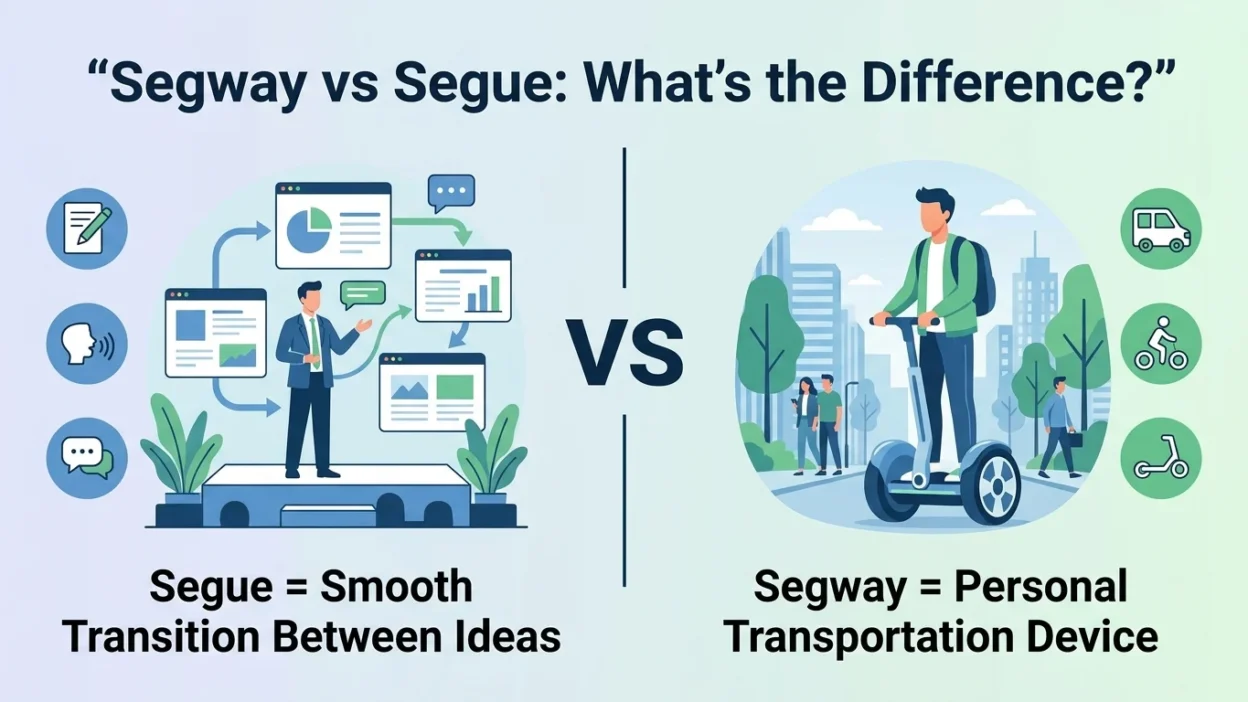
Segue is the correct word when referring to a smooth transition from one topic, idea, or activity to another.
Segway is a brand name for a two-wheeled self-balancing personal transportation device.
Examples:
- Let me segue into the next section of the presentation.
- He rode a Segway around the city tour.
If you’re talking about a transition in speech or writing, segue is almost always the word you need.
What Does Segue Mean?
The word segue is a verb and noun that refers to a smooth, uninterrupted transition from one subject, scene, song, or activity to another.
It originated from Italian and was originally used in music to indicate that one passage should continue directly into the next without a pause.
Today, it is commonly used in:
- Writing
- Public speaking
- Broadcasting
- Presentations
- Conversations
Examples of Segue
- The speaker used a personal story to segue into the main topic.
- That discussion provides a natural segue to our next point.
- The documentary segues smoothly between interviews.
- She found an elegant way to segue from one subject to another.
In all these examples, the word relates to a smooth transition.
What Does Segway Mean?
Segway is a trademarked brand name for a personal transportation device that balances on two wheels.
The vehicle became popular in the early 2000s for city tours, security patrols, and short-distance travel.
Examples of Segway
- We rented a Segway during our sightseeing tour.
- The security officer patrolled the area on a Segway.
- Learning to ride a Segway was easier than expected.
- Tourists often explore downtown areas using Segways.
Unlike segue, this word refers to a physical product rather than a transition.
Segway vs Segue: Side-by-Side Comparison
| Feature | Segue | Segway |
|---|---|---|
| Meaning | Smooth transition | Personal transportation device |
| Part of Speech | Noun and verb | Proper noun (brand name) |
| Common Context | Writing, speaking, music | Travel and transportation |
| Pronunciation | “SEG-way” | “SEG-way” |
| Example | Let’s segue into the next topic | He rode a Segway downtown |
Why Do People Confuse Segway and Segue?
The confusion occurs because both words are pronounced almost identically.
When people hear the word in conversation before seeing it in writing, they often assume the spelling must be Segway because the transportation device is widely recognized.
As a result, phrases such as:
❌ “That segways perfectly into my next point.”
appear frequently online.
The correct version is:
✅ “That segues perfectly into my next point.”
The pronunciation is the same, but the spelling depends entirely on the meaning.
When Should You Use Segue?
Use segue whenever you’re discussing a transition between ideas, topics, events, scenes, or activities.
Common Situations
- Presentations
- Essays
- Articles
- Speeches
- Podcasts
- Videos
Correct Examples
- I’d like to segue into a related issue.
- This chapter serves as a segue to the conclusion.
- The host segued smoothly into the interview segment.
- The discussion naturally segues into questions about leadership.
In each example, the word describes movement from one idea to another.
When Should You Use Segway?
Use Segway only when referring to the transportation device or the company associated with it.
Correct Examples
- The tour guide handed us helmets before we rode our Segways.
- He purchased a used Segway for commuting.
- Several officers patrolled the park on Segways.
- The group took a guided Segway tour.
If you’re not discussing a two-wheeled vehicle, Segway is probably not the word you want.
Common Mistakes with Segway and Segue
Mistake 1: Using Segway for a Transition
❌ That’s a great segway into our next topic.
✅ That’s a great segue into our next topic.
The sentence refers to a transition, not a vehicle.
Mistake 2: Using Segue for the Vehicle
❌ We rented a segue during our vacation.
✅ We rented a Segway during our vacation.
The sentence refers to transportation.
Mistake 3: Assuming Segway Is an Accepted Alternative
Many people mistakenly believe Segway can be used informally to mean transition.
In standard English, this usage is considered incorrect.
Professional editors and style guides consistently recommend segue when referring to transitions.
Easy Memory Tricks
A quick memory trick can help you remember the difference.
Remember Segue
Think of segue as connected to speech, writing, and flowing ideas.
- Segue = Smooth transition
- Segue = Flowing connection
Remember Segway
Think of Segway as a way to travel.
Notice the word way at the end.
- Segway = A way to move around
- Segway = Transportation device
This simple association helps prevent mistakes.
Segue in Professional Writing
The word segue appears frequently in professional communication.
Business Writing
- This report will segue into our recommendations section.
- The manager smoothly segued from budget concerns to growth opportunities.
Academic Writing
- The final paragraph should segue into the conclusion.
- Researchers often use transition sentences to segue between sections.
Public Speaking
- Let me segue into the next topic.
- The presenter used humor to segue into a serious discussion.
Using effective segues makes communication easier to follow and more engaging.
Segway in Everyday Life
Although less common than it once was, the Segway remains a recognizable transportation device.
It has been used for:
- Guided city tours
- Campus transportation
- Security patrols
- Event management
- Personal mobility
Because the brand became famous, many people first encountered the word before learning the spelling of segue, which contributes to the confusion.
American vs British English Differences
There is no meaningful difference between American and British English regarding segue and Segway.
Both varieties of English:
- Spell segue the same way.
- Use segue for transitions.
- Recognize Segway as a transportation brand.
- Pronounce the words similarly.
Whether you’re writing for an American or British audience, the distinction remains exactly the same.
Why the Difference Matters
Using the wrong spelling can affect your credibility, especially in professional writing.
Consider these sentences:
- That point provides a smooth segue into our conclusion.
- We explored the city on a Segway.
Although they sound alike, the meanings are completely unrelated.
Choosing the correct word ensures clarity and demonstrates attention to detail.
For writers, students, marketers, educators, and professionals, mastering this distinction helps avoid a surprisingly common mistake.
Frequently Asked Questions
What is the difference between segue and Segway?
Segue means a smooth transition between ideas or activities. Segway is a two-wheeled personal transportation device.
Which spelling is correct for a transition between topics?
Segue is the correct spelling when referring to a transition in writing or speech.
Why do people write “segway” instead of “segue”?
Because both words are pronounced the same way, many people assume the more familiar spelling, Segway, is correct.
Is “segway into the next topic” grammatically correct?
No. The correct phrase is “segue into the next topic.”
Can segue be used as a noun and a verb?
Yes. It can refer to the transition itself or the act of transitioning.
Is Segway a generic word?
No. Segway is a trademarked brand name.
Do British and American English use segue differently?
No. Both use segue for transitions and Segway for the transportation device.
How do you pronounce segue?
It is pronounced “SEG-way,” which is why it is often confused with Segway.
Summary
The distinction between segway vs segue is simple once you understand the meanings. Segue refers to a smooth transition from one topic, idea, or activity to another, while Segway is a well known personal transportation device. Although the two words share the same pronunciation, they are not interchangeable.
When writing or speaking about transitions, always choose segue. Reserve Segway for discussions about the two wheeled vehicle. Keeping this difference in mind will help you communicate more clearly, write more professionally, and avoid one of the most common spelling mistakes in modern English.

Dani Morrison is a dedicated language writer and spelling expert at Spelword.com, where she focuses on helping readers understand common English spelling mistakes and confusing word pairs. With a passion for clear communication, Dani creates easy-to-follow guides that simplify complex grammar and spelling rules for everyday use.