Have you ever heard someone say “nitch” and wondered if it’s just another spelling of “niche”? You’re not alone. This is one of the most common confusions in English, especially because pronunciation varies across regions.
Understanding nitch vs niche is important for both writing and speaking. One is the correct spelling, while the other is simply a way of pronouncing it in certain accents. Let’s break it down clearly so you can use the right form with confidence in any situation.
Quick Answer: Nitch vs Niche
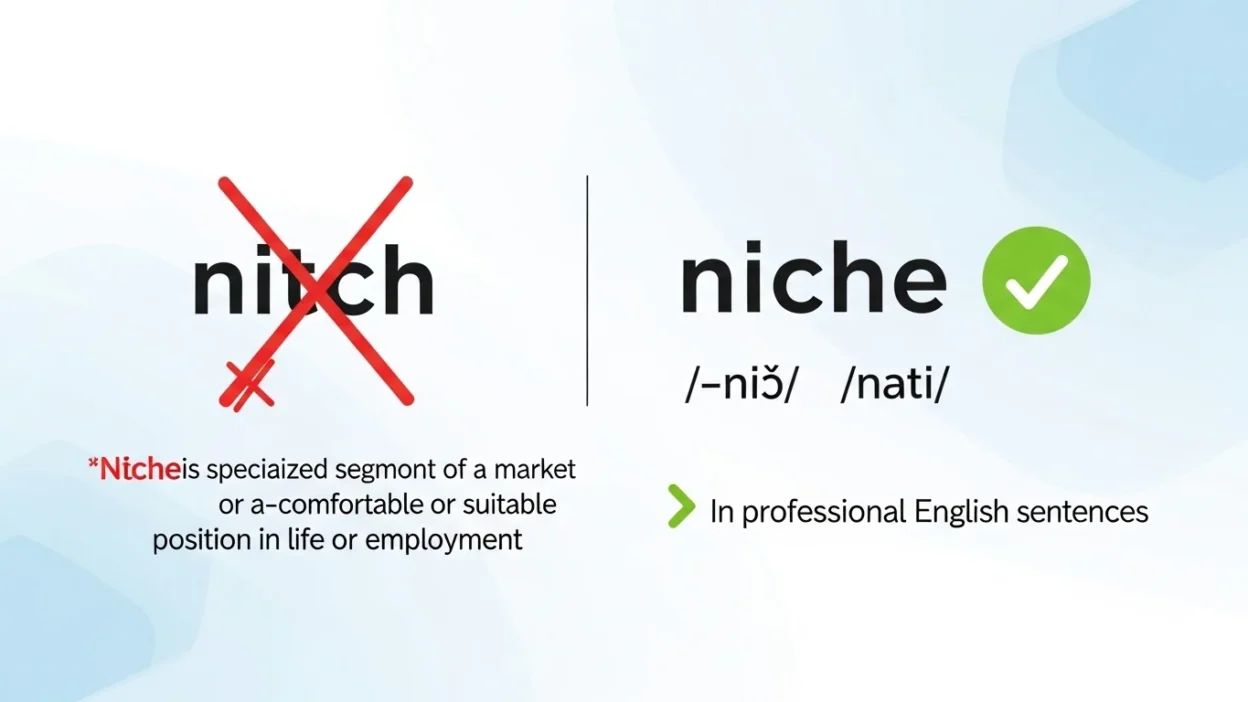
- ❌ Nitch = Incorrect spelling (only a pronunciation)
- ✅ Niche = Correct spelling
👉 Always write “niche”, even if you pronounce it as “nitch.”
What Does “Niche” Mean?
Niche is a noun with a few closely related meanings, depending on context.
Core Meanings of Niche
- A specialized segment or area (especially in business or marketing)
- A suitable position or role for someone
- A recess or small space in a wall (architectural meaning)
Examples of “Niche” in Sentences
- She found her niche in digital marketing.
- This brand targets a specific niche audience.
- The sculpture was placed in a wall niche.
- He discovered his niche after years of experimenting.
This word is widely used in business, career development, and creative fields.
What Is “Nitch”?
“Nitch” is not a correct spelling. It is simply a phonetic pronunciation used by some English speakers, especially in American English.
Why Do People Say “Nitch”?
- It reflects how the word is commonly pronounced in the U.S.
- The original French pronunciation influences variation
- Regional accents shape how the word sounds
However, regardless of pronunciation, the correct spelling remains niche.
Nitch vs Niche: Key Differences
| Feature | Niche | Nitch |
|---|---|---|
| Correct spelling | ✅ Yes | ❌ No |
| Meaning | Specialized area or role | Same intended meaning |
| Usage | Writing and formal speech | Spoken pronunciation only |
| Dictionary status | Recognized word | Not recognized as spelling |
| Professional use | Recommended | Not acceptable in writing |
Pronunciation: Niche vs “Nitch”
This is where much of the confusion comes from.
Common Pronunciations of “Niche”
- 🇺🇸 American English: /nɪtʃ/ (sounds like “nitch”)
- 🇬🇧 British English: /niːʃ/ (sounds like “neesh”)
👉 Both pronunciations are correct, but the spelling is always niche.
Common Mistakes to Avoid
When dealing with nitch vs niche, here are the most frequent errors:
1. Writing “Nitch” Instead of “Niche”
- ❌ Nitch
- ✅ Niche
Even if you say “nitch,” you must write “niche.”
2. Assuming Pronunciation Equals Spelling
English often has different spelling and pronunciation patterns.
3. Avoiding the Word Entirely
Some writers skip using “niche” because they’re unsure about it—but it’s a valuable and widely used word.
Easy Memory Trick
👉 “Niche is unique—so its spelling is unique too.”
Think of “niche” as a special word for a special category.
Real-Life Usage of “Niche”
Using “niche” correctly can improve your communication in many areas.
In Business and Marketing
- “Find your niche audience.”
- “This product serves a specific niche market.”
In Careers
- “She found her niche in teaching.”
In Everyday Conversation
- “It took time to discover his niche.”
This word is especially useful when talking about specialization.
Synonyms and Related Words
To enrich your writing, consider these alternatives:
- Specialty
- Area
- Segment
- Role
- Position
Example:
- “She found her specialty in design.”
- “This brand targets a specific segment.”
American vs British English
There is a difference in pronunciation, but not in spelling.
- 🇺🇸 American English: Niche (often pronounced “nitch”)
- 🇬🇧 British English: Niche (often pronounced “neesh”)
👉 The spelling never changes.
Why Correct Usage Matters
Using the correct form—niche—is important because:
- It ensures clarity and accuracy
- Maintains professional writing standards
- Builds credibility and trust
- Avoids confusion in formal contexts
Writing “nitch” can:
- Make your writing appear incorrect
- Reduce professionalism
- Distract readers
FAQs About Nitch vs Niche
What is the correct spelling: nitch or niche?
“Niche” is the correct spelling in standard English.
Is “nitch” ever correct?
No, it is only a pronunciation, not a valid spelling.
Why do people say “nitch”?
Because it’s a common American pronunciation of “niche.”
What does “niche” mean?
It refers to a specialized area, role, or segment.
Is “niche” used in business?
Yes, it is widely used in marketing and branding.
Is there a British vs American difference?
Only in pronunciation, not in spelling.
How should I pronounce “niche”?
You can say “nitch” or “neesh,” depending on your preference.
How can I remember the correct spelling?
Remember that “niche” has a unique spelling, just like its meaning.
Summary: Nitch vs Niche
The difference between nitch vs niche comes down to spelling versus pronunciation. “Niche” is the correct spelling used in all forms of writing, whether formal or informal. It refers to a specialized area, role, or market and is widely used in business, careers, and everyday language.
“Nitch,” on the other hand, is simply a way some people pronounce the word, especially in American English. It is not a correct spelling and should never be used in writing. Understanding this distinction helps you communicate more clearly and professionally.
By using “niche” correctly and recognizing pronunciation differences, you can confidently use this valuable word in any context. Small details like this make a big difference in how your writing is perceived.