
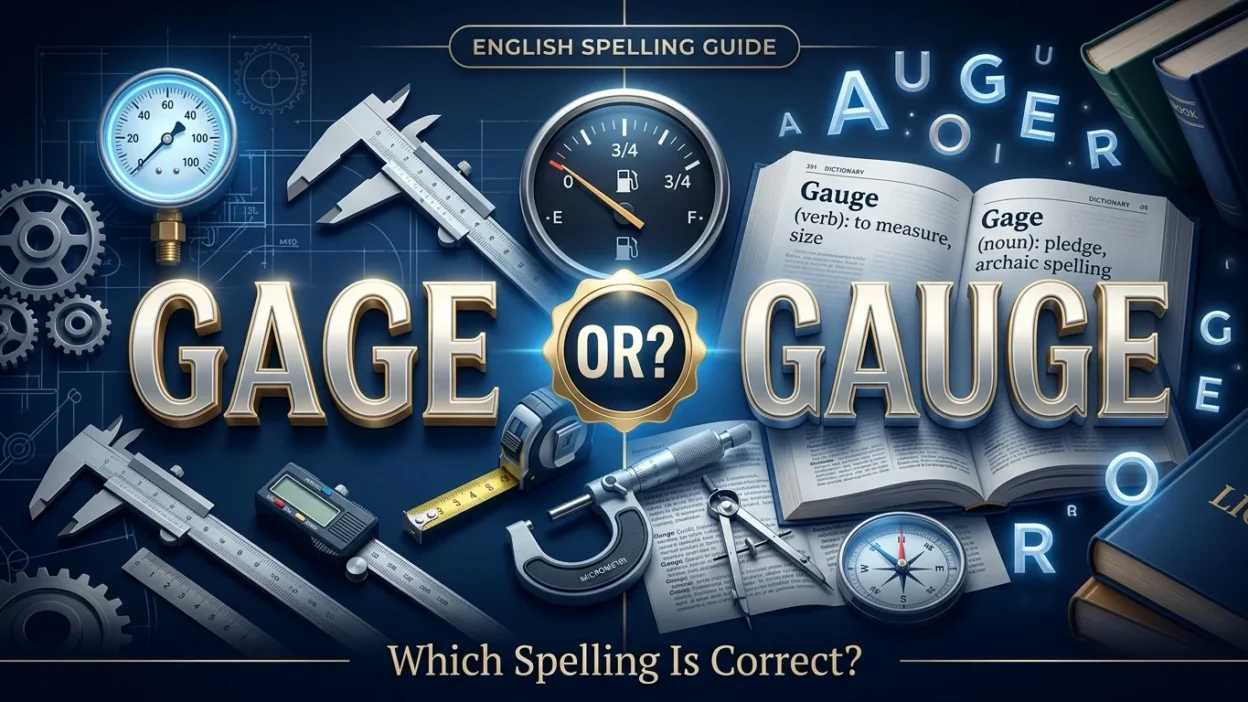
If you’ve ever hesitated over gage or gauge, you’re certainly not alone. These two spellings look different, but they can refer to the same idea in many contexts. The confusion becomes even greater because one spelling is much more common in modern English, while the other still appears in specific technical and historical uses.
The good news is that both “gage” and “gauge” are legitimate English words. In most everyday writing, gauge is the preferred spelling, especially when you mean a device used for measurement or the act of estimating something. Gage, however, remains valid in certain specialized contexts and as an alternative spelling.
Quick Answer
Gauge is the standard and much more common spelling in modern English.
Gage is also a correct word, but it is less common and is mainly found in specialized technical contexts, proper names, historical expressions, and some American usage.
For most general writing, choose gauge.
- Gauge: Standard and widely preferred spelling.
- Gage: Alternative spelling used in specific contexts.
- Gauge: Can be a noun, verb, or adjective-related term.
- Gage: Commonly appears in technical terminology and names.
What Does “Gauge” Mean?
The word gauge has several related meanings. As a noun, it can refer to an instrument used to measure something, such as pressure, thickness, or temperature.
For example:
- The mechanic checked the tire gauge.
- The pressure gauge showed a dangerous reading.
- Use a wire gauge to determine the thickness.
As a verb, gauge means to measure, assess, estimate, or judge something.
Examples:
- We need to gauge customer interest.
- She tried to gauge his reaction.
- The researchers gauged the effectiveness of the treatment.
The word can therefore describe both physical measurement and careful estimation or judgment.
What Does “Gage” Mean?
Gage can have the same basic meanings as gauge, particularly in some technical and engineering contexts.
For example:
- The technician checked the pressure gage.
- The machine uses a precision gage.
- The metal gage determines the thickness.
However, gage is much less common in general-purpose writing. If you’re writing an article, essay, email, or everyday document, gauge is normally the safer choice.
“Gage” can also appear as a surname or as part of established names and specialized terminology.
Gage vs Gauge: The Main Difference
| Feature | Gauge | Gage |
|---|---|---|
| General English | ✅ Very common | Less common |
| Measurement device | ✅ Standard | ✅ Used in some technical contexts |
| Verb meaning “assess” | ✅ Standard | Rare |
| American English | ✅ Preferred | Sometimes used technically |
| British English | ✅ Preferred | Uncommon |
| Historical usage | Common | Can appear |
| Proper names | Sometimes | Common as a surname |
The important point is that gauge is generally the preferred spelling, while gage has narrower applications.
When Should You Use “Gauge”?
Use gauge when you’re talking about measurement, estimation, assessment, or a measuring instrument.
Gauge as a Noun
A gauge can be an instrument that displays a measurement.
Examples:
- The fuel gauge is almost empty.
- The pressure gauge needs to be replaced.
- The temperature gauge indicates overheating.
- Check the tire gauge before driving.
It can also describe a standard or measurement system.
Examples:
- The wire gauge determines its thickness.
- The steel has a specific gauge.
- The needle size depends on the wire gauge.
Gauge as a Verb
As a verb, gauge means to evaluate or estimate.
Examples:
- We need to gauge public opinion.
- The teacher gauged the students’ understanding.
- The company is trying to gauge market demand.
- It is difficult to gauge his intentions.
This verbal use strongly favors gauge rather than gage.
When Can You Use “Gage”?
Gage is acceptable when it appears in a recognized technical term, established name, or context where that spelling is intentionally used.
You may encounter it in:
- Engineering terminology
- Manufacturing
- Mechanical measurement
- Historical documents
- Proper names
- Specialized American technical usage
For example, some manufacturers and technical standards may use gage in terms such as a particular type of measurement tool.
If you’re following a company’s terminology, technical specification, or industry standard, retain its established spelling rather than changing it automatically.
Gauge in American vs British English
Unlike many spelling differences between American and British English, gauge vs gage is not a straightforward US-versus-UK spelling pair.
Both American and British English commonly use gauge as the standard spelling.
For example:
American English:
- Check the pressure gauge.
- We need to gauge customer interest.
British English:
- Check the pressure gauge.
- We need to gauge customer interest.
The spelling gage can occur in American technical contexts, but it is not the general British equivalent of American “gauge.
Common Expressions With “Gauge”
Because gauge is so common, you’ll find it in many familiar expressions.
Gauge Interest
To determine how interested people are in something.
The company conducted a survey to gauge interest in the new product.
Gauge Reaction
To observe or assess someone’s response.
She waited to gauge his reaction.
Gauge the Situation
To evaluate circumstances before making a decision.
He took a few minutes to gauge the situation.
Gauge Pressure
A measuring device or reading related to pressure.
The engineer checked the gauge pressure before starting the machine.
Common Mistakes to Avoid
Mistake 1: Using “gage” Everywhere
Although gage is a legitimate spelling, replacing every occurrence of gauge with gage can make general writing look unusual.
❌ We need to gage customer interest.
✅ We need to gauge customer interest.
Mistake 2: Assuming They Are Always Interchangeable
The words can overlap in meaning, but established technical terms and proper names may specifically require one spelling.
Always check the terminology used by the relevant manufacturer, industry, organization, or publication.
Mistake 3: Confusing Gauge With “Guarantee”
Because gauge has an unusual spelling, some learners confuse it with words such as “guarantee.”
Remember:
- Gauge = measure or estimate.
- Guarantee = promise that something will happen or work.
Mistake 4: Pronouncing the “u”
The u in “gauge” is not pronounced as a separate vowel sound.
Gauge is pronounced approximately like “gage.”
Therefore, the spelling difference does not normally create a pronunciation difference.
Examples: Gauge or Gage?
Here are some practical examples to make the distinction easier.
Correct With Gauge
- The fuel gauge is broken.
- We need to gauge the audience’s response.
- Check the pressure gauge.
- The researcher tried to gauge the impact.
- The wire gauge determines its thickness.
Gage in Specialized Contexts
- The technician used a precision gage.
- The manufacturer’s manual specifies a particular gage.
- The historical document uses the spelling gage.
In ordinary writing, however, gauge remains the preferred choice.
How to Remember the Correct Spelling
If you’re unsure, remember this simple rule:
Use “gauge” for general writing.
Think about the phrase pressure gauge. If you’re measuring something or trying to assess something, gauge is almost always the spelling you want.
Use gage only when you have a specific reason, such as a technical convention, established name, or quoted terminology.
Why Is “Gauge” So Difficult to Spell?
The spelling gauge is unusual because its pronunciation doesn’t clearly reveal all of its letters. English contains many words whose spelling reflects historical influences rather than modern pronunciation.
This is why learners sometimes write:
- gage
- guage
- gauge
The most common spelling mistake is “guage.”
The correct general spelling is:
G-A-U-G-E
Not:
G-U-A-G-E
Frequently Asked Questions
Is gage or gauge correct?
Both are legitimate spellings, but gauge is the standard and much more common spelling in modern general English.
Is gage an acceptable spelling of gauge?
Yes. Gage is an accepted alternative spelling and appears in some technical, specialized, historical, and proper-name contexts.
Should I use gauge in academic writing?
Yes. Gauge is generally the better choice in academic writing when you mean to measure, assess, or estimate something.
Is gauge American or British English?
Gauge is used in both American and British English. It is not primarily a US-versus-UK spelling difference.
Does gage mean the same thing as gauge?
In many contexts, yes. Gage can refer to a measuring instrument or measurement. However, its use is much less common than gauge.
How do you pronounce gauge?
“Gauge” is pronounced approximately like “gage.” The letters “u” and “a” do not create separate vowel sounds.
Is “guage” a correct spelling?
No. Guage is a common misspelling. The correct general spelling is gauge.
What is the difference between gauge and gage in engineering?
In engineering, both forms may appear, depending on the terminology, manufacturer, or technical standard. Gauge is the more broadly recognized spelling, while gage can be used in certain specialized applications.
Summary
The choice between gage or gauge can seem complicated because both spellings exist. However, for most readers and most forms of writing, gauge is the clear choice. It can refer to a measuring instrument, a measurement standard, or the act of assessing and estimating something. It is also the spelling most readers expect in everyday, academic, business, and professional communication.
Gage is not simply a misspelling. It is a legitimate alternative that appears in certain technical, historical, and specialized contexts and can also occur in proper names. American and British English both generally favor gauge, so this pair should not be treated like straightforward regional differences such as “color” and “colour.” When in doubt, use gauge and reserve gage for contexts where that spelling is specifically established.