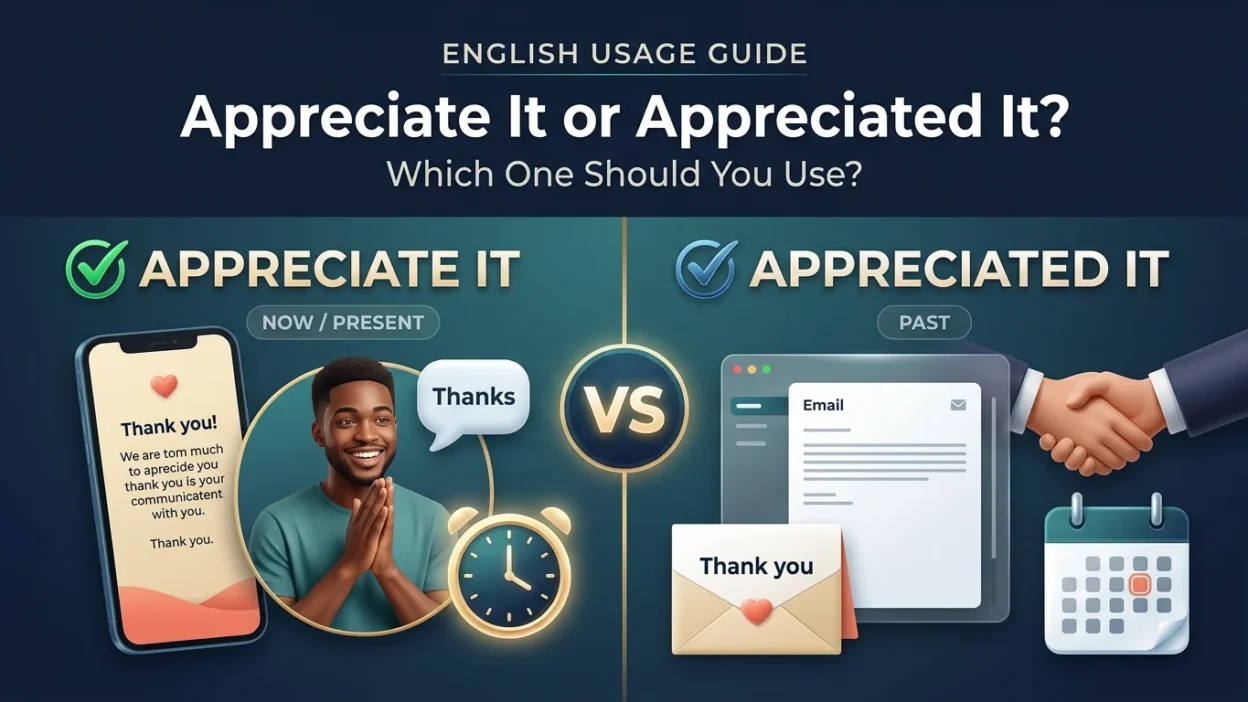
If you’ve ever wondered whether to say “appreciate it” or “appreciated it,” you’re not alone. These expressions look almost identical, but they are used in different situations. Choosing the right one depends mainly on when the appreciation is taking place and whether you’re talking about the present or the past.
The good news is that both expressions are grammatically correct. “Appreciate it” is commonly used when you are thanking someone for something they have just done or are doing, while “appreciated it” refers to appreciation in the past. Understanding this small difference can make your emails, messages, conversations, and professional communication sound much more natural.
Quick Answer
“Appreciate it” is generally used for something you appreciate now or for a recent favor, while “appreciated it” is used when talking about something you appreciated in the past.
- I appreciate it. → Present appreciation
- I appreciated it. → Past appreciation
For example: - “Thanks for helping me. I appreciate it.”
- “You helped me yesterday, and I appreciated it.”
Both are correct; the appropriate choice depends on the time and context.
What Does “Appreciate It” Mean?
“Appreciate it” is a common way to express gratitude or recognition for someone’s help, kindness, effort, or consideration.
It is essentially a shortened form of:
“I appreciate it.”
The word appreciate is in the present tense, so it communicates that you feel grateful now.
For example:
- “Thanks for your help. I appreciate it.”
- “Could you send me the document? I’d really appreciate it.”
- “Thanks for taking care of this. I appreciate it.”
The expression is extremely common in everyday conversation and professional communication.
What Does “Appreciated It” Mean?
“Appreciated it” uses the past tense of appreciate. It means that you felt grateful for something at a particular time in the past.
Examples include:
- “You helped me with the project, and I appreciated it.”
- “She gave me some useful advice, and I really appreciated it.”
- “Thanks for checking on me yesterday. I appreciated it.”
Because appreciated is past tense, it normally describes an earlier experience rather than your current feeling.
Appreciate It vs Appreciated It: Comparison Table
| Expression | Tense | Meaning | Typical Use |
|---|---|---|---|
| I appreciate it | Present | I am grateful for it now | Current or recent help |
| I appreciated it | Past | I was grateful for it | Past help or experience |
| I’d appreciate it | Conditional | I would be grateful | Requesting a favor |
| I really appreciate it | Present | Strong current gratitude | Thanking someone |
| I really appreciated it | Past | Strong past gratitude | Referring to earlier help |
The important distinction is time. If the gratitude is current, use appreciate. If you’re describing gratitude you felt previously, use appreciated.
When Should You Use “I Appreciate It”?
Use “I appreciate it” when you want to express gratitude for something that is happening now or has just happened.
For example:
- “Thanks for explaining that. I appreciate it.”
- “I appreciate it if you could send the report today.”
- “Thanks for waiting. I appreciate it.”
- “I appreciate your support.”
- “I really appreciate everything you’ve done.”
This expression is especially useful when you want to sound polite without being overly formal.
When Should You Use “I’d Appreciate It”?
A closely related expression is “I’d appreciate it.”
Here, “I’d” means “I would.” It is often used when making a polite request.
For example:
- “I’d appreciate it if you could review this document.”
- “I’d appreciate it if you could reply by Friday.”
- “I’d really appreciate it if you could help me with this task.”
This construction is particularly common in workplace emails and professional communication.
Notice the difference:
“I appreciate it.” → I am thankful.
“I’d appreciate it.” → I would be thankful if you did something.
When Should You Use “I Appreciated It”?
Use “I appreciated it” when you’re describing a past situation in which someone helped, supported, or treated you kindly.
Examples:
- “You stayed late to help me, and I appreciated it.”
- “I appreciated it when you called yesterday.”
- “Your advice was very helpful, and I appreciated it.”
- “I really appreciated it when everyone supported me.”
The expression clearly places the appreciation in the past.
Present vs Past: Simple Examples
Consider these two sentences:
“Thanks for helping me. I appreciate it.”
This means the speaker feels grateful now.
“Thanks for helping me yesterday. I appreciated it.”
This emphasizes a past event and the gratitude associated with it.
However, context can sometimes make the distinction less rigid. Someone may still say “I appreciate it” when thanking another person for something that happened moments, hours, or even days earlier because the feeling of gratitude still exists in the present.
Common Mistakes to Avoid
Using “Appreciated It” for a Current Request
❌ “Could you send me the file? I appreciated it.”
This sounds as though the file has already been sent and the appreciation happened in the past.
Better:
✅ “Could you send me the file? I’d appreciate it.”
Using “Appreciate It” When Clearly Describing the Past
❌ “You helped me last year, and I appreciate it.”
This is not necessarily grammatically wrong if you still feel grateful, but “I appreciated it” may be more appropriate when you’re specifically describing your feelings at that past time.
Better:
✅ “You helped me last year, and I really appreciated it.”
Confusing “Appreciate It” With “Appreciate You”
These expressions are related but not identical.
- I appreciate it. → I am grateful for an action or thing.
- I appreciate you. → I am grateful for you as a person and what you contribute.
For example:
“Thanks for fixing my computer. I appreciate it.”
“You always help me when I need you. I appreciate you.”
Is “Appreciate It” Formal or Informal?
“I appreciate it” is flexible and can work in both casual and professional situations.
In casual conversation:
“Thanks for picking me up. I appreciate it.”
In professional communication:
“Thank you for reviewing the document. I appreciate it.”
It sounds polite, natural, and sincere without being excessively formal.
For highly formal writing, alternatives such as “I greatly appreciate your assistance” or “Thank you for your assistance” may sometimes be more suitable.
American vs British English
There is no significant American vs British English spelling difference between appreciate and appreciated.
Both American English and British English use:
- I appreciate it.
- I appreciated it.
- I’d appreciate it.
The difference is grammatical rather than regional.
That means you can use these expressions confidently whether you’re writing for an American, British, Canadian, Australian, or international audience.
Appreciate It in Professional Emails
“I appreciate it” is particularly useful in workplace communication because it expresses gratitude clearly and naturally.
Examples:
- “Thank you for your quick response. I appreciate it.”
- “I appreciate your assistance with this matter.”
- “Thanks for reviewing the attached document. I really appreciate it.”
- “I’d appreciate it if you could confirm receipt.”
- “I appreciate your time and consideration.”
For professional writing, adding the specific thing you’re thankful for can make the message warmer and more genuine.
Instead of:
“I appreciate it.”
You could write:
“I appreciate your taking the time to review my application.”
How to Remember the Difference
A simple way to remember these expressions is to focus on the verb tense:
Appreciate = present
Appreciated = past
Think of it this way:
- Now: I appreciate it.
- Before: I appreciated it.
- Future/conditional request: I’d appreciate it.
This simple three-part pattern covers most everyday situations.
Frequently Asked Questions
Is “appreciate it” correct?
Yes. “I appreciate it” is grammatically correct and is a very common way to express gratitude for someone’s help, kindness, or effort.
Is “appreciated it” correct?
Yes. “I appreciated it” is also correct. It is the past-tense form and is normally used when referring to gratitude felt about something that happened earlier.
Should I say “I appreciate it” or “I appreciated it”?
Use “I appreciate it” when your gratitude is current. Use “I appreciated it” when you’re describing appreciation connected to a past event.
Is “I’d appreciate it” correct for a request?
Yes. “I’d appreciate it” is a polite way to make a request. For example, “I’d appreciate it if you could send the report.”
Is “I appreciate it” professional?
Yes. It is appropriate in many professional emails, messages, and conversations. It sounds polite, natural, and appreciative.
Is there a British and American difference?
No. Both British and American English use appreciate it and appreciated it. The difference is based on verb tense, not regional spelling.
Can I say “I really appreciate it”?
Absolutely. “I really appreciate it” is a natural way to emphasize your gratitude and is common in both casual and professional communication.
Can I say “I appreciated it” if I still feel grateful?
Yes. You can use “I appreciated it” when referring to your reaction to a past event, even if you continue to feel grateful. Context determines the most natural choice.
Summary
The difference between “appreciate it” and “appreciated it” is primarily a matter of verb tense. “I appreciate it” expresses present gratitude and is commonly used when thanking someone for current or recent help. “I appreciated it” describes gratitude connected to something that happened in the past.
Both expressions are correct, natural, and widely used in English. There is no meaningful American vs British English distinction between them. If you’re making a polite request, remember the useful expression “I’d appreciate it,” which means you would be grateful if someone did something.