Confused about boys or boy’s? You’re not alone. These two forms look almost identical, but they have completely different meanings. Choosing the wrong one can make your writing appear careless, whether you’re writing an email, school assignment, social media post, or business document.
The good news is that the difference is actually very easy to remember. Once you understand what the apostrophe does, you’ll know exactly when to use boys and when to use boy’s with confidence.
Quick Answer
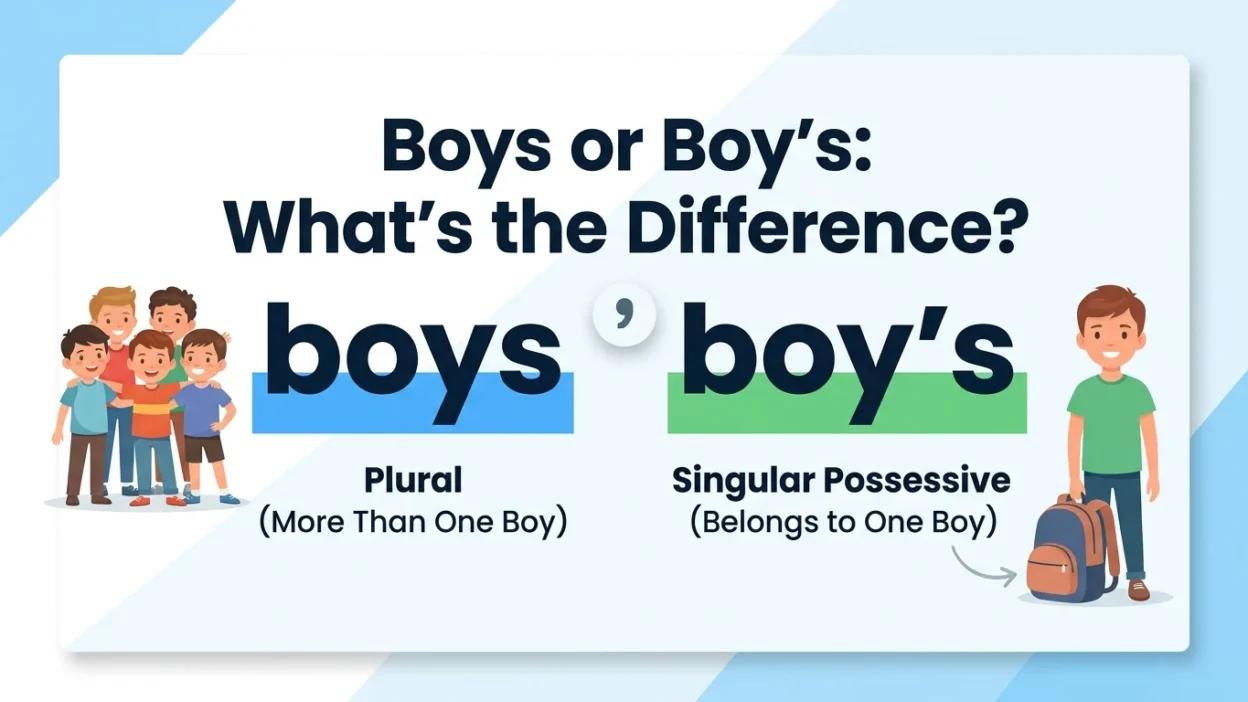
- Boys is the plural form of boy. It simply means more than one boy.
- The boys are playing soccer.
- Boy’s is the singular possessive form of boy. It shows that something belongs to one boy.
- The boy’s backpack is on the chair.
If you’re talking about multiple boys, use boys. If you’re showing that one boy owns something, use boy’s.
Boys vs Boy’s: What’s the Difference?
Although only an apostrophe separates these words, their meanings are completely different.
| Word | Meaning | Example |
|---|---|---|
| boys | More than one boy | The boys finished their homework. |
| boy’s | Something belongs to one boy | The boy’s bicycle is new. |
A simple way to remember this is:
- No apostrophe = plural
- Apostrophe + s = ownership by one boy
What Does “Boys” Mean?
Boys is simply the plural form of boy. It refers to two or more male children or young males.
Examples
- The boys are waiting for the school bus.
- Several boys joined the basketball team.
- The boys enjoyed the science experiment.
- Those boys live next door.
- The boys celebrated their victory together.
Notice that boys never shows ownership. It only tells you there is more than one boy.
What Does “Boy’s” Mean?
Boy’s is the singular possessive form of boy. It tells readers that something belongs to one boy.
Examples
- The boy’s hat blew away.
- I found the boy’s notebook.
- The boy’s mother arrived early.
- Everyone admired the boy’s painting.
- The boy’s room was clean.
Ask yourself this question:
Does something belong to one boy?
If the answer is yes, then boy’s is the correct choice.
What About “Boys'”?
Many learners also wonder about boys’.
This form is different from both boys and boy’s.
Boys’ is the plural possessive form. It shows that something belongs to multiple boys.
Examples
- The boys’ locker room is downstairs.
- The boys’ soccer team won the championship.
- The boys’ uniforms were washed.
- The boys’ parents attended the meeting.
Here’s the complete comparison:
| Form | Meaning | Example |
|---|---|---|
| boy | One boy | The boy smiled. |
| boys | More than one boy | The boys smiled. |
| boy’s | Belonging to one boy | The boy’s smile was bright. |
| boys’ | Belonging to several boys | The boys’ smiles were contagious. |
When Should You Use Boys?
Use boys whenever you’re talking about a group of boys without showing ownership.
Correct Examples
- The boys went camping.
- Three boys volunteered.
- The boys laughed loudly.
- Several boys entered the competition.
- All the boys wore blue uniforms.
When Should You Use Boy’s?
Use boy’s whenever something belongs to a single boy.
Correct Examples
- The boy’s shoes were muddy.
- I borrowed the boy’s pencil.
- The boy’s birthday is tomorrow.
- The boy’s dog is friendly.
- Everyone liked the boy’s speech.
Easy Trick to Remember
A quick memory trick can help.
Ask yourself:
Can I replace it with “belongs to the boy”?
If yes, write boy’s.
Example:
- The boy’s jacket = The jacket belongs to the boy.
If ownership isn’t involved, simply use boys.
Example:
- The boys are singing.
Common Mistakes
Many writers misuse apostrophes because plural words and possessive words look similar.
Here are the most common errors.
Incorrect
- The boys are outside.
Correct
- The boys are outside.
Incorrect
- The boys bicycle is red.
Correct
- The boy’s bicycle is red.
Incorrect
- The boys toys are everywhere. (when one boy owns them)
Correct
- The boy’s toys are everywhere.
Incorrect
- The boy’s are playing football.
Correct
- The boys are playing football.
Remember, apostrophes do not make words plural.
Examples in Everyday Sentences
Here are more examples to make the difference clear.
Boys
- The boys built a treehouse.
- Two boys answered correctly.
- The boys practiced every afternoon.
- The boys cleaned the classroom.
- Four boys won medals.
Boy’s
- The boy’s camera is expensive.
- The boy’s lunch is on the table.
- Everyone praised the boy’s kindness.
- The boy’s bicycle needs repair.
- I liked the boy’s drawing.
Boys’
- The boys’ classroom is on the second floor.
- The boys’ jackets were hanging by the door.
- The boys’ coach encouraged everyone.
- The boys’ science project won first prize.
- The boys’ performance impressed the audience.
Boys or Boy’s in School Writing
Students often lose marks because of apostrophe mistakes.
Before submitting your writing, check these questions:
- Am I talking about more than one boy?
- Does something belong to one boy?
- Does something belong to several boys?
Answering these questions usually makes the correct choice obvious.
Why Apostrophes Matter
A small punctuation mark can completely change a sentence.
- The boys are waiting.
- The boy’s brother is waiting.
- The boys’ brother is waiting.
Each sentence communicates a different meaning because the apostrophe changes the relationship between the words.
Using apostrophes correctly makes your writing more professional, accurate, and easier to understand.
American vs British English
There is no difference between American English and British English when using boys, boy’s, or boys’.
Both varieties follow the same grammar rules for plural nouns and possessive nouns.
Examples:
- American English: The boy’s backpack is missing.
- British English: The boy’s backpack is missing.
Likewise:
- American English: The boys are playing.
- British English: The boys are playing.
The apostrophe rules remain exactly the same in both forms of English.
Quick Comparison
| Situation | Correct Form | Example |
|---|---|---|
| One boy | boy | The boy smiled. |
| More than one boy | boys | The boys smiled. |
| Something belongs to one boy | boy’s | The boy’s shoes are new. |
| Something belongs to many boys | boys’ | The boys’ classroom is clean. |
Tips to Avoid Mistakes
- Never use an apostrophe just to make a word plural.
- Use boy’s only when one boy owns something.
- Use boys’ when several boys own something.
- Read the sentence carefully before adding an apostrophe.
- Replace the phrase with “belongs to” to test whether possession is intended.
FAQs
Is boys the plural of boy?
Yes. Boys is the regular plural form of boy and simply refers to more than one boy.
When should I use boy’s?
Use boy’s when something belongs to one boy, such as the boy’s backpack or the boy’s bicycle.
What does boys’ mean?
Boys’ is the plural possessive form. It shows ownership by multiple boys, as in the boys’ classroom.
Can boys have an apostrophe?
Yes, but only when showing possession. Use boys’ for something owned by several boys and boy’s for something owned by one boy.
Why is “the boy’s are playing” incorrect?
Because boy’s shows possession, not a plural. The correct sentence is The boys are playing.
Is there a grammar difference between American and British English?
No. Both American and British English use the same rules for boys, boy’s, and boys’.
How can I remember the difference easily?
Remember this simple rule: no apostrophe means plural, while an apostrophe usually shows ownership.
Summary
Understanding the difference between boys and boy’s is easier than it first appears. Boys simply refers to more than one boy, while boy’s shows that something belongs to one boy. If several boys own something, the correct form is boys’. Learning these three forms will help you avoid one of the most common punctuation mistakes in English.
Whenever you’re unsure, pause and ask whether you’re talking about a group or showing ownership. If there’s no possession, use boys. If one boy owns something, choose boy’s. If multiple boys own something, write boys’. This simple habit will make your writing clearer, more accurate, and grammatically correct.