
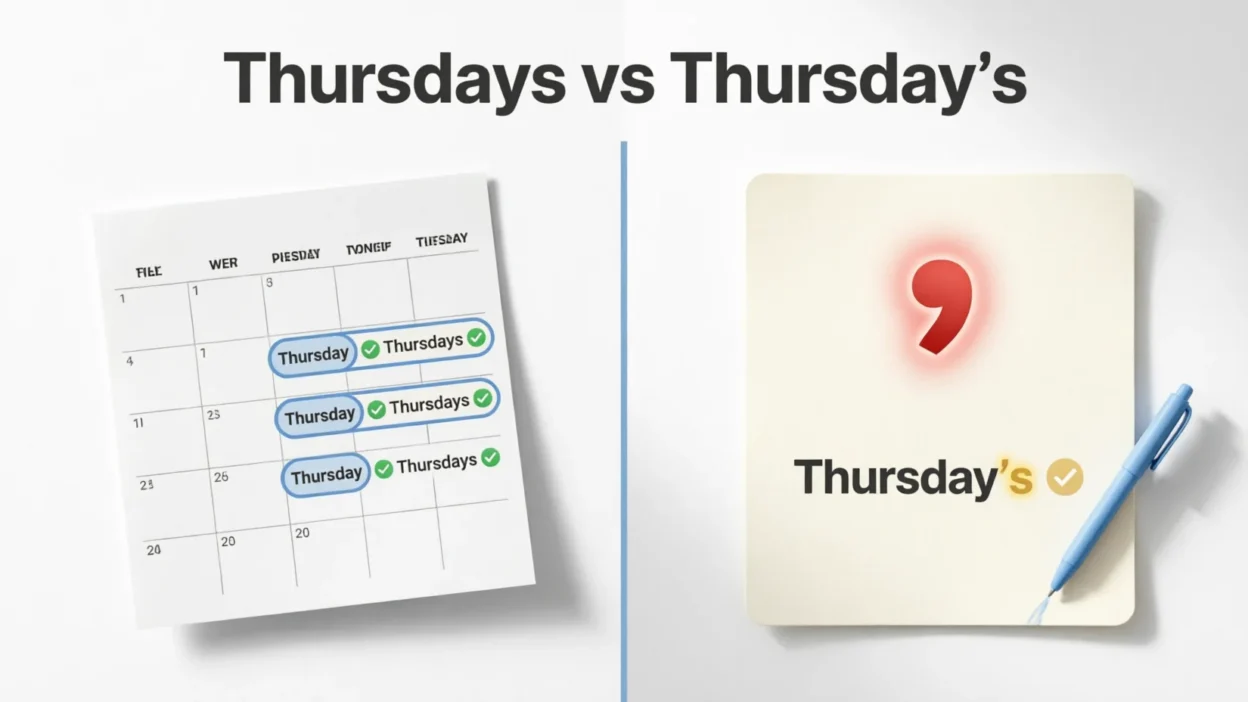
Small punctuation marks can completely change the meaning of a word in English, and apostrophes are one of the biggest sources of confusion. A common example is Thursdays vs Thursday’s. These two forms look very similar, but they serve different grammatical purposes and should not be used interchangeably.
If you’ve ever paused while writing a sentence like “See you on Thursdays” or “Thursday’s meeting was canceled,” you’re definitely not alone. Understanding the difference between Thursdays and Thursday’s can help your writing look cleaner, more professional, and grammatically correct in both casual and formal communication.
Quick Answer
- Thursdays = plural form of Thursday
- Thursday’s = possessive form of Thursday
Simple examples:
- We meet on Thursdays.
- Thursday’s presentation was successful.
What Does “Thursdays” Mean?
The word Thursdays is the plural form of Thursday.
It refers to:
More than one Thursday or repeated Thursdays.
Examples:
- I usually work late on Thursdays.
- Our classes happen every Thursdays. ❌
- Our classes happen every Thursday. ✔️
- We go to the gym on Thursdays.
In most cases, Thursdays is used when talking about recurring schedules or multiple Thursdays over time.
What Does “Thursday’s” Mean?
The word Thursday’s is the possessive form of Thursday.
It shows:
Something belongs to or is connected with Thursday.
Examples:
- Thursday’s meeting has been postponed.
- I’m preparing for Thursday’s interview.
- We discussed Thursday’s weather forecast.
The apostrophe + s indicates ownership, association, or connection.
Thursdays vs Thursday’s: Key Differences
| Word | Meaning | Usage |
|---|---|---|
| Thursdays ✅ | More than one Thursday | Plural noun |
| Thursday’s ✅ | Something connected to one Thursday | Singular possessive |
Why These Forms Are Confusing
The confusion mainly comes from apostrophes.
Many people mistakenly add apostrophes to plural words, even when no ownership is involved.
Compare:
- Thursdays = multiple Thursdays
- Thursday’s = belonging to Thursday
Because both forms sound identical when spoken, writers often rely on guesswork instead of grammar rules.
Understanding Plural and Possessive Forms
Plural Form: Thursdays
Used when discussing:
- Weekly routines
- Multiple weeks
- Recurring events
Examples:
- We have team meetings on Thursdays.
- Restaurants are crowded on Thursdays.
No apostrophe is needed because the word is simply plural.
Possessive Form: Thursday’s
Used when something belongs to or relates to Thursday.
Examples:
- Thursday’s deadline is approaching.
- Don’t forget Thursday’s appointment.
The apostrophe shows association or ownership.
What About “Thursdays’”?
There is also a plural possessive form:
Thursdays’
This means:
Something belonging to multiple Thursdays.
Although less common, it can appear in specific contexts.
Examples:
- The two Thursdays’ schedules were completely different.
- We compared several Thursdays’ attendance records.
Quick comparison:
| Form | Meaning |
|---|---|
| Thursday | One day |
| Thursdays | Multiple Thursdays |
| Thursday’s | Belonging to one Thursday |
| Thursdays’ | Belonging to multiple Thursdays |
Common Mistakes to Avoid
1. Adding Apostrophes to Plurals
One of the biggest grammar mistakes is using apostrophes unnecessarily.
❌ I work every Thursday’s.
✔️ I work every Thursdays.
✔️ I work every Thursday.
2. Forgetting the Apostrophe in Possessive Use
If something belongs to Thursday, you need an apostrophe.
❌ Thursdays meeting
✔️ Thursday’s meeting
3. Mixing Singular and Plural Forms
Remember:
- Thursday = one day
- Thursdays = recurring or multiple days
Easy Trick to Remember the Difference
A simple memory tip is:
👉 If ownership or connection exists, use an apostrophe.
Examples:
- Thursdays = many Thursdays
- Thursday’s = something related to one Thursday
Another quick reminder:
- No apostrophe = just plural
- Apostrophe = possession or connection
American vs British English
There is no difference between American and British English usage here.
American English:
- Thursdays
- Thursday’s
British English:
- Thursdays
- Thursday’s
The grammar rules remain the same in both styles of English.
Common Examples in Everyday Writing
Using “Thursdays”
- Yoga classes are held on Thursdays.
- Traffic is lighter on Thursdays than Fridays.
Using “Thursday’s”
- Thursday’s event sold out quickly.
- We finalized Thursday’s travel plans.
Using “Thursdays’”
- The two Thursdays’ schedules overlapped unexpectedly.
Why Apostrophes Matter in Writing
Correct punctuation improves:
- Readability
- Professionalism
- Reader trust
- Grammar accuracy
- Communication clarity
Even small apostrophe mistakes can distract readers and weaken the overall quality of writing.
This matters especially in:
- Academic writing
- Business communication
- Marketing content
- Professional emails
Similar Grammar Confusions
English contains many similar plural-versus-possessive challenges.
Examples:
| Incorrect Usage | Correct Usage |
|---|---|
| Mondays meeting | Monday’s meeting |
| Fridays schedule | Friday’s schedule |
| Teachers lounge | Teachers’ lounge |
| Dogs toy | Dog’s toy |
Recognizing these patterns helps strengthen grammar skills overall.
Why Correct Grammar Helps SEO
Proper grammar supports:
- Better readability
- Higher user trust
- Improved content quality
- Stronger engagement
Readers are more likely to stay on a page that feels polished and easy to understand.
Grammar accuracy also helps content appear more credible and authoritative.
Synonyms and Related Expressions
Depending on context, you may also use:
- Weekly schedule
- Thursday event
- Weekly routine
- Upcoming Thursday
- Thursday session
These alternatives can make writing feel more natural and varied.
FAQs
What is the difference between Thursdays and Thursday’s?
“Thursdays” is plural, while “Thursday’s” is possessive and shows something connected to Thursday.
Is Thursdays a plural word?
Yes, “Thursdays” refers to multiple Thursdays or recurring Thursdays.
What does Thursday’s mean?
It means something belongs to or is associated with one Thursday.
When should I use an apostrophe with Thursday?
Use an apostrophe when showing possession or connection, such as “Thursday’s meeting.”
Is there a British vs American difference?
No, both British and American English follow the same grammar rules.
What does Thursdays’ mean?
It is the plural possessive form, meaning something belongs to multiple Thursdays.
Why do people confuse these forms?
Because apostrophes and plural forms often look very similar in English writing.
Can apostrophe mistakes affect professional writing?
Yes, punctuation mistakes can reduce clarity and make writing appear less polished.
Summary
Understanding Thursdays vs Thursday’s becomes much easier when you remember the difference between plural and possessive forms. Thursdays refers to multiple Thursdays or recurring weekly events, while Thursday’s shows that something belongs to or is connected with one Thursday.
These small punctuation details may seem minor, but they play an important role in clear, professional writing. Correct apostrophe use improves readability, strengthens credibility, and helps readers instantly understand your intended meaning.

William Harved is a passionate language enthusiast and digital writer specializing in English spelling, grammar clarity, and common writing mistakes. As the primary author of Spelword.com, he focuses on helping readers understand confusing word pairs, correct spelling errors, and improve everyday communication.