
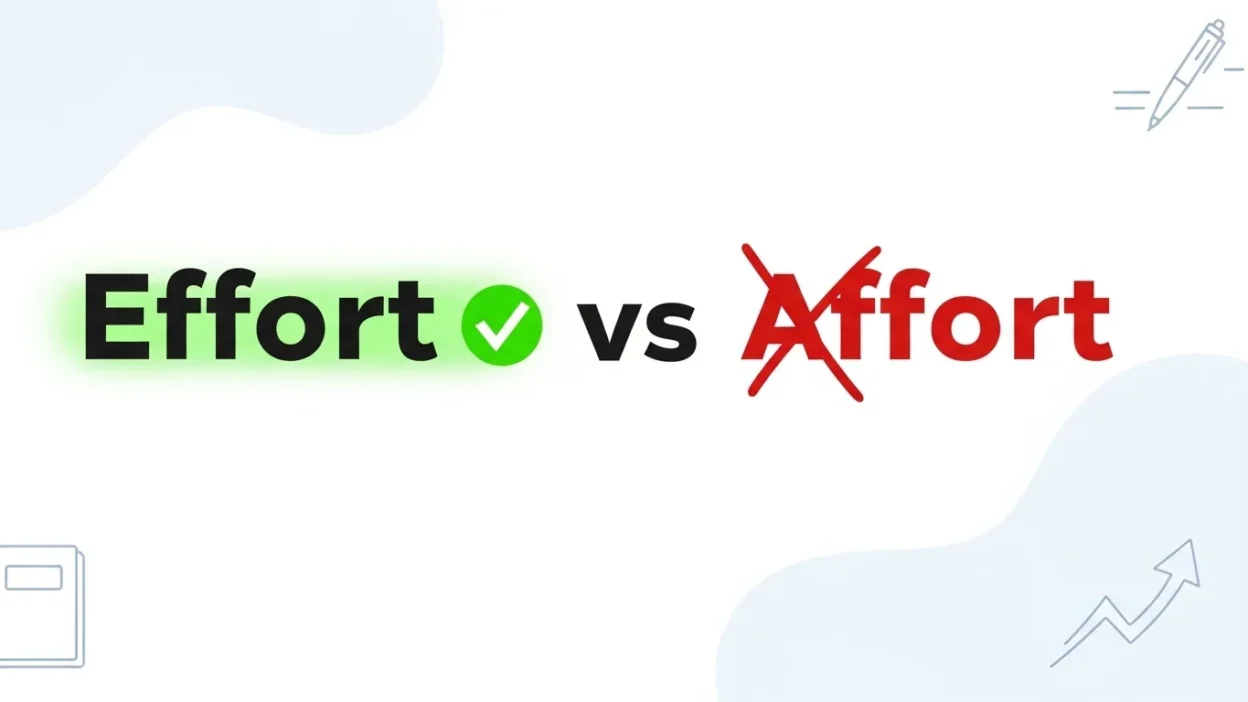
It’s easy to mix up words that sound alike, especially when you’re writing quickly. One common confusion is between effort and affort. At a glance, both may seem reasonable, but only one is actually correct in standard English.
If you’ve ever paused mid sentence wondering which spelling to use, you’re not alone. This guide will walk you through effort vs affort in a clear, friendly way so you can understand the difference, avoid mistakes, and write with confidence every time.
Quick Answer: Effort vs Affort
- Effort is the correct spelling and widely used in English.
- Affort is not a correct word and should never be used.
What Does “Effort” Mean?
The word effort is a noun that refers to the physical or mental energy you put into doing something.
Definition:
An attempt or exertion of energy to achieve a goal.
Examples:
- She made a great effort to finish the project on time.
- Learning a new language requires consistent effort.
- His effort paid off in the end.
It’s commonly used in everyday conversation, academic writing, and professional communication.
Is “Affort” a Real Word?
No, affort is not recognized as a valid English word. It is simply a misspelling of effort.
Why do people make this mistake?
- Confusion between similar sounds like “e” and “a.”
- Typing errors or lack of proofreading.
- Misunderstanding of English spelling patterns.
Even though it may look plausible, “affort” should always be corrected to “effort.”
Effort vs Affort: Key Differences
| Feature | Effort | Affort |
|---|---|---|
| Correct spelling | ✅ Yes | ❌ No |
| Meaning | Energy used to achieve something | No meaning in English |
| Usage | Formal and informal writing | Should not be used |
| Dictionary status | Recognized word | Not recognized |
Why “Effort” Is the Correct Form
The word effort comes from Old French and has been part of English for centuries. Its spelling has remained consistent over time, making it the standard and accepted form.
Unlike some words that have variations, effort has only one correct spelling. Using anything else, like affort, will be seen as an error.
Examples of “Effort” in Different Contexts
In daily life:
- He put a lot of effort into improving his skills.
In education:
- Success depends on both talent and effort.
In the workplace:
- The team’s effort led to a successful launch.
In personal development:
- Any meaningful change requires consistent effort.
The word works across many situations, making it essential for clear communication.
Common Mistakes to Avoid
Even though the difference is simple, these errors are common:
1. Writing “affort” instead of “effort”
Incorrect: She made a big affort.
Correct: She made a big effort.
2. Ignoring spellcheck suggestions
Most tools will flag affort. Don’t ignore those warnings.
3. Relying only on pronunciation
Both spellings may sound similar, but only one is correct.
4. Mixing it with similar-looking words
Words like afford can confuse spelling patterns, leading to mistakes like affort.
Easy Ways to Remember the Correct Spelling
Here are a few simple tricks:
- Think of “energy = effort”—both start with “e.”
- Remember: effort has a double “f”.
- Associate it with common phrases like “make an effort.”
Practicing these associations can help reinforce the correct spelling.
American vs British English Differences
There is no difference between American and British English in this case:
- Both use effort as the correct spelling.
- Affort is incorrect in all regions.
This makes it easier to apply the rule universally.
Why Correct Spelling Matters
Small spelling mistakes can have a big impact.
- Clarity: Correct words make your message easy to understand.
- Professionalism: Proper spelling improves your credibility.
- Engagement: Readers stay focused on your content.
- Search performance: Accurate keywords help content rank better.
Even a small typo like affort can distract readers or reduce trust.
Frequently Asked Questions (FAQs)
Is affort ever a correct word?
No, affort is not a correct English word. The correct spelling is effort.
What does effort mean?
Effort means the energy or attempt you put into achieving something.
Why do people write affort instead of effort?
This usually happens due to spelling confusion or similarity with words like afford.
Can effort be used in formal writing?
Yes, effort is appropriate for both formal and informal contexts.
How can I remember the correct spelling of effort?
Think of “energy” and “effort”—both start with “e,” and remember the double “f.”
Is there any regional difference in spelling effort?
No, both American and British English use effort the same way.
What are some synonyms for effort?
Words like attempt, endeavor, and exertion can sometimes be used depending on context.
Summary
The difference between effort vs affort is simple yet important. Effort is the correct and widely accepted word used to describe the energy or attempt put into achieving something. In contrast, affort is a common spelling mistake that should be avoided in all forms of writing.
By understanding this distinction and practicing correct usage, you can improve both your writing accuracy and confidence. Paying attention to small details like spelling helps ensure your communication is clear, professional, and effective.