If you’ve ever wondered whether to write “weeped” or “wept,” you’re not alone. English past tense verbs can be confusing, especially when they don’t follow the usual “ed” rule. It’s easy to assume that adding “ed” to weep makes sense but in this case, that instinct leads to a mistake.
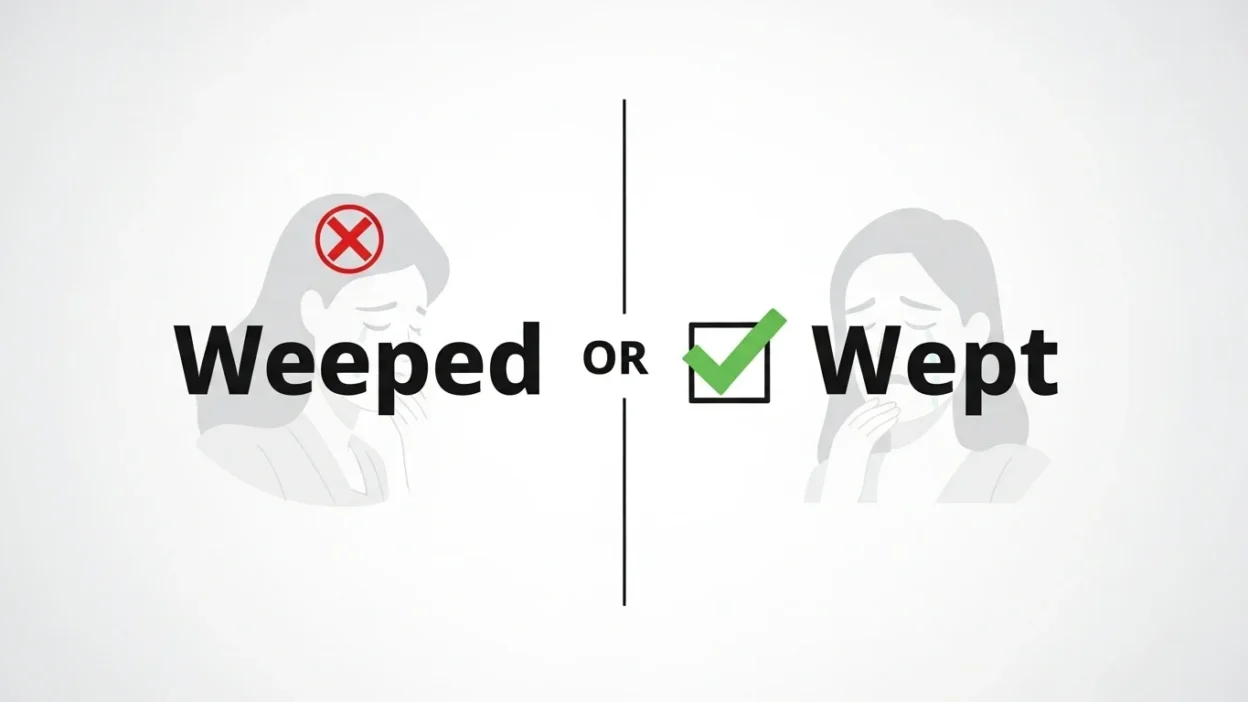
The correct past tense of weep is “wept,” not “weeped.” Understanding the difference between weeped or wept will help you write more accurately and sound more natural in both spoken and written English. In this guide, you’ll learn the correct form, why it works, examples, and how to avoid this common error.
Quick Answer: Weeped or Wept
- Wept – ✅ Correct past tense and past participle of weep
- Weeped – ❌ Incorrect spelling
✔ Correct: She wept quietly after hearing the news.
✖ Incorrect: She weeped quietly after hearing the news.
Always use “wept” when referring to the past form of weep.
What Does “Weep” Mean?
The verb weep means to cry, shed tears, or express deep sorrow or emotion. It is often used in more formal or literary contexts than the word “cry.”
Basic Meaning
Weep = to express sadness or strong emotion through tears
Examples in Present Tense
- She begins to weep when she hears the story.
- He tries not to weep in public.
- They weep for those who are suffering.
Synonyms for “Weep”
To make your writing richer, you can use:
- cry
- sob
- mourn
- lament
- grieve
- shed tears
Each carries slightly different emotional tones.
Why “Wept” Is Correct
The word wept is an irregular verb form, which means it does not follow the standard -ed pattern.
Verb Forms of “Weep”
| Form | Word |
|---|---|
| Base | weep |
| Past Tense | wept |
| Past Participle | wept |
Unlike regular verbs:
- walk → walked
- play → played
The verb weep changes completely in the past tense.
Examples with “Wept”
- She wept during the emotional scene.
- He has wept many times over the loss.
- They wept with joy at the reunion.
Why “Weeped” Is Incorrect
The spelling weeped is incorrect because it treats weep as a regular verb.
Incorrect:
- She weeped all night.
Correct:
- She wept all night.
Why This Mistake Happens
- Assuming all verbs take “-ed”
- Lack of familiarity with irregular verbs
- Influence of similar regular verbs
But in standard English, weeped is not accepted.
Weeped or Wept: Key Differences
| Feature | Weeped | Wept |
|---|---|---|
| Spelling | Incorrect | Correct |
| Grammar Type | Regular (wrong assumption) | Irregular verb |
| Meaning | None | Past of “weep” |
| Usage | Error | Standard English |
| Recommended Use | ✖ Avoid | ✔ Always use |
The correct choice is always wept.
Examples of “Wept” in Different Contexts
Emotional Situations
- She wept after hearing the sad news.
- He wept for his lost friend.
Literature and Storytelling
- The character wept under the moonlight.
- She wept silently in the dark.
Joyful Moments
- They wept with happiness at the reunion.
- The parents wept with pride.
Formal Writing
- Witnesses wept during the ceremony.
- The audience wept at the powerful performance.
These examples show how wept is used across emotional and expressive contexts.
Common Mistakes with Weeped or Wept
Mistake 1: Adding “-ed” Automatically
❌ weeped
✔ wept
Mistake 2: Confusing with Regular Verbs
Writers assume all verbs follow the same pattern.
Mistake 3: Avoiding the Word Entirely
Some people avoid “weep” and use “cry” instead due to uncertainty.
Mistake 4: Mixing Verb Forms
❌ She has weeped.
✔ She has wept.
Why People Confuse These Forms
1. Irregular Verb Patterns
English has many irregular verbs that don’t follow consistent rules.
2. Limited Exposure
“Weep” is less common in everyday conversation than “cry.”
3. Overgeneralization
Writers apply the -ed rule to all verbs.
4. Pronunciation Simplicity
“Weeped” may sound acceptable to some ears, even though it’s incorrect.
American vs British English
The verb forms weep → wept → wept are the same in both American and British English.
Examples:
American English:
- She wept after the speech.
British English:
- She wept after the speech.
There are no spelling differences for this verb.
Related Irregular Verbs
Learning similar verbs can help you remember the pattern.
| Base | Past | Past Participle |
|---|---|---|
| keep | kept | kept |
| sleep | slept | slept |
| feel | felt | felt |
These follow a similar pattern to weep → wept.
Tips to Remember the Correct Form
1. Memorize Common Irregular Verbs
Practice frequently used ones like wept, kept, slept.
2. Use a Memory Trick
Think:
“Weep becomes wept, just like keep becomes kept.”
3. Read More Literature
You’ll often see wept in books and formal writing.
4. Avoid Guessing
If unsure, check a dictionary or grammar tool.
FAQs About Weeped or Wept
1. Is “weeped” a real word?
No. Weeped is not correct in standard English.
2. Which is correct: weeped or wept?
The correct form is wept.
3. What does “wept” mean?
It means cried or expressed emotion through tears.
4. Is “wept” formal or informal?
It is slightly more formal or literary than “cried.”
5. Can “wept” be used in modern English?
Yes, especially in writing, storytelling, and emotional contexts.
6. Is there a difference between American and British English?
No. Both use wept.
7. What is the past participle of “weep”?
The past participle is wept.
8. What are similar verbs to “weep”?
Examples include keep → kept and sleep → slept.
Summary
The difference between weeped or wept is simple but important. Wept is the correct past tense of “weep,” while weeped is incorrect and should never be used in proper English writing.
This confusion happens because many verbs follow the regular “-ed” pattern, but weep is an irregular verb. Once you recognize this pattern and practice similar verbs, it becomes much easier to remember the correct form.