If you’ve ever paused while typing to bad or too bad, you’re definitely not alone. These phrases sound identical when spoken, which makes them easy to confuse in writing. Many English learners and native speakers accidentally use the wrong version because the words to and too are pronounced the same way.
Understanding the difference between to bad vs too bad is important because only one phrase is correct in most situations. Using the proper spelling helps your writing sound more polished, natural, and grammatically accurate in conversations, emails, school assignments, and online content.
Quick Answer
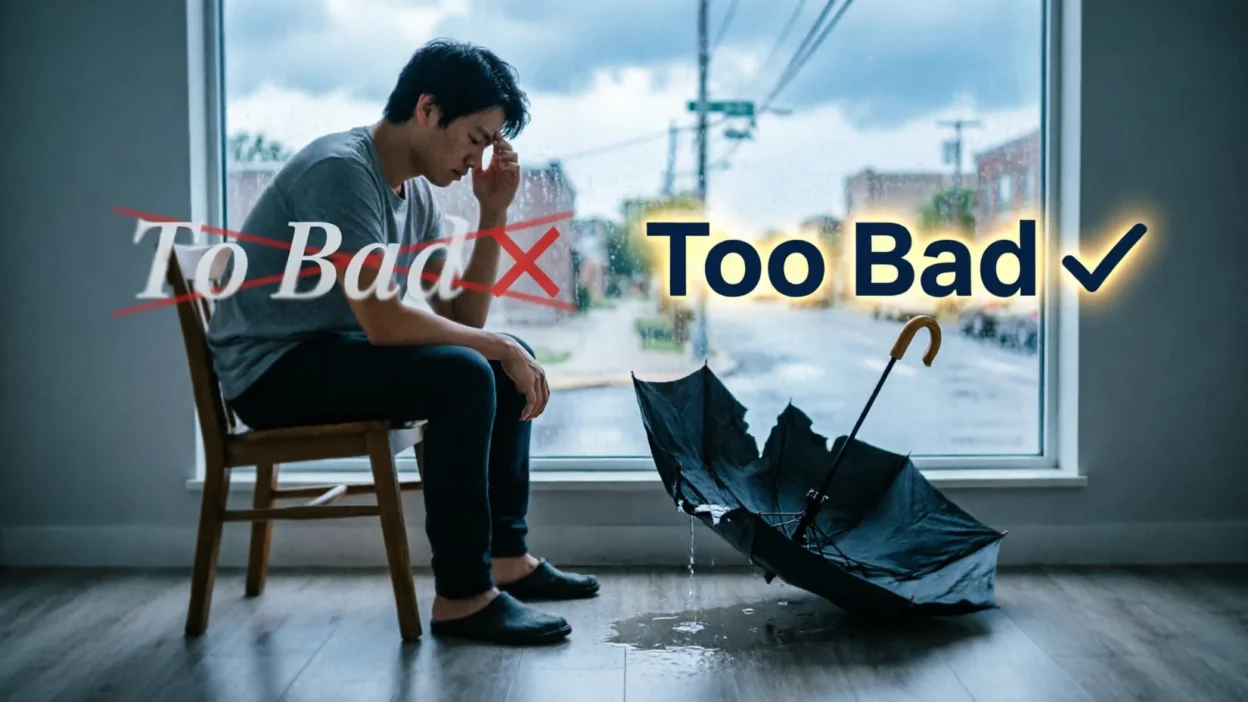
“Too bad” is the correct phrase in most contexts.
“To bad” is usually a grammar mistake unless “to” is part of a larger sentence structure.
What Does “Too Bad” Mean?
The phrase too bad is a common English expression used to show:
- Sympathy
- Disappointment
- Regret
- Mild criticism
It often means something unfortunate happened.
Examples:
- It’s too bad you missed the concert.
- That’s too bad about your car.
- It’s too bad we couldn’t meet earlier.
In casual speech, it can also express indifference depending on tone.
Example:
- You didn’t finish on time? Too bad.
Is “To Bad” Correct?
Usually, no.
The phrase to bad is generally incorrect because the word to does not work properly before the adjective bad in this expression.
Incorrect example:
- ❌ It’s to bad you couldn’t come.
Correct example:
- ✔️ It’s too bad you couldn’t come.
However, to bad may appear correctly in rare sentence structures where “to” belongs to a verb phrase.
Example:
- He went from good behavior to bad behavior.
In this case, “to” functions as a preposition, not part of the phrase too bad.
To Bad vs Too Bad: Key Differences
| Feature | Too Bad ✅ | To Bad ❌ |
|---|---|---|
| Correct common phrase | Yes | No |
| Expresses regret or disappointment | Yes | No |
| Standard English usage | Yes | Rarely |
| Common grammar mistake | No | Yes |
| Used in everyday conversation | Very common | Incorrect in most cases |
Why People Confuse “To” and “Too”
The confusion happens because:
- Both words sound exactly alike
- English contains many homophones
- Fast typing leads to mistakes
- Autocorrect may miss context errors
Understanding the Difference:
| Word | Meaning |
|---|---|
| To | Direction, connection, or purpose |
| Too | Also, excessively, or more than needed |
In the phrase too bad, the word too means “excessively” or adds emphasis to the feeling of disappointment.
Meaning of “Too” in “Too Bad”
The word too strengthens the adjective bad.
It suggests:
- Something unfortunate
- A disappointing situation
- A regrettable outcome
Similar examples:
- Too expensive
- Too difficult
- Too late
- Too noisy
So:
- Too + adjective = emphasis
That’s why too bad is grammatically correct.
Common Uses of “Too Bad”
1. Expressing Sympathy
Used when reacting kindly to unfortunate news.
Example:
- That’s too bad your trip was canceled.
2. Showing Disappointment
Used when something unfortunate happens.
Example:
- It’s too bad the weather ruined the picnic.
3. Casual Dismissal
Sometimes used in a blunt or sarcastic way.
Example:
- You forgot your ticket? Too bad.
Tone matters greatly in these situations.
Common Mistakes to Avoid
1. Writing “To Bad” Automatically
This is one of the most common homophone mistakes in English.
2. Forgetting That “Too” Adds Emphasis
Remember:
- Too = extra emphasis
- To = direction or connection
3. Depending Only on Pronunciation
Because both words sound identical, relying on speech alone can lead to spelling errors.
Easy Trick to Remember the Correct Phrase
A helpful memory tip is:
👉 “Too” has an extra “o,” just like it adds extra emphasis.
Since the phrase expresses stronger emotion or emphasis, the correct word is too.
Another easy reminder:
- Too = also or excessively
- To = direction
American vs British English
There is no difference between American and British English here.
American English:
- Too bad ✅
British English:
- Too bad ✅
Both forms of English use the same phrase and spelling.
Examples of “Too Bad” in Sentences
Everyday Conversation
- It’s too bad you couldn’t join us.
- That’s too bad about the game.
Professional Situations
- It’s too bad the meeting had to be postponed.
- The delay was too bad for customer satisfaction.
Informal Responses
- You lost your keys again? Too bad.
Similar Common Word Confusions
English contains many confusing homophones like this pair.
Examples:
| Incorrect | Correct |
|---|---|
| To much | Too much |
| To late | Too late |
| To expensive | Too expensive |
| To bad | Too bad |
| To many | Too many |
Recognizing these patterns improves overall grammar and writing confidence.
Synonyms and Related Expressions
Depending on context, you could also say:
- What a shame
- Unfortunately
- That’s unfortunate
- Regrettably
- Sadly
- That’s disappointing
These alternatives help vary tone and style naturally.
Why Correct Grammar Matters
Using the correct phrase improves:
- Writing professionalism
- Reader trust
- Communication clarity
- SEO quality
- Academic accuracy
Small grammar mistakes can distract readers and reduce confidence in your writing.
For bloggers, students, businesses, and professionals, proper grammar creates a stronger impression.
Why “Too Bad” Matters in SEO and Online Writing
Search engines and readers both favor correctly written content.
Using incorrect phrases repeatedly can:
- Reduce readability
- Hurt user experience
- Lower content quality
- Make writing appear careless
Correct grammar helps content appear more reliable and authoritative online.
FAQs
Is “to bad” ever correct?
Only in rare sentence structures where “to” functions separately, not as the phrase “too bad.”
Which phrase is correct: to bad or too bad?
“Too bad” is the correct phrase in standard English.
What does “too bad” mean?
It expresses disappointment, sympathy, regret, or sometimes indifference.
Why do people write “to bad”?
Because “to” and “too” sound the same when spoken.
Is “too bad” formal or informal?
It is mostly informal but can appear in casual professional communication.
Is there a British vs American spelling difference?
No, both American and British English use “too bad.”
How can I remember the correct spelling?
Remember that “too” has an extra “o” for extra emphasis.
Can grammar mistakes affect writing quality?
Yes, repeated grammar errors can reduce readability and professionalism.
Summary
The difference between to bad vs too bad comes down to grammar and meaning. Too bad is the correct phrase because the word too adds emphasis to the adjective bad, creating an expression of disappointment or sympathy.
While to bad may occasionally appear in unrelated sentence structures, it is incorrect in the common phrase most people intend to use. Learning these small grammar distinctions can make your writing clearer, more natural, and more professional in every type of communication.

William Harved is a passionate language enthusiast and digital writer specializing in English spelling, grammar clarity, and common writing mistakes. As the primary author of Spelword.com, he focuses on helping readers understand confusing word pairs, correct spelling errors, and improve everyday communication.