Have you ever typed “panick” and paused, wondering if something looked off? You’re not alone. This is a surprisingly common spelling confusion, especially because many English words add a “k” in certain forms (like picnic → picnicking). It’s easy to assume the same rule applies here but it doesn’t.
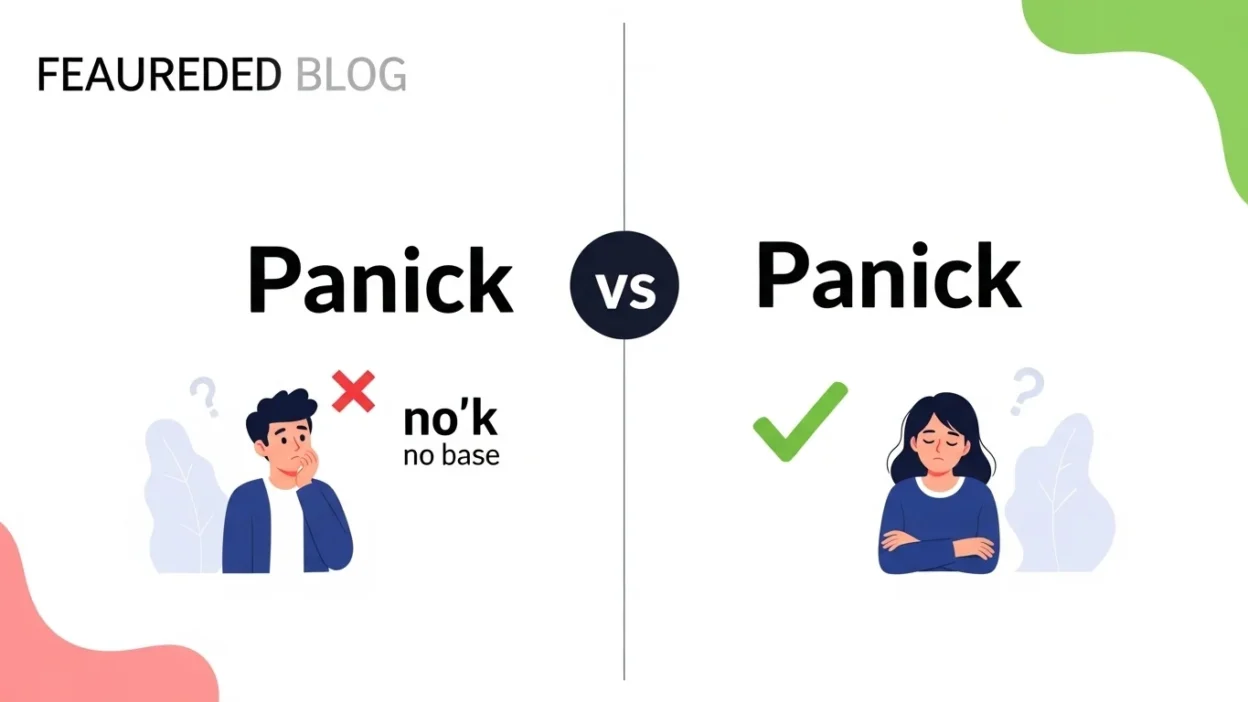
The correct spelling is “panic,” while “panick” is incorrect. Understanding the difference between panic vs panick will help you avoid simple mistakes and write with more confidence in both casual and professional settings. In this guide, you’ll learn the correct usage, grammar rules, examples, and tips to remember the right form every time.
Quick Answer: Panic vs Panick
- Panic – ✅ Correct spelling; refers to sudden fear or anxiety
- Panick – ❌ Incorrect spelling; not a valid English word
✔ Correct: Don’t panic during an emergency.
✖ Incorrect: Don’t panick during an emergency.
Always use “panic” in standard English writing.
What Does “Panic” Mean?
The word panic can function as both a noun and a verb, making it very versatile in everyday English.
Basic Meaning
Panic = a sudden feeling of fear, anxiety, or loss of control.
As a Noun
When used as a noun, panic describes the feeling itself.
Examples:
- A sense of panic spread through the crowd.
- She felt sudden panic before the exam.
- There was widespread panic during the storm.
As a Verb
As a verb, panic means to react with fear or anxiety.
Examples:
- He started to panic when he lost his wallet.
- Don’t panic—we can fix this problem.
- She didn’t panic under pressure.
Synonyms for Panic
Using related words can improve your writing variety:
- fear
- anxiety
- alarm
- distress
- terror
- worry
- unease
These words are often used in similar emotional or situational contexts.
Why “Panick” Is Incorrect
The spelling panick is incorrect because it does not follow standard English spelling rules.
The Key Rule
The base word is panic, and it never ends with a “k” in its standard form.
Incorrect:
- I felt a sudden panick.
Correct:
- I felt a sudden panic.
Where the Confusion Comes From
The confusion arises because some related forms of the word do include a “k.”
Examples:
- panic → panicking
- panic → panicked
In these cases, the “k” is added before suffixes like -ing or -ed to maintain pronunciation.
However, the base word remains:
✔ panic
✖ panick
Panic vs Panick: Key Differences
| Feature | Panic | Panick |
|---|---|---|
| Spelling | Correct | Incorrect |
| Meaning | Fear or anxiety | None |
| Usage | Standard English | Misspelling |
| Dictionary Status | Recognized | Not recognized |
| Recommended Use | ✔ Always use | ✖ Avoid |
The correct choice is always panic.
Correct Forms of “Panic”
Understanding how the word changes in different forms helps prevent confusion.
| Form | Correct Spelling |
|---|---|
| Base | panic |
| -ing form | panicking |
| Past tense | panicked |
| Adjective | panicky |
Examples
- She is panicking about the test.
- He panicked during the interview.
- The situation made her feel panicky.
Notice how the “k” appears only when adding suffixes, not in the base word.
Examples of “Panic” in Real-Life Contexts
Everyday Situations
- Don’t panic if things don’t go as planned.
- I felt panic when I couldn’t find my phone.
Professional Settings
- The manager stayed calm and didn’t panic under pressure.
- Avoid making decisions in a state of panic.
Emergency Situations
- People began to panic during the evacuation.
- The announcement helped prevent widespread panic.
These examples show how commonly the word is used across different contexts.
Common Mistakes with Panic vs Panick
Mistake 1: Adding an Unnecessary “K”
❌ I felt panick before the exam.
✔ I felt panic before the exam.
Mistake 2: Confusing Base Word with Derived Forms
Writers see panicking or panicked and assume the base word includes a “k.”
Mistake 3: Typing Errors
Fast typing often leads to accidental extra letters.
Mistake 4: Overgeneralizing Rules
Some words require extra letters, but panic does not in its base form.
Why People Confuse Panic and Panick
1. Influence of Related Forms
Words like panicking and panicked include a “k,” causing confusion.
2. Similar Words
Other words behave differently:
- picnic → picnicking
- traffic → trafficking
This inconsistency makes English spelling tricky.
3. Pronunciation Patterns
The sound of panic may lead people to assume it ends with “k.”
4. Habitual Typing
Many writers accidentally add letters when typing quickly.
American vs British English
The spelling panic is the same in both American and British English.
Examples:
American English:
- Don’t panic during emergencies.
British English:
- Don’t panic during emergencies.
There are no spelling differences between the two versions.
Helpful Tips to Remember the Correct Spelling
1. Keep the Base Word Simple
The correct base word is:
panic (no “k”)
2. Remember the Rule
Add “k” only when adding -ing or -ed:
- panic → panicking
- panic → panicked
3. Use a Memory Trick
Think:
“Panic stays simple—no ‘k’ at the end.”
4. Double-Check Your Writing
Proofreading helps catch extra letters.
FAQs About Panic vs Panick
1. Is “panick” a real word?
No. Panick is not a correct word in English.
2. Which spelling is correct: panic or panick?
The correct spelling is panic.
3. Why does “panicking” have a “k”?
The “k” is added to maintain pronunciation when adding -ing.
4. What does panic mean?
It means sudden fear, anxiety, or loss of control.
5. Is panic a noun or a verb?
It can be both:
- Noun: a feeling of fear
- Verb: to react with fear
6. Is there a difference in British and American English?
No. Both use panic.
7. What is the past tense of panic?
The past tense is panicked.
8. How can I avoid this mistake?
Remember: no “k” in the base word—only in suffix forms.
Summary
The difference between panic vs panick is simple but important. Panic is the correct spelling, used to describe a sudden feeling of fear or anxiety, while panick is an incorrect variation that should always be avoided.
This confusion often happens because related forms like panicking and panicked include a “k,” leading writers to assume the base word does as well. However, once you understand the rule, it becomes much easier to remember the correct spelling.