It’s easy to second-guess yourself when writing words like “cancel” especially when you’ve seen variations like “cancell” floating around. Is it just a regional spelling, or is one of them actually wrong?
If you’ve ever paused to check cancell vs cancel, you’re not alone. This is a common confusion in English spelling, particularly because similar words sometimes double letters. Let’s clear it up in a simple, practical way so you can write with confidence every time.
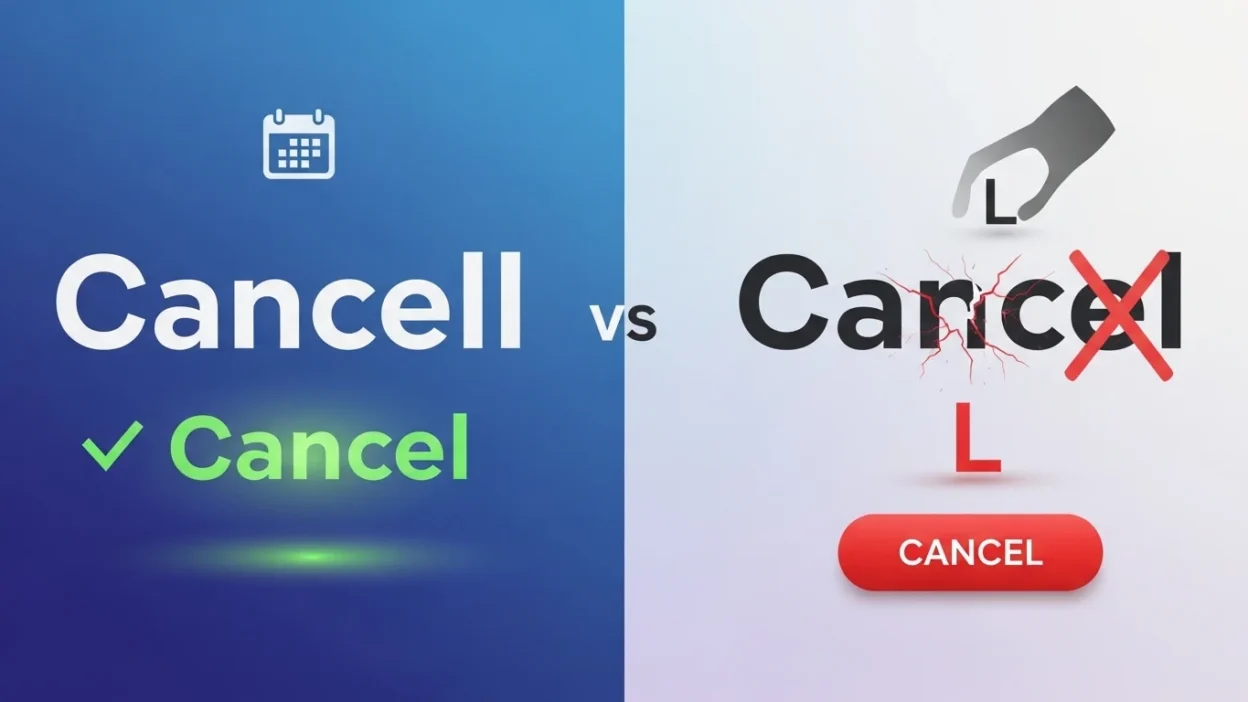
Quick Answer: Cancell vs Cancel
- ❌ Cancell = Incorrect spelling
- ✅ Cancel = Correct spelling
👉 Always use “cancel” in standard English.
What Does “Cancel” Mean?
Cancel is a verb that means to stop something from happening, end an agreement, or decide that something will not take place.
Core Meanings of Cancel
- To call off or stop an event
- To end a subscription or agreement
- To make something void or no longer valid
Examples of “Cancel” in Sentences
- They decided to cancel the meeting due to bad weather.
- I need to cancel my subscription before the next billing cycle.
- The airline had to cancel several flights.
- She chose to cancel her plans and stay home.
Common Forms of “Cancel”
- Cancel (base form)
- Cancelled / Canceled (past tense)
- Cancelling / Canceling (present participle)
These variations often create confusion, which we’ll explain below.
What Is “Cancell”?
“Cancell” is not a correct English word. It is a misspelling of “cancel” and should not be used in any standard writing.
Why Do People Write “Cancell”?
This error usually happens because:
- Writers assume the final “l” should be doubled
- Confusion with words like “travel” → “travelled”
- Influence from British vs American spelling differences
However, the base word never has two “l”s. The correct form is always cancel.
Cancell vs Cancel: Key Differences
| Feature | Cancel | Cancell |
|---|---|---|
| Correct spelling | ✅ Yes | ❌ No |
| Meaning | To stop or call off something | None (incorrect form) |
| Usage | Formal & informal writing | Should be avoided |
| Dictionary status | Recognized word | Not recognized |
| Grammar | Standard verb | Invalid spelling |
Common Mistakes to Avoid
Confusion around cancell vs cancel often comes from misunderstanding spelling patterns.
1. Adding an Extra “L”
- ❌ Cancell
- ✅ Cancel
The base form always uses one “l.”
2. Mixing Up Past Tense Forms
This is where things get tricky:
- 🇺🇸 American English: Canceled, Canceling
- 🇬🇧 British English: Cancelled, Cancelling
Both are correct depending on the region, but the base word remains cancel.
3. Overgeneralizing Spelling Rules
Some verbs double the final consonant, but not all follow the same pattern. “Cancel” is one of those exceptions in its base form.
American vs British English Differences
This is where many writers get confused, so let’s simplify it.
Base Form (Same in Both)
- Cancel ✅
Past Tense and -ing Forms
| Form | American English 🇺🇸 | British English 🇬🇧 |
|---|---|---|
| Past tense | Canceled | Cancelled |
| Present participle | Canceling | Cancelling |
👉 Key takeaway: The difference appears only when adding endings—not in the base word.
Easy Memory Trick
👉 “Cancel has one ‘L’ to start, but may double later.”
This helps you remember:
- Base form = one “l”
- Some derived forms = double “l” (depending on region)
Real-Life Usage of “Cancel”
Using “cancel” correctly is essential in everyday communication.
In Professional Contexts
- “We may need to cancel the contract.”
- “Please cancel the order if it hasn’t shipped.”
In Travel and Services
- “The airline may cancel flights due to weather.”
- “You can cancel your booking online.”
In Daily Conversations
- “Let’s cancel our plans for tonight.”
- “He forgot to cancel the subscription.”
Synonyms and Related Words
To make your writing more engaging and varied, consider these alternatives:
- Call off
- Abort
- Terminate
- Revoke
- End
- Withdraw
Example:
- “They decided to call off the event.”
- “The company will terminate the agreement.”
Why Correct Spelling Matters
Using the correct form—cancel—improves your writing quality in several ways:
- Builds credibility and trust
- Enhances clarity and professionalism
- Prevents misunderstandings
- Supports better SEO performance
Mistakes like “cancell” can:
- Make writing appear careless
- Confuse readers
- Reduce authority in formal contexts
FAQs About Cancell vs Cancel
What is the correct spelling: cancell or cancel?
“Cancel” is the correct spelling in standard English.
Is “cancell” ever correct?
No, it is always incorrect and should not be used.
Why do people spell it as “cancell”?
Because of confusion with words that double the final consonant or British spelling patterns.
Is “cancelled” correct?
Yes, it is correct in British English. American English uses “canceled.”
Does the base word ever have two “l”s?
No, the base form is always spelled “cancel.”
What is the past tense of “cancel”?
It can be “canceled” (American) or “cancelled” (British).
Can I use “cancel” in formal writing?
Yes, it is commonly used in both formal and informal contexts.
How can I remember the correct spelling?
Remember that the base word has only one “l.”
Summary: Cancell vs Cancel
The difference between cancell vs cancel is simple but important. “Cancel” is the correct spelling used to describe stopping or calling off something. It is widely accepted in both American and British English and appears in everyday communication, business writing, and formal contexts.
“Cancell,” on the other hand, is a common spelling mistake that should always be avoided. While some forms like “cancelled” include double “l,” the base word never does. Understanding this distinction helps you write more clearly and confidently.
By consistently using “cancel” correctly and being aware of regional spelling differences in its variations, you can avoid confusion and improve the overall quality of your writing.