
If you’ve ever typed “bodys” and wondered if it looked right, you’re not alone. Plural forms in English can be tricky especially when words end in “y.” It’s easy to assume you can just add an “s,” but that rule doesn’t always apply.
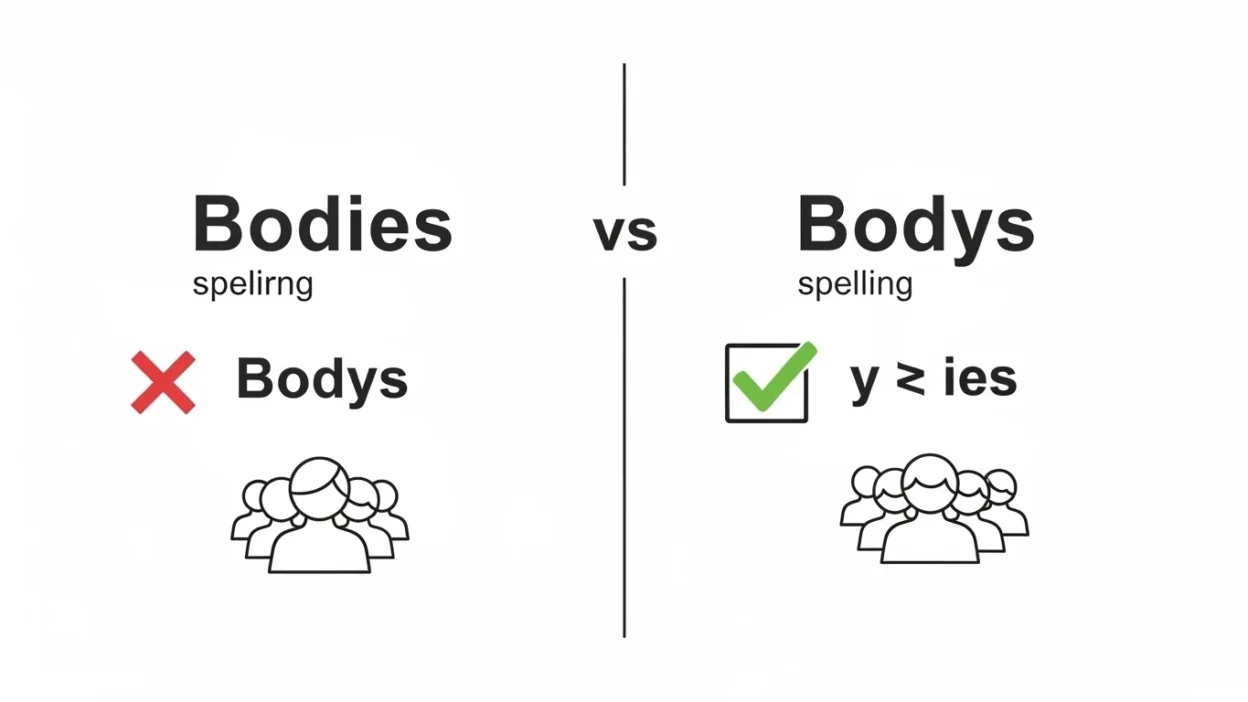
When it comes to bodies vs bodys, only one is correct. The right spelling is “bodies,” while “bodys” is a common mistake. In this guide, you’ll learn the correct plural form, why it works, examples in real sentences, and how to avoid this error in your writing.
Quick Answer: Bodies vs Bodys
- Bodies – ✅ Correct plural of body
- Bodys – ❌ Incorrect spelling
✔ Correct: Several bodies were found in the study.
✖ Incorrect: Several bodys were found in the study.
Always use “bodies” as the plural form of body.
What Does “Bodies” Mean?
The word bodies is the plural form of “body.” It refers to more than one physical structure, object, or group, depending on the context.
Basic Meaning
Bodies = more than one body
Common Uses of “Bodies”
The word bodies can have several meanings:
- Physical form – human or animal bodies
- Scientific context – celestial bodies (planets, stars)
- Organizations – governing bodies or official groups
- Objects – solid forms or structures
Examples in Sentences
- The doctor examined several bodies during the study.
- The solar system contains many celestial bodies.
- Government bodies regulate public policies.
- The lake contained floating bodies of debris.
Synonyms for “Bodies”
Depending on the context, similar words include:
- forms
- figures
- structures
- entities
- groups
- organizations
These alternatives can enhance your vocabulary and writing clarity.
Why “Bodys” Is Incorrect
The spelling bodys is incorrect because it ignores a key English grammar rule for plural nouns ending in “y.”
The Rule Explained
When a noun ends in a consonant + y, you:
➡ Change “y” to “ies” before adding the plural.
Example:
- body → bodies
Incorrect:
- body → bodys ❌
Why This Rule Exists
This change helps maintain correct pronunciation and readability in English.
Bodies vs Bodys: Key Differences
| Feature | Bodies | Bodys |
|---|---|---|
| Spelling | Correct | Incorrect |
| Meaning | Plural of body | None |
| Grammar Rule | Follows rule | Breaks rule |
| Usage | Standard English | Typo/error |
| Recommended Use | ✔ Always use | ✖ Avoid |
The correct plural form is always bodies.
Examples of “Bodies” in Different Contexts
Everyday Use
- The gym helps people strengthen their bodies.
- Several bodies were involved in the research.
Science and Astronomy
- Scientists study celestial bodies like planets and stars.
- Gravity affects all physical bodies.
Government and Organizations
- Regulatory bodies ensure safety standards.
- International bodies handle global issues.
Medical Context
- The hospital examined multiple bodies for research.
- Healthy habits support strong bodies.
These examples show how versatile and commonly used the word is.
Common Mistakes with Bodies vs Bodys
Mistake 1: Simply Adding “S”
❌ bodys
✔ bodies
Mistake 2: Ignoring the “Y to IES” Rule
Many writers forget to replace “y” with “ies.”
Mistake 3: Confusing with Words That Just Add “S”
Some words do follow a simpler rule:
- toy → toys
- boy → boys
This happens because those words end in a vowel + y, not a consonant + y.
Why People Confuse Bodies and Bodys
1. Overgeneralizing Plural Rules
Writers assume all plurals just need an “s.”
2. Fast Typing
Quick typing often leads to skipping grammar rules.
3. Lack of Grammar Awareness
Not everyone knows the “y to ies” rule.
4. Similar Words
Words like “boys” and “toys” can mislead writers into thinking “bodys” is correct.
American vs British English
The spelling bodies is the same in both American and British English.
Examples:
American English:
- The study examined several bodies.
British English:
- The study examined several bodies.
There are no regional differences for this word.
Related Grammar Rule: Plurals Ending in “Y”
Understanding this rule helps avoid similar mistakes.
Rule 1: Consonant + Y → IES
- body → bodies
- city → cities
- baby → babies
Rule 2: Vowel + Y → Add “S”
- boy → boys
- toy → toys
- key → keys
This distinction is essential for correct spelling.
Tips to Remember the Correct Form
1. Check the Letter Before “Y”
- Consonant before “y”? → change to ies
- Vowel before “y”? → just add s
2. Use a Simple Memory Trick
Think:
“Consonant + y → ies”
3. Practice with Similar Words
- body → bodies
- baby → babies
- city → cities
4. Proofread Your Writing
Always double-check plural forms before finalizing your text.
FAQs About Bodies vs Bodys
1. Is “bodys” a correct word?
No. Bodys is not correct in standard English.
2. What is the plural of “body”?
The correct plural is bodies.
3. Why does “body” become “bodies”?
Because it follows the rule: consonant + y → ies.
4. Are there exceptions to this rule?
Yes. If the word ends in a vowel + y, you just add “s” (e.g., boys, toys).
5. Is “bodies” used in formal writing?
Yes. It is the correct form in both formal and informal contexts.
6. Does British English spell it differently?
No. Both American and British English use bodies.
7. Can “bodies” refer to organizations?
Yes. It can mean groups or governing bodies.
8. How can I avoid this mistake?
Remember to replace “y” with “ies” when forming the plural.
Summary
The difference between bodies vs bodys is based on a simple but important grammar rule. Bodies is the correct plural form of “body,” while bodys is incorrect and should never be used in proper English.
This mistake is common because English plural rules can vary depending on spelling patterns. However, once you understand the “consonant + y → ies” rule, it becomes much easier to apply correctly in everyday writing.