
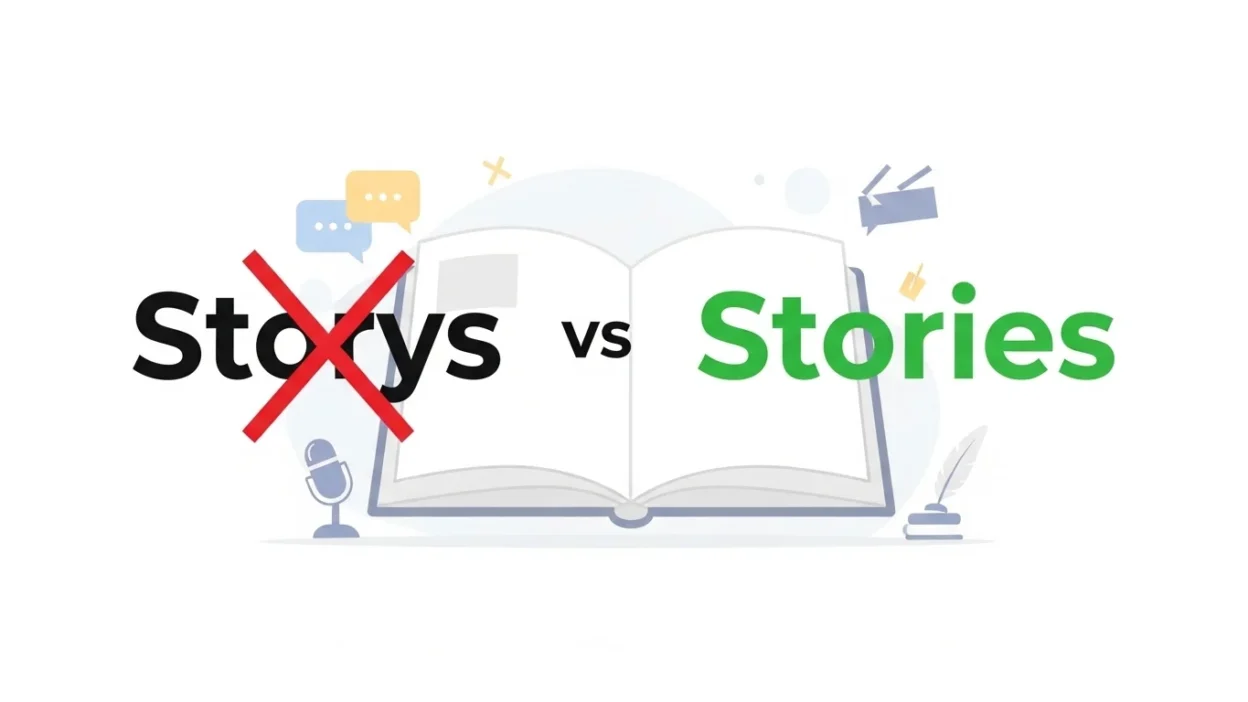
Spelling can feel tricky, especially when small changes completely alter whether a word is correct or not. If you’ve ever wondered whether to write storys or stories, you’re asking a very common and important question.
Getting this right isn’t just about grammar it helps your writing look polished, professional, and trustworthy. In this guide, you’ll learn the correct form, understand the rule behind it, see real life examples, and avoid mistakes with confidence.
Quick Answer: Storys or Stories
- ✅ Correct spelling: Stories
- ❌ Incorrect spelling: Storys
The plural of “story” is stories, not storys. This follows a standard English grammar rule for words ending in “-y.”
What Does “Stories” Mean?
The word stories is the plural form of “story.” It can have more than one meaning depending on the context.
Common Meanings:
- More than one narrative or tale
- Multiple accounts of events
- Levels or floors in a building (mainly American English)
Examples in Sentences:
- She loves reading short stories before bed.
- The news covered several stories about the event.
- The building has five stories.
Why Is “Storys” Incorrect?
The spelling storys doesn’t follow standard English plural rules. While many nouns form plurals by simply adding “-s,” words ending in “-y” often behave differently.
The Key Problem:
“Story” ends with a consonant + “y,” which means you must change the “y” before adding the plural ending.
That’s why:
- Story → Stories ✅
- Story → Storys ❌
The Rule: Consonant + Y → IES
To form the plural of words like “story,” follow this rule:
👉 If a word ends in a consonant + “y,” change the “y” to “ies.”
Examples:
- Story → Stories
- City → Cities
- Baby → Babies
- Party → Parties
Important Exception:
If the word ends in a vowel + y, simply add “-s”:
- Toy → Toys
- Key → Keys
- Boy → Boys
Understanding this rule helps you avoid writing incorrect forms like storys.
Storys or Stories: Comparison Table
| Feature | Stories ✅ | Storys ❌ |
|---|---|---|
| Correct spelling | Yes | No |
| Grammar rule | Follows “y → ies” | Breaks rule |
| Dictionary status | Valid word | Not recognized |
| Usage | Formal & informal writing | Incorrect usage |
| Clarity | Clear and professional | Confusing and incorrect |
Common Mistakes to Avoid
Even though the rule is simple, mistakes still happen. Here are the most common ones:
1. Adding “-S” Automatically
❌ I wrote many storys in school.
✅ I wrote many stories in school.
2. Forgetting the Letter Before “Y”
Always check the letter before “y.” In story, it’s “r” (a consonant), so the rule applies.
3. Misusing Apostrophes
❌ Story’s (when you mean plural)
✅ Stories (correct plural)
Use story’s only for possession:
- The story’s ending was surprising.
4. Confusing Singular and Plural
❌ This stories is interesting.
✅ This story is interesting.
✅ These stories are interesting.
More Examples of “Stories” in Context
In Everyday Language:
- Children enjoy bedtime stories.
- She shared her travel stories with us.
In Professional Writing:
- Journalists covered multiple stories during the conference.
- The report includes several success stories.
In Architecture (American English):
- The office building has ten stories.
American vs British English Differences
The spelling stories remains the same in both American and British English. However, there is a slight difference in usage when referring to buildings:
- 🇺🇸 American English: stories (for building floors)
- 🇬🇧 British English: storeys (alternative spelling for floors)
Example:
- American: The building has 12 stories.
- British: The building has 12 storeys.
For narratives or tales, both use stories universally.
Why Correct Spelling Matters
Using the correct plural form isn’t just about following rules—it impacts how your writing is perceived.
Benefits of Using “Stories” Correctly:
- Improves readability and clarity
- Builds credibility and trust
- Enhances academic and professional writing
- Helps with SEO and keyword optimization
Small mistakes like storys can distract readers and reduce the quality of your content.
Related Words and Patterns
Learning similar word patterns strengthens your grammar skills.
Words That Follow the Same Rule:
- Lady → Ladies
- Family → Families
- Country → Countries
- Industry → Industries
Related Keywords (LSI for SEO):
- plural of story
- stories meaning and examples
- grammar rules for y endings
- spelling mistakes in English
- story vs stories difference
Easy Memory Trick
Here’s a simple way to remember:
👉 “If a consonant comes before Y, change Y to IES.”
Think of it like transforming the word:
- Story → Remove “y” → Add “ies” → Stories
This quick trick helps you get it right every time.
FAQs About Storys or Stories
1. Is “storys” ever correct?
No, storys is always incorrect in standard English.
2. What is the correct plural of “story”?
The correct plural form is stories.
3. Why does “story” become “stories”?
Because it ends in a consonant + “y,” requiring “y” to change to “ies.”
4. What is the difference between “story’s” and “stories”?
- Story’s = possessive (one story)
- Stories = plural (more than one story)
5. Are there exceptions to this rule?
Yes, words ending in vowel + “y” simply add “-s” (e.g., toys, keys).
6. Is the rule the same in American and British English?
Yes, both follow the same pluralization rule.
7. Why do people make this mistake?
Because many English words form plurals by adding “-s,” leading to confusion.
8. How can I improve my grammar?
Practice regularly, read more, and review basic grammar rules like plural formation.
Summary: Storys or Stories
The confusion between storys or stories is common, but the solution is simple. Stories is the correct plural form of “story,” following the rule of changing “y” to “ies” when it comes after a consonant. On the other hand, storys is incorrect and should never be used in proper writing.
By understanding this rule and applying it consistently, you can avoid common spelling errors and improve your overall writing quality. Whether you’re writing casually or professionally, using the correct form makes your communication clearer and more effective.