
If you’ve ever written “recognization” and paused to question it, you’re not alone. Many English learners and even fluent writers get confused by this pair because both forms seem logical at first glance.
Understanding recognization vs recognition is important for clear, polished communication. One is the correct and widely accepted word, while the other is a common mistake that can weaken your writing. Let’s explore the difference in a simple, practical way.
Quick Answer: Recognization vs Recognition
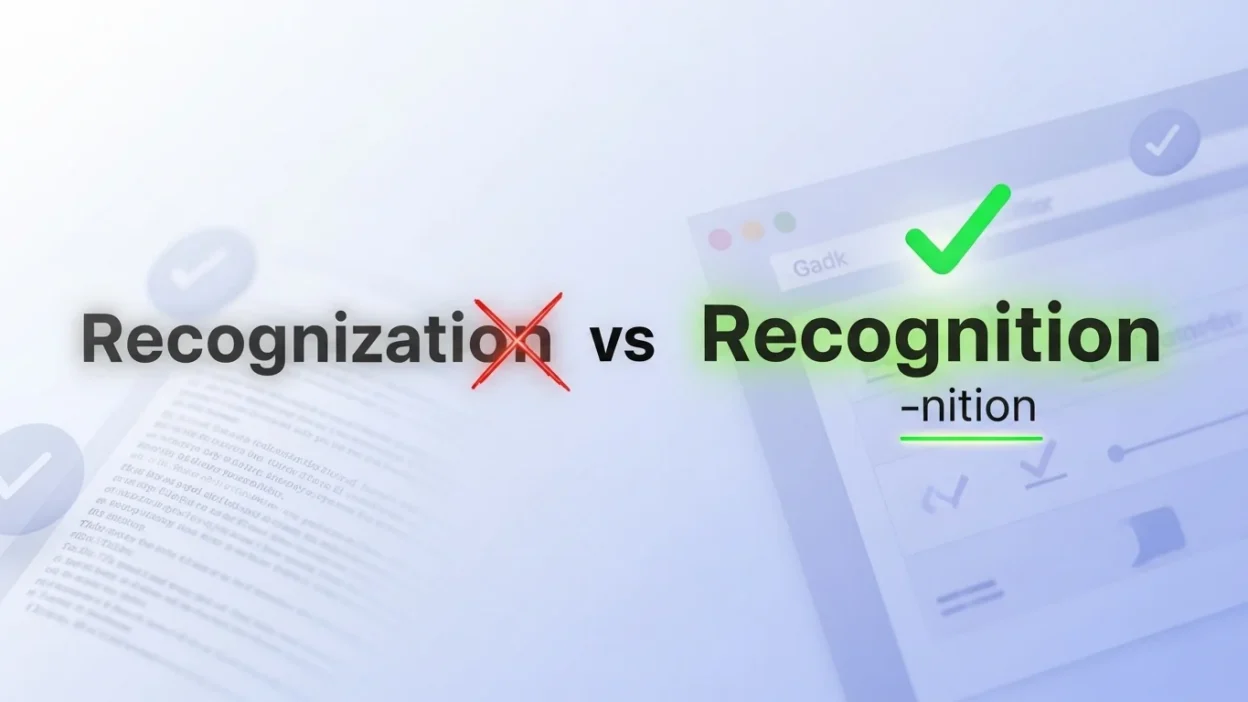
- ❌ Recognization = Incorrect and nonstandard
- ✅ Recognition = Correct spelling
👉 Always use “recognition” in both formal and informal writing.
What Does “Recognition” Mean?
Recognition is a noun that refers to the act of identifying, acknowledging, or appreciating someone or something.
Core Meanings of Recognition
- Identifying something previously known
- Acknowledging achievements or contributions
- Accepting something as valid or official
Examples of “Recognition” in Sentences
- She received recognition for her hard work.
- Facial recognition technology is widely used today.
- The award brought him international recognition.
- There was immediate recognition of the problem.
Where “Recognition” Is Commonly Used
- Workplace and professional settings
- Academic writing
- Technology (e.g., voice or image recognition)
- Social and cultural discussions
Because of its broad usage, “recognition” is a standard and essential English word.
What Is “Recognization”?
Recognization is not considered a standard English word. While it may appear logical (similar to “organization” or “realization”), it is incorrect and should be avoided.
Why Do People Use “Recognization”?
This mistake often happens because:
- Writers try to apply common word formation patterns
- Words like “realization” and “organization” influence spelling
- It feels grammatically consistent, even though it’s not correct
However, English does not follow a strict rule here—“recognition” is the only accepted form.
Recognization vs Recognition: Key Differences
| Feature | Recognition | Recognization |
|---|---|---|
| Correct spelling | ✅ Yes | ❌ No |
| Meaning | Acknowledgment or identification | None (nonstandard) |
| Usage | Formal & informal writing | Incorrect usage |
| Dictionary status | Recognized word | Not recognized |
| Professional use | Widely accepted | Should be avoided |
Common Mistakes to Avoid
Confusion between recognization vs recognition can lead to awkward or incorrect writing. Here are the most frequent mistakes:
1. Adding “-ization” Incorrectly
- ❌ Recognization
- ✅ Recognition
Not all verbs form nouns with “-ization.”
2. Overgeneralizing Patterns
Words like “modernization” and “globalization” may mislead you into thinking “recognization” is valid.
3. Using Incorrect Forms in Formal Writing
Using “recognization” in academic or professional documents can reduce credibility.
Easy Memory Trick
👉 “Recognition ends with ‘-nition,’ not ‘-zation.’”
You can also link it to similar correct words:
- Cognition
- Ignition
This pattern helps reinforce the correct spelling.
Real-Life Usage of “Recognition”
Using “recognition” correctly strengthens your writing across different contexts.
In Professional Settings
- “Employees deserve recognition for their efforts.”
- “The company gained global recognition.”
In Technology
- “Speech recognition systems are improving rapidly.”
- “The phone uses facial recognition for security.”
In Everyday Language
- “There was instant recognition when they met again.”
- “She smiled in recognition of his voice.”
American vs British English
There is a slight variation in spelling between American and British English.
American English 🇺🇸
- Recognition
British English 🇬🇧
- Recognition
In this case, both use the same spelling, unlike words such as “organization” vs “organisation.”
Why Correct Usage Matters
Using the correct form—recognition—is essential for:
- Professional credibility
- Clear communication
- Accurate academic writing
- Strong SEO performance
Using “recognization” can:
- Make your writing appear incorrect
- Confuse readers
- Reduce trust in your content
Synonyms and Related Words
To improve variety and clarity in your writing, consider these alternatives:
- Acknowledgment
- Appreciation
- Identification
- Acceptance
- Validation
- Credit
Example:
- “She received acknowledgment for her contribution.”
- “The system ensures accurate identification.”
FAQs About Recognization vs Recognition
What is the correct word: recognization or recognition?
“Recognition” is the correct and standard word in English.
Is “recognization” ever correct?
No, it is not accepted in standard English and should be avoided.
Why do people say “recognization”?
It’s usually due to confusion with similar word patterns like “organization.”
Is “recognition” used in formal writing?
Yes, it is widely used in both formal and informal contexts.
Are there spelling differences in British English?
No, both American and British English use “recognition.”
What does “recognition” mean in technology?
It refers to systems that identify patterns, such as voice or facial recognition.
Can I use “recognition” in academic writing?
Yes, it is commonly used and fully acceptable.
How can I remember the correct spelling?
Remember it ends with “-nition,” not “-zation.”
Summary: Recognization vs Recognition
The difference between recognization vs recognition is straightforward once you understand it. “Recognition” is the correct and widely accepted word used to describe acknowledgment, identification, or appreciation. It appears in everyday language, professional communication, and technical fields.
“Recognization,” on the other hand, is a nonstandard form that should not be used. Although it may seem logical, it is not recognized in proper English usage. Avoiding this mistake helps ensure your writing remains clear, credible, and professional.
Understanding and applying the correct spelling strengthens your communication and leaves a positive impression on readers. By consistently choosing “recognition,” you can write with confidence and accuracy in any context.