If you’ve ever written “puting” instead of “putting,” you’re not alone. Many English learners and even native speakers occasionally get confused about whether the word should have one “t” or two. Because the verb “put” is so short and simple, it can be tricky to know how its continuous form should be spelled.
The good news is that the rule is actually straightforward once you understand it. In modern English, “putting” is the correct spelling, while “puting” is considered a misspelling. In this guide, we’ll explain the difference between puting vs putting, show examples, highlight common mistakes, and help you remember the correct form every time.
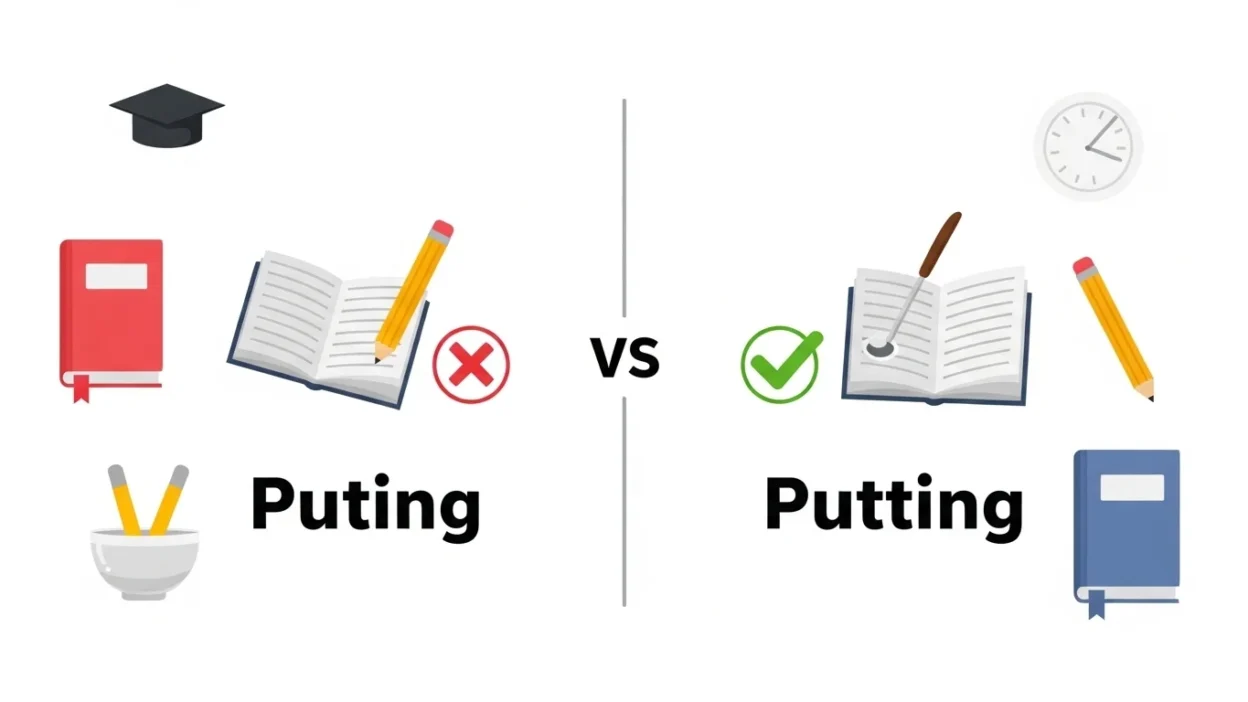
Quick Answer: Puting vs Putting
- Putting – The correct spelling. It is the present participle or gerund form of the verb “put.”
- Puting – Incorrect spelling and considered a typo or spelling mistake.
Correct example:
✔ She is putting the books on the shelf.
Incorrect example:
✖ She is puting the books on the shelf.
In short, always use “putting.”
What Does “Putting” Mean?
The word putting comes from the verb “put,” which means to place something somewhere.
When we add “-ing” to the verb put, it becomes putting, which can function as:
- A present participle (used in continuous tenses)
- A gerund (a verb acting as a noun)
Basic Meaning
Putting = the act of placing or moving something to a specific location.
Examples in Sentences
- She is putting the groceries on the table.
- I’m putting together a new project at work.
- They are putting the chairs in the conference room.
- He keeps putting off his homework.
Common Phrases Using “Putting”
You’ll often see this word in everyday expressions such as:
- Putting effort into something
- Putting together a plan
- Putting pressure on someone
- Putting ideas into action
- Putting off a task
These phrases are common in both spoken and written English.
Why “Puting” Is Incorrect
The spelling puting is simply a mistake. It happens when someone forgets the English rule about doubling consonants before adding “-ing.”
In standard English grammar, many short verbs with one syllable double their final consonant when adding -ing.
Examples:
| Base Verb | Correct -ing Form |
|---|---|
| put | putting |
| sit | sitting |
| run | running |
| stop | stopping |
| get | getting |
Because put ends with a consonant and has a short vowel sound, the “t” must be doubled before adding -ing.
That’s why putting is correct.
Puting vs Putting: Key Differences
| Feature | Putting | Puting |
|---|---|---|
| Spelling | Correct | Incorrect |
| Grammar | Present participle or gerund | Misspelling |
| Usage | Standard English writing and speech | Typo or mistake |
| Dictionaries | Listed and accepted | Not recognized |
| Recommended Use | ✔ Always use | ✖ Avoid |
So whenever you’re writing, emailing, or publishing content, remember that putting is the only correct option.
Understanding the Grammar Rule
To fully understand puting vs putting, let’s look at the grammar rule involved.
The Double Consonant Rule
When a one-syllable verb ends in:
- consonant
- vowel
- consonant
the final consonant usually doubles before adding -ing.
This is called the CVC pattern (Consonant–Vowel–Consonant).
Example pattern:
put → putting
Other examples include:
- sit → sitting
- run → running
- hop → hopping
The purpose of doubling the consonant is to maintain the short vowel sound.
Without doubling the letter, the pronunciation could change.
Examples of “Putting” in Everyday English
The word putting appears frequently in daily communication.
Everyday Situations
- I’m putting my phone in my bag.
- She’s putting the kids to bed.
- We’re putting the finishing touches on the report.
- They’re putting new policies in place.
In Business Context
- The company is putting more focus on customer satisfaction.
- Managers are putting new strategies into action.
In Academic Writing
- Researchers are putting forward new theories.
- The study is **putting emphasis on climate change.
“Putting” in Golf
Interestingly, putting also has a specific meaning in the sport of golf.
In golf, putting refers to hitting the golf ball gently on the green toward the hole using a putter.
Examples:
- He practiced putting for an hour before the tournament.
- Her putting skills improved this season.
Although this meaning is different from the verb “put,” the spelling putting remains the same.
Common Mistakes with “Putting”
Many writers accidentally make errors with this word.
Here are the most common ones.
Mistake 1: Dropping the Double “T”
❌ She is puting the files on the desk.
✔ She is putting the files on the desk.
Mistake 2: Mixing Verb Tenses
❌ He putting the groceries away yesterday.
✔ He was putting the groceries away yesterday.
Mistake 3: Confusing “Putting” with “Put”
Remember:
- Put = base verb
- Putting = continuous form
Examples:
✔ I put the keys on the table.
✔ I am putting the keys on the table.
American vs British English
Unlike some spelling differences in English (such as color vs colour), the spelling putting is the same in both American English and British English.
There is no variation between the two.
Examples
American English:
- She is putting the books away.
British English:
- She is putting the books away.
Both forms are identical, which makes the rule easier to remember.
Tips to Remember the Correct Spelling
If you struggle with puting vs putting, these simple tricks can help.
1. Think “Double the T”
Whenever you add -ing to put, remember to double the t.
Put → Put t + ing → Putting
2. Use the Short Verb Rule
Short verbs often double the final consonant.
Examples:
- run → running
- sit → sitting
- put → putting
3. Say It Out Loud
When spoken naturally, the word sounds like “put-ting.”
Hearing the double sound can remind you to write two t’s.
FAQs About Puting vs Putting
1. Is “puting” a real word?
No. Puting is not a correct English word. It is simply a misspelling of putting.
2. Which spelling is correct: puting or putting?
The correct spelling is putting, with two t’s.
3. Why does “put” become “putting”?
Because English grammar requires doubling the final consonant before adding -ing to certain short verbs.
4. Is putting used in sports?
Yes. In golf, putting refers to gently hitting the ball on the green toward the hole.
5. Does American English spell it differently?
No. Both American and British English use “putting.”
6. What tense uses “putting”?
It is commonly used in continuous tenses, such as:
- present continuous
- past continuous
Example:
- She is putting the dishes away.
7. Can “putting” be a noun?
Yes. As a gerund, it can function as a noun.
Example:
- Putting effort into learning English improves your skills.
8. Why do people misspell putting?
The mistake usually happens because writers forget to double the consonant before adding -ing.
Summary
The confusion between puting vs putting is very common, but the rule is simple. Putting is the correct spelling and represents the present participle or gerund form of the verb put, meaning to place something somewhere.
On the other hand, puting is an incorrect spelling that occurs when writers forget to double the t before adding -ing. This mistake often happens because English spelling rules can sometimes feel inconsistent, especially for short verbs.
Actionable Takeaway
Whenever you add -ing to the verb put, remember to double the “t.”
✔ put → putting
✖ put → puting
Keeping this simple rule in mind will help you write more clearly, avoid spelling mistakes, and improve your confidence in English writing.