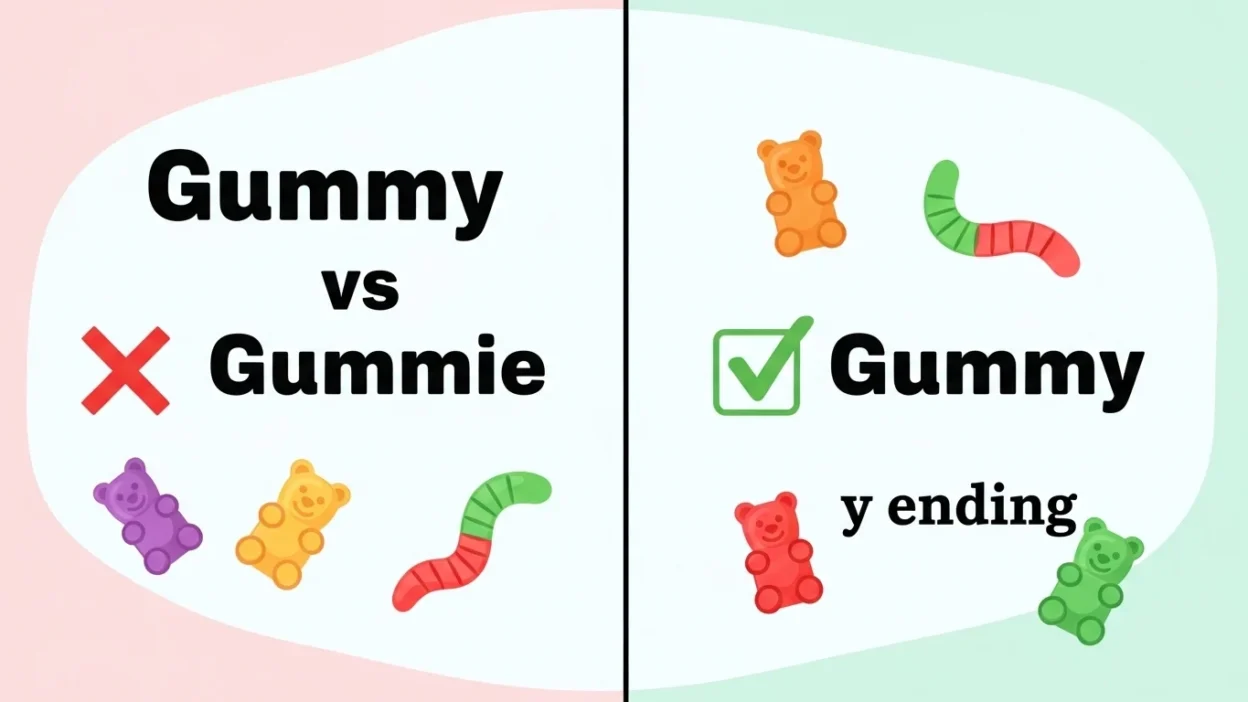
If you’ve ever hesitated between “gummy” and “gummie,” you’re not alone. This confusion is especially common when talking about candies like gummy bears or describing something soft and chewy. The two spellings look similar, but only one is widely accepted in standard English.
The correct spelling is “gummy,” while “gummie” is considered incorrect or nonstandard in most contexts. Understanding the difference between gummy vs gummie will help you write more accurately, whether you’re describing food, textures, or even dental conditions.
Quick Answer: Gummy vs Gummie
- Gummy – ✅ Correct spelling; means soft, sticky, or chewy
- Gummie – ❌ Incorrect or nonstandard spelling
✔ Correct: I love eating gummy candies.
✖ Incorrect: I love eating gummie candies.
Always use “gummy” in proper English writing.
What Does “Gummy” Mean?
The word gummy is an adjective (and sometimes a noun in informal use) that describes something soft, sticky, or chewy in texture.
Basic Meaning
Gummy = having a soft, elastic, or sticky consistency
Common Uses of “Gummy”
You’ll often see gummy used in these contexts:
- Food – gummy candies, gummy bears
- Texture – sticky or chewy surfaces
- Dental context – gummy smile (excess gum visibility)
Examples in Sentences
- These gummy candies are my favorite snack.
- The bread turned out too gummy inside.
- She has a gummy smile.
- The mixture became thick and gummy.
Synonyms for “Gummy”
Depending on context, you can use:
- chewy
- sticky
- rubbery
- soft
- elastic
- tacky
These words help describe similar textures or qualities.
Why “Gummie” Is Incorrect
The spelling gummie is generally incorrect because it does not follow standard English word formation rules.
Incorrect:
- gummie ❌
Correct:
- gummy ✔
The Grammar Rule Behind It
When forming adjectives or modifying words, English typically uses:
➡ -y endings rather than -ie endings for words like this
Examples:
- gum → gummy ✔
- fun → funny ✔
- sun → sunny ✔
Not:
- gummie ❌
- funnie ❌
- sunnie ❌
Gummy vs Gummie: Key Differences
| Feature | Gummy | Gummie |
|---|---|---|
| Spelling | Correct | Incorrect |
| Meaning | Soft, chewy, sticky | None |
| Grammar Rule | Follows standard pattern | Breaks pattern |
| Usage | Widely accepted | Nonstandard |
| Recommended Use | ✔ Always use | ✖ Avoid |
The correct choice is always gummy.
Examples of “Gummy” in Different Contexts
Food and Candy
- Kids love gummy bears and worms.
- These vitamins come in gummy form.
Cooking and Baking
- The cake turned out too gummy due to underbaking.
- Overmixing can make bread gummy.
Health and Dental Context
- He has a slightly gummy smile.
- The dentist explained how to fix gummy gums.
Everyday Use
- The glue became thick and gummy.
- The surface felt sticky and gummy.
These examples show how flexible and commonly used the word is.
Common Mistakes with Gummy vs Gummie
Mistake 1: Using “ie” Instead of “y”
❌ gummie
✔ gummy
Mistake 2: Confusing with Plural Forms
Some people think gummie is a plural form, but the correct plural is:
✔ gummies
✖ gummie
Mistake 3: Following Incorrect Patterns
Writers sometimes assume all words can end in “ie,” which is not true.
Mistake 4: Brand or Informal Influence
Occasionally, “gummie” may appear in branding or informal contexts, but it is not standard.
Why People Confuse Gummy and Gummie
1. Similar Word Patterns
Words like “cookie” or “brownie” may influence spelling choices.
2. Pronunciation
Both spellings sound the same, making it harder to detect errors.
3. Visual Habit
Writers may be more familiar with “ie” endings.
4. Lack of Rule Awareness
Not everyone knows that -y endings are standard for adjectives like this.
American vs British English
The spelling gummy is the same in both American and British English.
Examples:
American English:
- I bought gummy vitamins.
British English:
- I bought gummy sweets.
There are no spelling differences between regions.
Related Words and Forms
Understanding related forms helps reinforce correct usage.
Word Forms
- gummy (adjective)
- gummies (plural noun)
Similar Words
- funny
- sunny
- sticky
- chewy
All follow the -y ending pattern.
Tips to Remember the Correct Spelling
1. Stick with “Y,” Not “IE”
Think:
“Soft and chewy ends with Y.”
2. Use a Simple Memory Trick
“Gum becomes gummy—not gummie.”
3. Compare with Similar Words
- funny ✔ not funnie
- sunny ✔ not sunnie
4. Proofread Your Writing
Always check for small spelling errors before finalizing.
FAQs About Gummy vs Gummie
1. Is “gummie” a real word?
No. Gummie is not standard English and should be avoided.
2. Which spelling is correct?
The correct spelling is gummy.
3. What does “gummy” mean?
It means soft, sticky, or chewy in texture.
4. What is the plural of gummy?
The plural is gummies.
5. Is “gummy” used in British English?
Yes. It is used in both American and British English.
6. Why do people write “gummie”?
Because of confusion with words ending in -ie.
7. Can “gummy” describe things other than candy?
Yes. It can describe textures, food, and even smiles.
8. How can I avoid this mistake?
Remember to use “y” endings for adjectives like this.
Summary
The difference between gummy vs gummie is simple yet important. Gummy is the correct spelling, used to describe something soft, sticky, or chewy, while gummie is an incorrect or nonstandard form that should be avoided in proper writing.
This confusion often happens due to similar-looking words and pronunciation patterns. However, once you understand that -y endings are standard, it becomes much easier to remember the correct form.