Have you ever typed “equipt” and wondered if it looks slightly off? You’re not alone. This is a common spelling confusion that trips up even confident writers, especially when writing quickly in emails, assignments, or professional documents.
Understanding equipt vs equipped is important because small spelling errors can affect clarity, credibility, and even SEO performance. Once you learn the simple rule behind this word, you’ll never second guess it again.
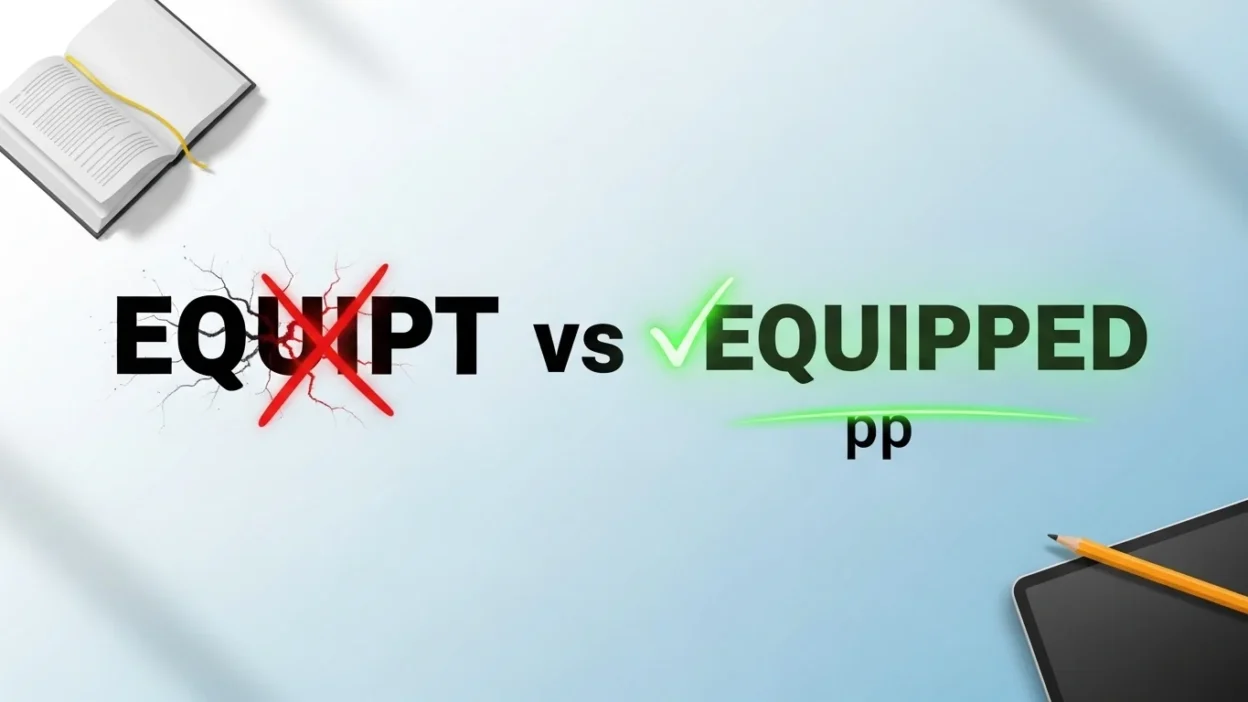
Quick Answer: Equipt vs Equipped
- ❌ Equipt = Incorrect spelling
- ✅ Equipped = Correct spelling
Always use “equipped” when referring to being prepared, supplied, or furnished with tools, skills, or resources.
What Does “Equipped” Mean?
The word “equipped” is the past tense and past participle of the verb equip. It means:
- To provide someone or something with necessary tools or resources
- To prepare for a particular purpose or situation
- To supply with skills or abilities
Examples of “Equipped” in Sentences
- The lab is fully equipped with modern technology.
- She felt well equipped to handle the interview.
- The rescue team was equipped with safety gear.
- Our classroom is equipped for digital learning.
This word is widely used in academic, professional, and everyday contexts.
What Is “Equipt”?
“Equipt” is a misspelling of “equipped.” It is not recognized in standard English and should never be used in formal or informal writing.
Why Do People Write “Equipt”?
This mistake usually happens because:
- Writers forget to double the final consonant (p)
- English spelling rules for adding -ed can be confusing
- The pronunciation sounds like “equip-t,” which misleads spelling
But remember—correct spelling always doubles the “p” before adding -ed: equipped.
Why “Equipped” Has Double “P”
Here’s a simple rule that explains it:
👉 When a verb ends in a consonant-vowel-consonant (CVC) pattern (like equip), you double the final consonant before adding -ed.
- Equip → Equipped ✅
- Stop → Stopped ✅
- Plan → Planned ✅
This rule helps maintain proper pronunciation and consistency.
Equipt vs Equipped: Key Differences
| Feature | Equipped | Equipt |
|---|---|---|
| Correct spelling | ✅ Yes | ❌ No |
| Meaning | Prepared or supplied | None |
| Grammar | Past tense of “equip” | Not a valid form |
| Usage | Formal & informal writing | Incorrect usage |
| Dictionary status | Recognized word | Not recognized |
Common Mistakes to Avoid
Even small spelling errors can weaken your writing. Here are the most common issues related to equipt vs equipped:
1. Forgetting the Double “P”
- ❌ Equiped
- ❌ Equipt
- ✅ Equipped
2. Misapplying Spelling Rules
Some verbs don’t follow the same pattern, which creates confusion:
- Equip → Equipped
- Open → Opened (no doubling)
3. Relying Only on Pronunciation
The spoken form doesn’t clearly show the double “p,” so it’s easy to miss.
Easy Memory Trick
👉 Think: “You need extra power (P) to be fully equipped.”
The double “p” represents extra strength or readiness—just like being properly equipped.
Real-Life Usage of “Equipped”
Using “equipped” correctly can make your writing more polished and professional.
In Professional Contexts
- “Our team is fully equipped to handle complex projects.”
- “The office is equipped with advanced software tools.”
In Education
- “Students should be equipped with critical thinking skills.”
In Daily Life
- “He came equipped with everything needed for camping.”
Synonyms of “Equipped”
To enhance your writing and improve SEO, consider these alternatives:
- Prepared
- Supplied
- Furnished
- Outfitted
- Ready
- Armed (figuratively)
Example:
- “She was fully prepared for the challenge.”
- “The car is outfitted with safety features.”
American vs British English
There is no difference between American and British English in this case.
- 🇺🇸 American English: Equipped
- 🇬🇧 British English: Equipped
Both follow the same spelling rule and usage.
Why Correct Spelling Matters
Correct spelling isn’t just about grammar—it directly impacts how others perceive your writing.
Benefits of Using “Equipped” Correctly
- Builds trust and credibility
- Improves readability and clarity
- Enhances professional communication
- Supports better SEO rankings
Risks of Using “Equipt”
- Makes writing look careless
- Confuses readers
- Reduces authority in academic or business contexts
FAQs About Equipt vs Equipped
1. Is “equipt” ever correct?
No, “equipt” is always incorrect. The correct spelling is “equipped.”
2. Why is there a double “p” in “equipped”?
Because of the consonant-vowel-consonant rule, the final “p” is doubled before adding “-ed.”
3. Is “equipped” formal or informal?
It can be used in both formal and informal contexts.
4. What is the base form of “equipped”?
The base form is “equip.”
5. Can I use “equipped” in resumes?
Yes, it’s commonly used to describe skills and readiness.
6. What’s the difference between “equipped” and “prepared”?
“Equipped” focuses on having tools or resources, while “prepared” emphasizes readiness.
7. Is “equiped” correct?
No, it’s also incorrect. The correct form is “equipped.”
8. How can I remember the correct spelling?
Think of needing “extra power (P)”—so you double the “p.”
Summary: Equipt vs Equipped
The difference between equipt vs equipped is simple but important. “Equipped” is the correct spelling used to describe being prepared, supplied, or ready with tools, skills, or resources. “Equipt,” on the other hand, is a common mistake that should always be avoided.
Mastering this small detail can significantly improve your writing quality. Whether you’re drafting emails, academic papers, or blog posts, using the correct spelling helps you communicate clearly and professionally.