It’s easy to hesitate when writing plural nouns in English especially when words don’t follow simple “add s” rules. One common confusion is countrys vs countries. If you’ve ever second guessed which one is correct, you’re not alone.
This guide will help you confidently choose the right spelling every time. You’ll learn the rule behind it, see real examples, avoid common mistakes, and understand how this small detail can improve your writing clarity and professionalism.
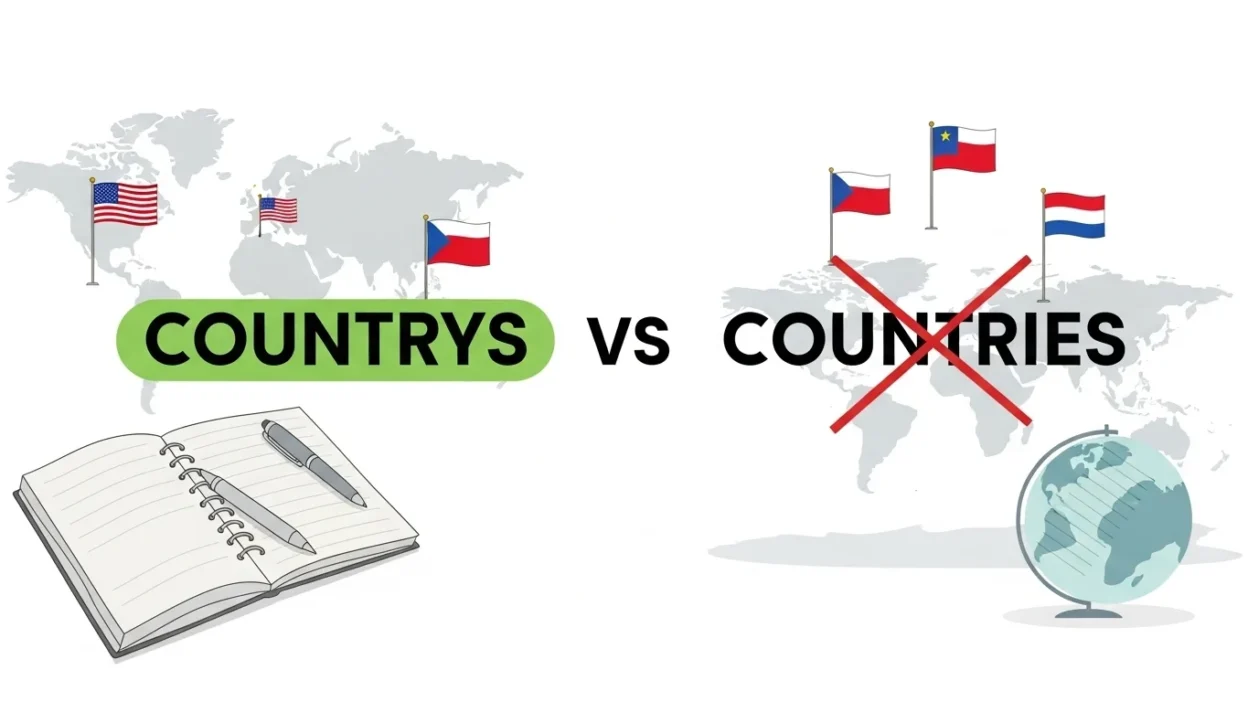
Quick Answer: Countrys vs Countries
- ✅ Correct spelling: Countries
- ❌ Incorrect spelling: Countrys
The plural of “country” is countries, not countrys. This follows a standard English rule for words ending in “-y.”
What Does “Countries” Mean?
The word countries is the plural form of “country,” which refers to a nation with its own government, territory, and identity.
Simple Meaning:
- More than one country
- Multiple nations or states
Examples in Sentences:
- Many countries are working together to solve climate issues.
- She has traveled to over 20 countries.
- Different countries have unique cultures and traditions.
Why Is “Countrys” Incorrect?
The spelling countrys ignores an important grammar rule in English. While adding “-s” works for many nouns, words ending in “-y” often follow a different pattern.
The Core Issue:
When a noun ends in a consonant + “y,” you don’t simply add “-s.” Instead, you replace the “y” with “-ies.”
That’s why:
- Country → Countries ✅
- Country → Countrys ❌
The Rule: Changing “Y” to “IES”
Here’s the rule that makes everything clear:
👉 If a word ends in a consonant + “y,” change the “y” to “ies” to make it plural.
Examples:
- City → Cities
- Baby → Babies
- Story → Stories
- Country → Countries
Exception:
If the word ends in a vowel + y, just add “-s”:
- Boy → Boys
- Toy → Toys
This distinction helps you avoid mistakes like countrys.
Countrys vs Countries: Comparison Table
| Feature | Countries ✅ | Countrys ❌ |
|---|---|---|
| Correct spelling | Yes | No |
| Grammar rule | Follows “y → ies” | Breaks rule |
| Dictionary status | Valid word | Invalid word |
| Usage | Formal & informal writing | Never correct |
| Readability | Clear and correct | Looks unprofessional |
Common Mistakes to Avoid
Understanding the rule is one thing—applying it correctly is another. Here are the most frequent mistakes people make:
1. Adding Just “-S” Automatically
❌ Many countrys are developing fast.
✅ Many countries are developing fast.
2. Forgetting the Consonant Rule
Some writers forget to check the letter before “y.” In country, the “r” is a consonant, so the rule applies.
3. Confusing Singular and Plural Forms
❌ This countries is beautiful.
✅ This country is beautiful.
4. Mixing Apostrophes Incorrectly
❌ Countrys’ economy
✅ Countries’ economy (correct plural possessive)
More Examples for Clarity
Correct Usage:
- Different countries celebrate festivals in unique ways.
- Developed countries often have advanced infrastructure.
- Neighboring countries signed a peace agreement.
Incorrect Usage:
- Several countrys participated in the summit.
- These countrys are rich in culture.
American vs British English Differences
Good news—there is no difference between American and British English when it comes to countries.
- 🇺🇸 American English: countries
- 🇬🇧 British English: countries
Both follow the same pluralization rule, making it easier to remember and apply universally.
Why This Rule Matters in Writing
Using the correct plural form isn’t just about grammar—it affects how your writing is perceived.
Benefits of Using “Countries” Correctly:
- Builds credibility and trust
- Improves readability and clarity
- Enhances academic and professional writing
- Helps with SEO and keyword accuracy
Even small spelling errors like countrys can make content appear less polished.
Related Words and Similar Patterns
Learning similar patterns strengthens your understanding and prevents future mistakes.
Words That Follow the Same Rule:
- Lady → Ladies
- Party → Parties
- Family → Families
- Industry → Industries
Related Keywords (LSI for SEO):
- plural of country
- countries meaning and examples
- spelling rules for y endings
- English grammar plural rules
- common spelling mistakes in English
Easy Memory Trick
Here’s a simple trick to remember:
👉 “If a consonant comes before Y, say goodbye to Y and add IES.”
Think of it like this:
- Country → Drop “y” → Add “ies” → Countries
This quick mental check can save you from mistakes every time.
FAQs About Countrys vs Countries
1. Is “countrys” ever correct?
No, countrys is always incorrect in standard English.
2. What is the plural of “country”?
The correct plural form is countries.
3. Why does “country” change to “countries”?
Because it ends in a consonant + “y,” which requires changing “y” to “ies.”
4. Are there exceptions to this rule?
Yes, if a word ends in a vowel + “y,” you simply add “-s” (e.g., boys, toys).
5. How do I write possessive plural of countries?
Use countries’ (e.g., countries’ economies).
6. Does pronunciation change in plural form?
Yes, slightly. “Country” becomes “countries,” adding an extra syllable.
7. Is this rule the same worldwide?
Yes, both American and British English follow the same rule.
8. How can I improve my spelling skills?
Practice regularly, read more, and use grammar tools for checking your writing.
Summary: Countrys vs Countries
The difference between countrys vs countries is simple but important. Countries is the correct plural form of “country,” following the rule of changing “y” to “ies” when preceded by a consonant. On the other hand, countrys is a common mistake that should always be avoided.
Mastering this rule not only improves your grammar but also boosts your confidence in writing. Whether you’re creating content, writing emails, or working on academic tasks, using the correct form ensures your message is clear and professional.