If you’ve ever paused while writing “possess” and wondered if it should be “posses,” you’re not alone. This is a very common spelling confusion, especially because double letters in English can feel tricky and inconsistent.
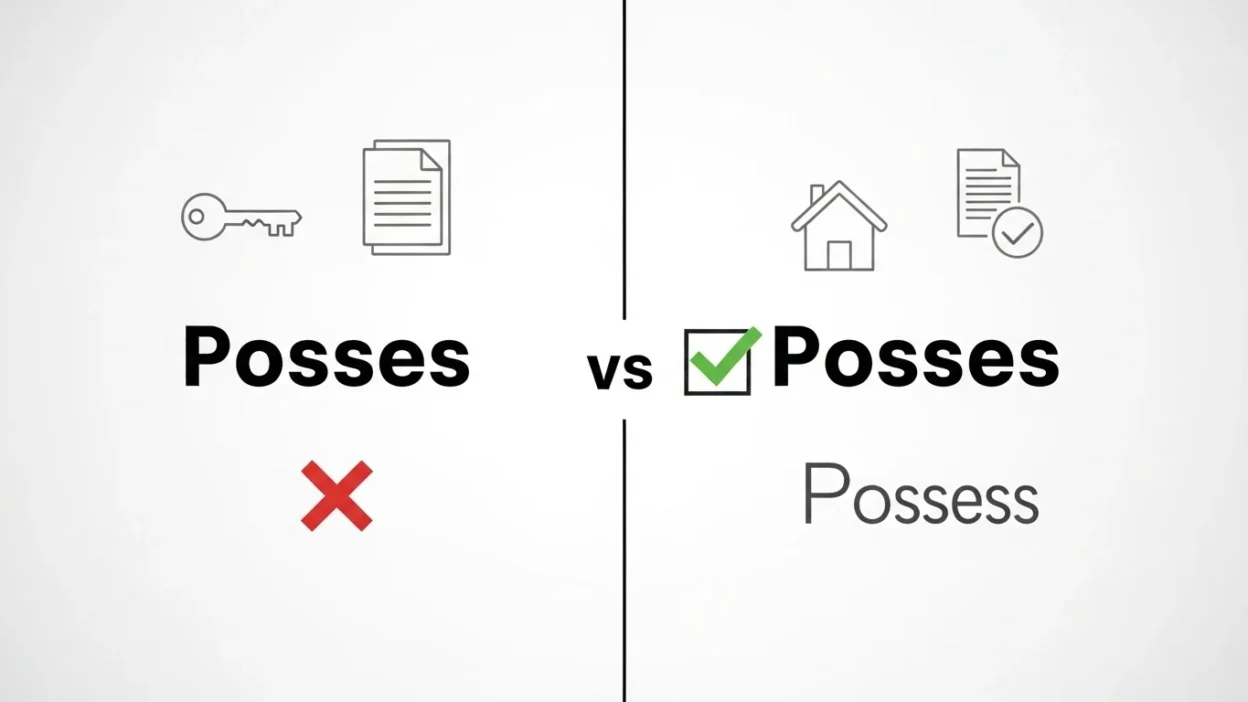
The correct spelling is “possess,” while “posses” is incorrect in standard usage. Understanding the difference between possess vs posses will help you write more accurately and confidently, whether you’re working on academic writing, emails, or everyday communication.
Quick Answer: Possess vs Posses
- Possess – ✅ Correct spelling; means to own or have something
- Posses – ❌ Incorrect spelling (often confused with “posse”)
✔ Correct: She possesses great talent.
✖ Incorrect: She posses great talent.
Always use “possess” in proper English.
What Does “Possess” Mean?
The verb possess means to have, own, or hold something, either physically or as a quality or trait.
Basic Meaning
Possess = to own, have, or control something
Common Uses of “Possess”
The word is widely used in different contexts:
- Ownership – possessing property or items
- Skills/qualities – possessing talent or intelligence
- Formal/legal language – possessing rights or authority
- Figurative meaning – being influenced or controlled by something
Examples in Sentences
- She possesses excellent communication skills.
- They possess a large piece of land.
- He possesses great determination.
- The team possesses strong leadership qualities.
Synonyms for “Possess”
To enrich your vocabulary, you can use:
- own
- have
- hold
- retain
- command
- exhibit
These alternatives fit different tones and contexts.
Why “Posses” Is Incorrect
The spelling posses is incorrect when you mean “to possess.”
Incorrect:
- She posses great skills. ❌
Correct:
- She possesses great skills. ✔
The Correct Structure
The word possess contains:
➡ Double “s” in the middle and at the end
Spelling breakdown:
- po + ss + e + ss = possess
Common Confusion: “Posses” vs “Posse”
The word posse is a real word, meaning a group of people (often in informal or historical contexts). Its plural is:
- posse → posses ✔
But this is completely different from possess.
Possess vs Posses: Key Differences
| Feature | Possess | Posses |
|---|---|---|
| Spelling | Correct | Incorrect (for verb) |
| Meaning | To own or have | None (or plural of posse) |
| Grammar Role | Verb | Not a valid verb form |
| Usage | Standard English | Error in most contexts |
| Recommended Use | ✔ Always use | ✖ Avoid |
The correct spelling for the verb is always possess.
Examples of “Possess” in Different Contexts
Personal Qualities
- She possesses a kind heart.
- He possesses strong leadership skills.
Ownership
- They possess several properties.
- The company possesses valuable assets.
Academic and Professional Use
- Students must possess critical thinking skills.
- A good leader possesses patience.
Formal Writing
- The applicant must possess relevant qualifications.
- The organization possesses legal authority.
These examples show how commonly the word appears in both formal and informal contexts.
Common Mistakes with Possess vs Posses
Mistake 1: Dropping One “S”
❌ posses
✔ possess
Mistake 2: Confusing with “Posse”
Writers mistakenly use “posses” thinking it relates to “possess.”
Mistake 3: Typing Too Quickly
Double letters are often skipped during fast typing.
Mistake 4: Incorrect Verb Forms
❌ He posses talent.
✔ He possesses talent.
Why People Confuse These Words
1. Double Letter Difficulty
Words with repeated letters are harder to remember.
2. Visual Similarity
“Possess” and “posses” look very similar.
3. Influence of Other Words
Words like “process” or “assess” can create confusion.
4. Lack of Practice
Less frequent use leads to more spelling mistakes.
American vs British English
The spelling possess is the same in both American and British English.
Examples:
American English:
- She possesses strong skills.
British English:
- She possesses strong skills.
There are no differences in spelling or meaning.
Related Words and Forms
Understanding related forms helps reinforce correct usage.
Verb Forms
- possess (base form)
- possesses (present tense)
- possessed (past tense)
- possessing (present participle)
Related Terms
- possession (noun)
- possessive (adjective)
Examples
- He possessed great courage.
- They are possessing the required skills.
- This is her personal possession.
Tips to Remember the Correct Spelling
1. Focus on Double “S”
Think:
“Possess has two sets of double S.”
2. Use a Memory Trick
“To possess something, you need extra ‘S’.”
3. Break the Word
po + ss + e + ss = possess
4. Practice Similar Words
- assess
- process
- address
These also use double consonants.
5. Proofread Carefully
Double-check words with repeated letters.
FAQs About Possess vs Posses
1. Is “posses” a correct word?
No, not as a verb. It’s incorrect when you mean “possess.”
2. What is the correct spelling?
The correct spelling is possess.
3. What does “possess” mean?
It means to own, have, or hold something.
4. Is “posses” ever correct?
Yes, only as the plural of posse, not as a verb.
5. How do I remember the spelling?
Remember: possess has double ‘s’ twice.
6. Is there a difference in British English?
No. Both use possess.
7. What is the past tense of possess?
The past tense is possessed.
8. What are similar words?
Words like assess, process, and address follow similar patterns.
Summary
The difference between possess vs posses is simple but important. Possess is the correct spelling, meaning to own or have something, while posses is incorrect when used as a verb and should be avoided in standard English writing.
This mistake often happens due to confusion with double letters or similar-looking words. However, once you understand the structure and practice it, the correct spelling becomes easy to remember.