If you’ve ever paused mid-sentence wondering whether to write “offerring” or “offering,” you’re not alone. This is one of those subtle spelling mistakes that can easily slip into emails, assignments, or even professional document especially when typing quickly.
The confusion usually comes from uncertainty about whether to double the “r” when adding ing. While English spelling rules can feel tricky, the answer here is simple: “offering” is correct, and “offerring” is a misspelling. In this guide, you’ll learn the difference between offerring vs offering, understand the grammar behind it, see real examples, and avoid this common error for good.
Quick Answer: Offerring vs Offering
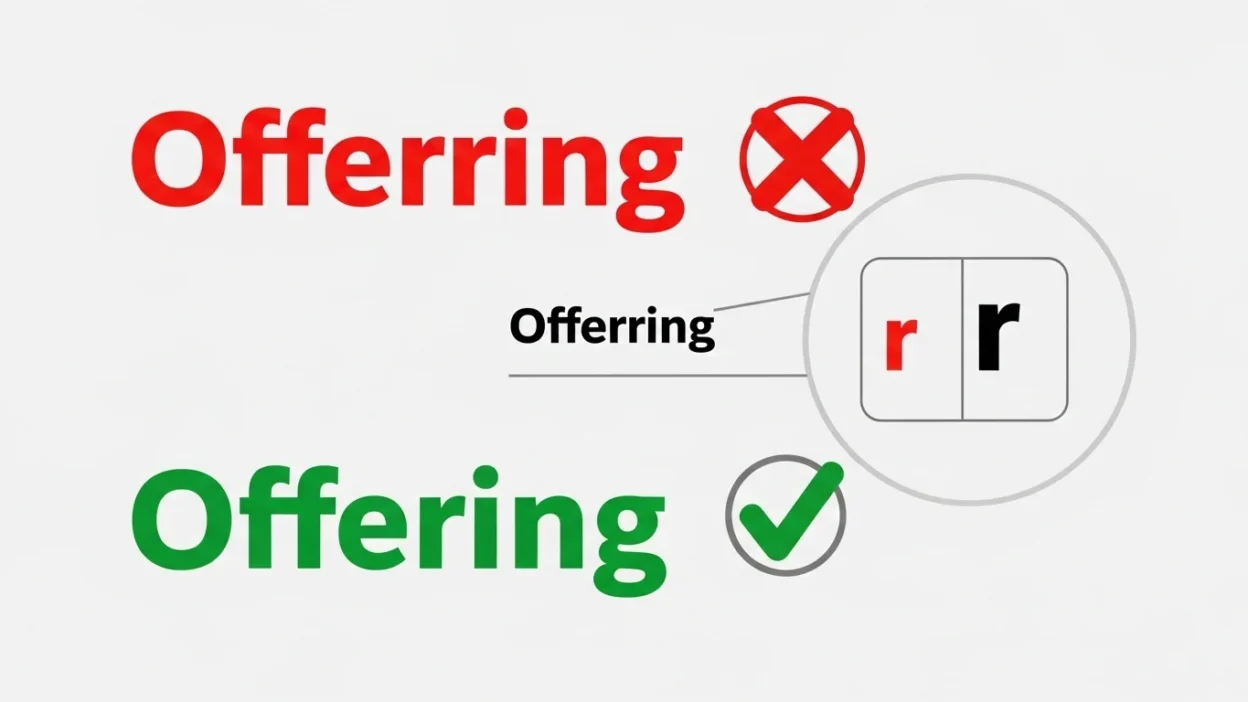
- Offering – ✅ Correct spelling; means giving, presenting, or providing something
- Offerring – ❌ Incorrect spelling; unnecessary double “r”
✔ Correct: She is offering help to her team.
✖ Incorrect: She is offerring help to her team.
Always use “offering” in proper English writing.
What Does “Offering” Mean?
The word offering comes from the verb offer, which means to present, give, or provide something voluntarily. When you add -ing, it becomes a present participle or gerund, describing an action in progress or a concept.
Basic Meaning
Offering = the act of giving, presenting, or providing something.
Common Uses of “Offering”
You’ll find the word offering in a wide range of contexts:
- Business and marketing – products or services offered
- Religious context – gifts or sacrifices
- Everyday conversation – help, support, or suggestions
Examples in Sentences
- The company is offering new services this year.
- She is offering assistance to those in need.
- The restaurant is offering a special discount.
- They are offering valuable advice to beginners.
“Offering” as a Noun
Interestingly, offering can also function as a noun.
Examples:
- The temple received many offerings.
- The company’s latest product offering is impressive.
This dual usage makes offering a versatile and commonly used word.
Why “Offerring” Is Incorrect
The spelling offerring is incorrect because it breaks a key English spelling rule related to adding -ing.
The Rule Explained
When adding -ing to a verb, you only double the final consonant if:
- The word ends in consonant + vowel + consonant, and
- The final syllable is stressed
Let’s apply this to offer:
- The stress is on the first syllable: OF-fer
- The final “r” is not stressed
So, you do not double the “r.”
Correct form:
- offer → offering
Incorrect form:
- offer → offerring
Offerring vs Offering: Key Differences
| Feature | Offerring | Offering |
|---|---|---|
| Spelling | Incorrect | Correct |
| Meaning | None | Giving or presenting something |
| Grammar Rule | Violates rule | Follows rule |
| Usage | Typo or mistake | Standard English |
| Recommended Use | ✖ Avoid | ✔ Always use |
In all contexts, offering is the correct spelling.
Examples of “Offering” in Different Contexts
Everyday Communication
- I’m offering to help you with your project.
- He is offering his support during a difficult time.
Business and Marketing
- The company is offering a new subscription plan.
- Their latest product offering targets young professionals.
Academic and Formal Writing
- The study is offering new insights into climate change.
- The university is offering additional courses this semester.
Religious Context
- Devotees brought offerings to the temple.
- The ritual included a symbolic offering.
These examples show how widely offering is used across different domains.
Common Mistakes with Offerring vs Offering
Many writers make similar errors when spelling this word.
Mistake 1: Doubling the “R” Unnecessarily
❌ She is offerring help.
✔ She is offering help.
Mistake 2: Confusing with Words That Double Consonants
Some words do double the final consonant, such as:
- run → running
- begin → beginning
This leads to confusion with offer, which does not follow the same pattern.
Mistake 3: Typing Quickly Without Checking
Fast typing often leads to accidental extra letters like “rr.”
Proofreading helps catch this.
Why People Confuse Offerring and Offering
1. Overgeneralizing Grammar Rules
Writers may assume all verbs double the final consonant when adding -ing.
2. Pronunciation Influence
Some accents may slightly emphasize the second syllable, causing confusion.
3. Similar Words
Words like referring and transferring do double the “r,” which can mislead writers.
4. Typing Errors
It’s easy to accidentally add an extra “r” when typing quickly.
American vs British English
There is no difference between American and British English for this word.
Both use:
- offering (correct)
- offerring (incorrect)
Examples:
American English:
- The company is offering discounts.
British English:
- The company is offering discounts.
The spelling rule remains consistent across both varieties.
Related Words and Forms
Understanding related forms can strengthen your vocabulary.
Verb Forms
- offer (base form)
- offered (past tense)
- offering (present participle)
Related Nouns
- offer
- offering
Synonyms for “Offering”
- providing
- giving
- presenting
- supplying
- proposing
Using these alternatives can make your writing more engaging and varied.
Tips to Remember the Correct Spelling
1. Focus on Stress
The stress in offer is on the first syllable, so no doubling is needed.
2. Keep It Simple
Just remember:
offer → offering (one “r”)
3. Compare with Similar Words
- refer → referring (double “r”)
- offer → offering (single “r”)
4. Use Spell Check
Modern tools can quickly catch offerring as an error.
FAQs About Offerring vs Offering
1. Is “offerring” ever correct?
No. Offerring is always incorrect in standard English.
2. Which spelling is correct: offerring or offering?
The correct spelling is offering.
3. Why doesn’t “offer” double the “r”?
Because the stress is on the first syllable, so the doubling rule does not apply.
4. What does “offering” mean?
It means giving, presenting, or providing something.
5. Can “offering” be a noun?
Yes. It can refer to something that is given or presented.
6. Is there a difference in British and American English?
No. Both use offering with the same spelling and meaning.
7. What are similar words that double consonants?
Examples include referring, beginning, and running.
8. How can I avoid this mistake?
Remember: not all verbs double consonants—offer does not.
Summary
The difference between offerring vs offering comes down to correct spelling and understanding a simple grammar rule. Offering is the correct form, meaning giving or presenting something, while offerring is a common mistake caused by incorrectly doubling the final “r.”
This confusion often happens because English spelling rules vary depending on stress patterns. Since offer has stress on the first syllable, there’s no need to double the “r” when adding -ing.