If you’ve ever hesitated while writing minuscule vs miniscule, you’re definitely not alone. These two spellings look almost identical, and many writers aren’t sure which one is actually correct. The confusion happens often in emails, essays, blog posts, and even professional writing.
The truth is that only one spelling is considered the proper form in standard English. Understanding the difference between minuscule vs miniscule can help you write with more accuracy and confidence. In this guide, we’ll explain the correct spelling, explore the meaning of the word, provide examples, highlight common mistakes, and share helpful tips to remember the right version every time.
Quick Answer: Minuscule vs Miniscule
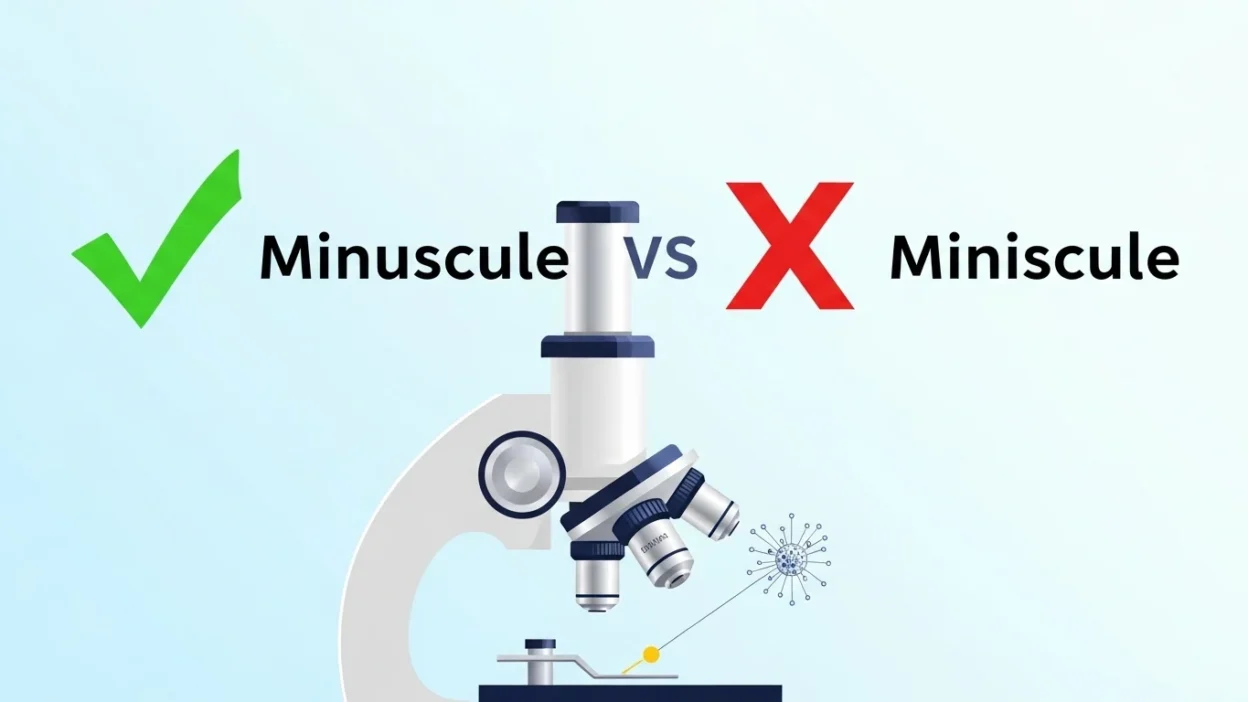
The correct spelling is minuscule.
- Minuscule – Correct English word meaning extremely small or tiny.
- Miniscule – A common misspelling of “minuscule.”
In short: Always use “minuscule.” Avoid “miniscule.”
What Does “Minuscule” Mean?
The word minuscule means extremely small, tiny, or insignificant in size or amount. It’s often used to describe something so small that it is almost unnoticeable.
The word originally comes from Latin minusculus, meaning “rather small.” Over time, it became widely used in English to describe tiny objects, minimal amounts, or very small details.
Simple Definition
Minuscule means very tiny, extremely small, or almost insignificant.
Examples of Minuscule in Sentences
Here are some examples that show how the word is used correctly:
- The scientist examined a minuscule particle under the microscope.
- The error in the report was minuscule, but it still needed correction.
- Only a minuscule portion of the budget was spent on advertising.
- The island appears minuscule on the world map.
- A minuscule crack in the wall caused the leak.
In each sentence, the word describes something very small or barely noticeable.
Why Do People Write “Miniscule”?
The spelling miniscule appears frequently, even though it is technically incorrect. There are several reasons why this mistake is so common.
1. Pronunciation Confusion
When spoken, minuscule may sound like “mini-skule.” Because of this, many people assume the word must contain “mini.”
2. Influence of the Word “Mini”
English includes many words with the prefix mini, such as:
- mini skirt
- mini fridge
- mini version
Because of this familiarity, writers often incorrectly change minuscule to miniscule.
3. Typing Habits
Sometimes miniscule appears simply because it looks easier to spell or is typed quickly without checking.
Despite its common use online, miniscule is still considered a spelling mistake in standard English.
Minuscule vs Miniscule: Comparison Table
| Word | Correct Spelling | Meaning | Example |
|---|---|---|---|
| Minuscule | ✅ Yes | Extremely small or tiny | The difference between the numbers was minuscule. |
| Miniscule | ❌ No | Common misspelling | “Miniscule” should be corrected to “minuscule.” |
This table clearly shows that minuscule is the correct form.
Common Uses of the Word “Minuscule”
The word minuscule is used in many contexts where something is extremely small or insignificant.
1. Minuscule Amount
Example:
Only a minuscule amount of sugar is needed in the recipe.
2. Minuscule Detail
Example:
The detective noticed a minuscule detail that solved the case.
3. Minuscule Difference
Example:
There was only a minuscule difference between the two measurements.
4. Minuscule Probability
Example:
The chance of winning the lottery is minuscule.
In each example, the word emphasizes tiny size or minimal importance.
Synonyms and Related Words
Using related vocabulary helps make writing more natural and engaging.
Common synonyms for minuscule include:
- tiny
- microscopic
- minute
- insignificant
- negligible
- trivial
- infinitesimal
Example with Synonyms
Original sentence:
The difference between the two results was minuscule.
Alternative version:
The difference between the two results was microscopic.
Using synonyms can help vary language and improve readability.
Examples Showing Correct Usage
Here are more examples demonstrating the proper use of minuscule.
Correct sentences:
- Scientists studied minuscule bacteria in the laboratory.
- The improvement in speed was minuscule.
- She spotted a minuscule scratch on the car.
- The chances of error are minuscule.
Incorrect sentence:
- The difference between the prices is miniscule. ❌
Correct version:
- The difference between the prices is minuscule. ✅
Common Mistakes People Make
When comparing minuscule vs miniscule, several typical mistakes appear.
1. Replacing “nu” With “ni”
Incorrect: miniscule
Correct: minuscule
2. Assuming the Word Uses “Mini”
Even though the word sounds similar, minuscule is not related to “mini.”
3. Ignoring Spellcheck Warnings
Many spelling tools flag miniscule as incorrect, but some writers ignore the suggestion.
Tips to Remember the Correct Spelling
If you struggle to remember minuscule vs miniscule, these simple tricks can help.
1. Remember “Minus”
The word minuscule comes from minus, which means small.
Minus → Minuscule
2. Look for the “U”
The correct spelling always includes “nu.”
Minuscule
Not miniscule.
3. Practice Writing the Word
Using the correct spelling regularly helps it become a natural writing habit.
American vs British English
Interestingly, the spelling minuscule is the same in both major forms of English.
- American English: minuscule
- British English: minuscule
So there is no regional difference when comparing minuscule vs miniscule.
No matter where you’re writing—whether in the US, UK, Canada, or Australia—the correct spelling remains minuscule.
Minuscule in Writing and Communication
The word minuscule is often used in:
- academic writing
- scientific discussions
- journalism
- business communication
It helps describe small quantities, subtle details, or minimal differences.
Example contexts:
Science:
Scientists analyze minuscule particles invisible to the human eye.
Business:
The company reported a minuscule increase in profits.
Everyday conversation:
The mistake was minuscule, so it didn’t affect the results.
Because of its precision, the word adds clarity and sophistication to writing.
Frequently Asked Questions (FAQs)
1. Is “miniscule” a real word?
No. Miniscule is a common misspelling. The correct word is minuscule.
2. What does minuscule mean?
Minuscule means extremely small, tiny, or insignificant in size or amount.
3. Why do people spell minuscule as miniscule?
This happens because the pronunciation sounds similar to “mini.”
4. Is minuscule related to the word mini?
No. The word actually comes from minus, meaning small.
5. Is minuscule used in both American and British English?
Yes. Both varieties use the same spelling: minuscule.
6. What are examples of minuscule things?
Examples include:
- microscopic particles
- tiny insects
- small details
- minimal differences
7. Can minuscule describe numbers?
Yes. It can describe very small amounts or percentages.
Example:
The improvement was minuscule.
8. Is minuscule formal or informal?
It can be used in both formal and everyday writing.
Summary: Minuscule vs Miniscule
The difference between minuscule vs miniscule is straightforward once you know the rule. Minuscule is the correct spelling and means extremely small, tiny, or insignificant. The spelling miniscule is a common mistake that occurs mainly because people assume the word is related to “mini.”
By remembering the correct spelling and understanding its meaning, you can avoid one of the most frequent spelling errors in English. Whether you’re writing professionally, academically, or casually, using minuscule correctly improves the clarity and credibility of your writing.
Actionable Takeaway
Whenever you write this word, remember its origin from minus, meaning small. If the word contains “nu”, you’re using the correct spelling.
Think of this simple rule:
Minus → Minuscule → Extremely Small
Keeping this connection in mind will help you confidently avoid the common mistake of writing miniscule.