If you’ve ever typed “havnt” or “havent” and wondered which one is correct, you’re definitely not alone. These forms show up frequently in texts, emails, and social media, especially when writing quickly. The confusion usually comes from skipping punctuation or not knowing how contractions work in English.
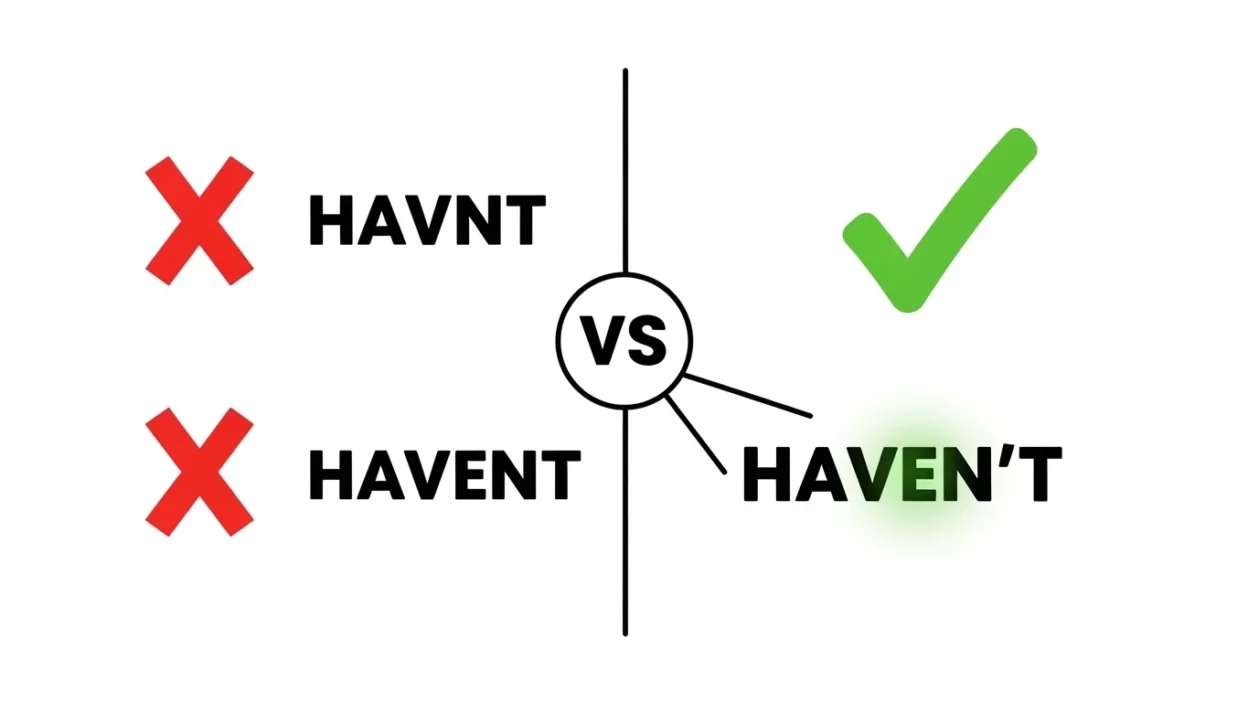
Here’s the truth: both “havnt” and “havent” are incorrect spellings. The correct form is “haven’t”, with an apostrophe. Understanding the difference between havnt vs havent helps you write more clearly, sound more professional, and avoid a very common grammar mistake.
Quick Answer: Havnt vs Havent
- Haven’t – ✅ Correct contraction of have not
- Havent – ❌ Incorrect (missing apostrophe)
- Havnt – ❌ Incorrect (missing apostrophe and vowel)
✔ Correct: I haven’t finished my work yet.
✖ Incorrect: I havent finished my work yet.
✖ Incorrect: I havnt finished my work yet.
Always use “haven’t” in proper English writing.
What Does “Haven’t” Mean?
The word haven’t is a contraction of have not. Contractions combine two words into one by replacing missing letters with an apostrophe.
Structure of “Haven’t”
- Have + not = haven’t
The apostrophe replaces the missing letter “o” in “not.”
Examples in Sentences
- I haven’t seen that movie before.
- They haven’t completed the project yet.
- We haven’t received your email.
- She hasn’t arrived, and I haven’t heard from her.
This contraction is widely used in both spoken and written English.
When to Use “Haven’t”
Use haven’t when:
- Talking about something that has not happened yet
- Expressing negative statements
- Writing in a conversational or informal tone
Example:
- I haven’t eaten breakfast today.
Why “Havent” Is Incorrect
The spelling havent is incorrect because it omits the apostrophe required in contractions.
In English grammar, contractions must include an apostrophe to indicate missing letters.
Incorrect:
- I havent finished my assignment.
Correct:
- I haven’t finished my assignment.
Even though havent is commonly seen online, it is not accepted in formal or correct writing.
Why “Havnt” Is Incorrect
The spelling havnt is even further from the correct form. It contains two issues:
- Missing the apostrophe
- Missing the vowel “e”
Incorrect:
- I havnt called him yet.
Correct:
- I haven’t called him yet.
Because of these errors, havnt is never acceptable in proper English.
Havnt vs Havent vs Haven’t: Key Differences
| Word | Correctness | Meaning | Usage |
|---|---|---|---|
| Havnt | Incorrect | None | Avoid completely |
| Havent | Incorrect | Intended as “have not” | Missing apostrophe |
| Haven’t | Correct | Contraction of “have not” | Standard English |
The takeaway is simple: only “haven’t” is correct.
Examples of “Haven’t” in Everyday English
Casual Conversations
- I haven’t watched that show yet.
- We haven’t met before.
- They haven’t decided on a date.
Professional Writing
- We haven’t received your application.
- The team hasn’t completed the task, and we haven’t finalized the report.
Questions
- Haven’t you finished your homework?
- Haven’t they arrived yet?
These examples show how naturally haven’t fits into everyday communication.
Common Mistakes with Havnt vs Havent
Many writers make similar errors when using contractions.
Mistake 1: Skipping the Apostrophe
❌ I havent done my work.
✔ I haven’t done my work.
Mistake 2: Dropping Letters
❌ I havnt finished reading.
✔ I haven’t finished reading.
Mistake 3: Avoiding Contractions Incorrectly
Some writers avoid contractions entirely but mix them incorrectly.
✔ I have not finished the task. (formal)
✔ I haven’t finished the task. (informal)
Both are correct, but consistency matters.
Why People Make This Mistake
1. Fast Typing
When typing quickly, people often skip apostrophes.
2. Informal Messaging Habits
Texting and social media encourage shortened forms like havent.
3. Lack of Grammar Awareness
Some writers are not fully familiar with contraction rules.
4. Autocorrect Limitations
Not all devices automatically fix missing apostrophes.
American vs British English
The contraction haven’t is used the same way in both American and British English. There are no spelling differences.
Examples:
American English:
- I haven’t seen him today.
British English:
- I haven’t seen him today.
However, in very formal writing (especially British academic writing), contractions like haven’t may be avoided in favor of have not.
Related Grammar Concepts
Understanding contractions helps improve overall writing skills.
Other Common Contractions
- don’t = do not
- can’t = cannot
- won’t = will not
- hasn’t = has not
- didn’t = did not
Formal vs Informal Writing
- Formal writing: avoid contractions
Example: I have not completed the report. - Informal writing: contractions are acceptable
Example: I haven’t completed the report.
Knowing when to use each style improves clarity and tone.
Helpful Tips to Remember the Correct Form
1. Look for the Apostrophe
If there’s no apostrophe, it’s probably incorrect.
2. Expand the Word
If you can replace it with “have not,” then haven’t is correct.
3. Avoid Shortcuts
Don’t rely on informal spellings like havent or havnt.
4. Proofread Carefully
A quick review can catch missing punctuation.
FAQs About Havnt vs Havent
1. Is “havent” a real word?
No. Havent is not a correct word in standard English.
2. Which is correct: havnt or havent?
Neither is correct. The proper form is haven’t.
3. What does “haven’t” mean?
It means “have not” and is used in negative sentences.
4. Can I use “haven’t” in formal writing?
It’s better to use “have not” in formal contexts, though haven’t is acceptable in many situations.
5. Why is the apostrophe important?
The apostrophe shows that letters are missing in a contraction.
6. Is “havnt” ever acceptable?
No. It is always incorrect.
7. What is the difference between haven’t and hasn’t?
- Haven’t = have not
- Hasn’t = has not
Example:
- I haven’t finished.
- She hasn’t finished.
8. How can I avoid this mistake?
Always remember: contractions need apostrophes.
Summary
The confusion between havnt vs havent comes from missing punctuation and informal writing habits. However, the rule is simple: neither “havnt” nor “havent” is correct. The only correct form is “haven’t,” which is the contraction of have not.
Using the correct spelling not only improves your grammar but also makes your writing look more polished and professional. Whether you’re writing emails, essays, or social media posts, small details like apostrophes can make a big difference.