Have you ever stopped while writing and wondered whether the correct spelling is “flys” or “flies”? It’s a common confusion in English because both words look possible, and the pronunciation can sound similar in everyday speech. Many writers accidentally choose the wrong spelling, especially when describing movement through the air or referring to insects.
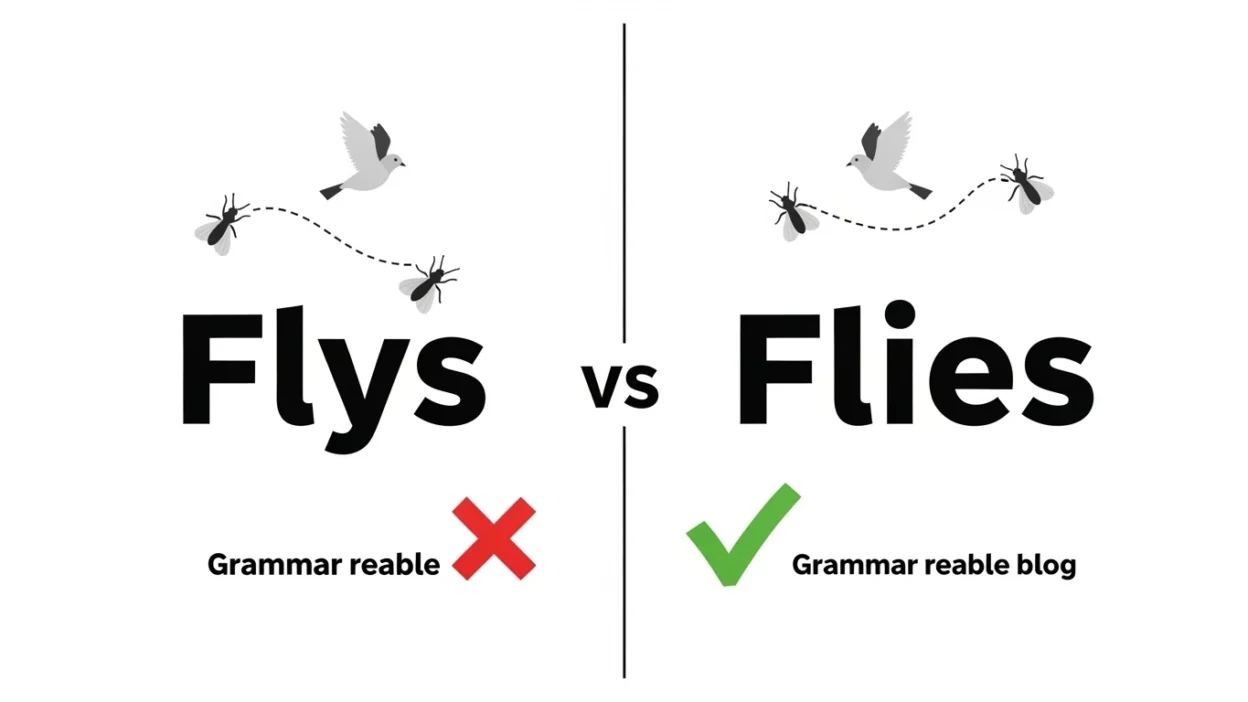
The truth is that “flies” is almost always the correct spelling in modern English, while “flys” is rarely used and usually considered a mistake. Understanding the difference between flys vs flies can help you avoid spelling errors and write more clearly in both casual and professional contexts. In this guide, we’ll explain the meanings, examples, grammar rules, and common mistakes so you can confidently choose the correct word every time.
Quick Answer: Flys vs Flies
- Flies – The correct and standard spelling in most situations. It can be the plural of fly (the insect) or the third-person form of the verb fly.
- Flys – Rare and usually incorrect in modern English, except in a few specialized contexts like some proper names or historical usage.
✔ Correct: The bird flies across the sky.
✔ Correct: Several flies landed on the fruit.
✖ Incorrect: The bird flys across the sky.
In nearly all everyday writing, you should use “flies.”
What Does “Flies” Mean?
The word flies has two main meanings in English depending on the context.
1. Plural Form of “Fly”
A fly is a small insect known for buzzing around food and garbage. When there is more than one, the plural becomes flies.
Examples:
- The kitchen window was open, so several flies came inside.
- Fruit flies gathered around the ripe bananas.
- The picnic was ruined by dozens of buzzing flies.
2. Third-Person Form of the Verb “Fly”
The word flies is also the third-person singular present tense of the verb fly, meaning to move through the air.
Examples:
- The airplane flies to New York every morning.
- A butterfly flies from flower to flower.
- The eagle flies high above the mountains.
In both cases, flies is the correct spelling.
Why “Flys” Is Usually Incorrect
The spelling flys appears logical because the base word is fly, but English spelling rules require a change when forming certain plural nouns or verb forms.
When a word ends in “y” preceded by a consonant, the “y” changes to “ies.”
Examples:
| Base Word | Correct Form |
|---|---|
| fly | flies |
| cry | cries |
| try | tries |
| reply | replies |
Because of this rule, fly becomes flies, not flys.
In modern English writing, flys is generally considered a spelling mistake.
Flys vs Flies: Key Differences
| Feature | Flys | Flies |
|---|---|---|
| Spelling | Rare or incorrect | Correct |
| Meaning | Rare usage or typo | Plural of fly or verb form |
| Dictionary Status | Rarely recognized | Standard English |
| Usage | Very uncommon | Widely used |
| Recommended Use | ✖ Avoid | ✔ Always use |
In everyday writing, flies is almost always the correct choice.
Examples of “Flies” in Sentences
Here are some practical examples showing how flies works in different contexts.
Referring to Insects
- The fruit bowl attracted several flies.
- House flies often appear during summer.
- The buzzing flies were annoying during the picnic.
Describing Flight
- The drone flies smoothly over the city.
- The bird flies south for the winter.
- A kite flies best on a windy day.
Figurative Expressions
English also uses flies in many idioms and expressions.
Examples:
- Time flies when you’re having fun.
- The rumor flies quickly through social media.
These examples show how widely the word flies appears in daily language.
Common Mistakes with Flys vs Flies
Even experienced writers sometimes mix up these spellings.
Mistake 1: Writing “Flys” Instead of “Flies”
❌ The bird flys across the lake.
✔ The bird flies across the lake.
Mistake 2: Incorrect Plural Forms
❌ Several flys were buzzing around.
✔ Several flies were buzzing around.
Mistake 3: Ignoring the “Y to IES” Rule
Many spelling errors happen when writers forget the y → ies rule.
Remember:
- fly → flies
- cry → cries
- try → tries
Following this rule prevents the mistake.
Why This Spelling Confusion Happens
Several reasons explain why people confuse flys vs flies.
1. Logical Guessing
Since the base word is fly, people assume adding s should create the plural.
2. Pronunciation Similarity
Both spellings sound the same when spoken quickly.
3. Typing Habits
While typing fast, writers may simply add s instead of applying the spelling rule.
4. Limited Grammar Awareness
Not everyone remembers the y-to-ies rule, especially when writing quickly.
American vs British English
Unlike many English words that differ between American and British spelling (such as color vs colour), flies is spelled the same in both varieties.
Examples:
American English:
- The plane flies daily.
British English:
- The plane flies daily.
There is no spelling difference between the two forms, making the rule universal.
Tips to Remember the Correct Spelling
If you often hesitate between flys and flies, these tips can help.
1. Remember the “Y to IES” Rule
When a word ends with y, change it to ies when forming certain plurals or verbs.
Example:
fly → flies
2. Think of Similar Words
Many words follow the same pattern:
- cry → cries
- try → tries
- spy → spies
- reply → replies
3. Use a Memory Trick
A simple phrase can help:
“If it ends in Y, it becomes IES.”
This quick rule makes it easier to remember the correct spelling.
FAQs About Flys vs Flies
1. Is “flys” a real word?
In modern English, flys is generally considered incorrect and is rarely used except in specialized contexts.
2. Which spelling is correct: flys or flies?
Flies is the correct spelling in almost all cases.
3. Why does fly become flies?
English grammar rules change y to ies when forming certain plurals and verb forms.
4. Is flies the plural of fly?
Yes. Flies is the plural form of the insect fly.
5. What does flies mean as a verb?
As a verb, flies means moves through the air, such as when birds or planes travel.
Example:
- The eagle flies above the mountains.
6. Does British English use flys?
No. Both American and British English use flies.
7. Are there other words like this?
Yes. Many words follow the same spelling rule.
Examples:
- try → tries
- cry → cries
- apply → applies
8. What is the past tense of fly?
The past tense of fly is flew, and the past participle is flown.
Example:
- The bird flew away.
Summary
The difference between flys vs flies comes down to English spelling rules. Flies is the correct spelling used for both the plural form of the insect fly and the third-person form of the verb fly, meaning to move through the air.
On the other hand, flys is rarely correct and usually appears as a spelling mistake. This confusion happens because writers assume they can simply add “s” to the base word fly, but English grammar requires changing y to ies instead.
Actionable Takeaway
Whenever you need the plural or verb form of fly, remember this simple rule:
✔ fly → flies
✖ fly → flys
By remembering the “y becomes ies” rule, you can avoid this common spelling mistake and write with greater confidence and clarity.